






JAMES TURRELL
b. 1943, United StatesA key figure associated with the Light and Space movement, James Turrell harnesses light as his material, making the intangible tangible in works that invite the viewer to question notions of perception.
James Turrell’s Early Life
Born in Los Angeles, James Turrell first studied psychology before going on to study art at the University of California, Irvine in 1965. During this time, Turrell rented a studio in the former Mendota Hotel in Ocean Park, California, where he began to produce his early projection pieces.
In 1966, he decided to focus exclusively on his practice and left his studies. Between 1968 and 1969, Turrell took part in the Art and Technology programme at the Los Angeles County Museum of Art, during which time he learnt about the Ganzfeld effect, an optical phenomenon in which the brain, deprived of visual stimulation, ‘fills in the blanks’, often leading to unusual visual patterns and even hallucinations. Alongside his aviation experience (Turrell is a seasoned pilot), these studies of perceptual anomalies greatly informed his practice, inspiring the works that he is best known for.
James Turrell Artworks
Projection Pieces
Turrell’s earliest series of works is his ‘Projection Pieces’ (1966—1969). In these works, Turrell used high-intensity projectors as a light source, projecting a single, controlled beam of light across a room to create ethereal shapes of light that could almost be portals into another world.
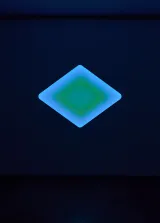
In Alta (Green) (1968), a three-dimensional triangle emanates a green glow, colouring the room. The shape looks tangible, with its crisp edges and the way it exudes colour; yet, if the viewer tried to touch it, they would feel only empty air. In this way, Turrell uses light as an illusion, inviting the viewer to question their sense of perception. In his ‘Projection Pieces’ series, the artist went on to pair projection with structural cuts in the building, bringing another layer to the work: the relationship between the interior and exterior.
Skyspaces
This investigation into interior/exterior spaces and natural/artificial light led to Turrell’s series ‘Skyspaces’ (1974—ongoing), site-specific installations and architectural interventions that appear in buildings across the world.
An example of this work is Meeting (1980—1986/2016) at MoMA PS1, Turrell’s second ‘Skyspace’ work and his first in the U.S. Although the work was originally commissioned for the museum’s opening in 1976, it was not realised until 1980 and Turrell continued to modify it until 1986. Turrell cut a rectangular hole in the roof of PS1, the room below lined with deep wooden benches from which the viewer can gaze uninterrupted at the sky. Often described as meditative, the work acts as a meeting point between the sky and its audience, encouraging the viewer to question what lies beyond our initial perception—the sky beyond the building, the sun beyond the clouds.
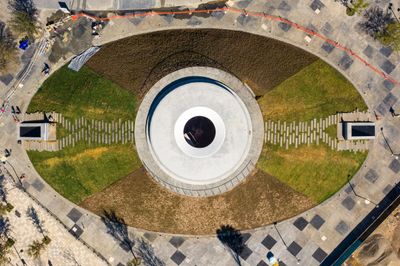
The experiential nature of Turrell’s work is imperative to his practice and is exemplified in the Roden Crater Project (1977—ongoing). Begun in 1977 and inspired by the Mayan Pyramids in Central America, Turrell has spent over 30 years transforming the basin of a 400,000-year-old extinct volcano near Flagstaff, Arizona into a naked-eye observatory. According to Turrell, the work’s aim is to ‘increase a sense of close-in celestial vaulting from the bottom of the crater.’ Turrell initially discovered the site for this work whilst flying and has since shaped the rim of the crater to frame the sky, also incorporating chambers and tunnels within the crater, as well as ‘Skyspaces’ and a camera obscura. Throughout the project he has worked with astronomers to transform the crater into a celestial viewing room, harnessing light from the sun, moon, and stars.
Turrell has been the recipient of several prestigious awards, including Commandeur de l’Ordre des Arts et des Lettres in 2006 and a National Medal of Arts in 2013. He was awarded a Guggenheim Fellowship in 1974 and a MacArthur ‘Genius’ Fellowship in 1984.
Exhibitions
Select solo exhibitions include James Turrell: Passages of Light, Fundación Jumex, Mexico City (2019); James Turrell: Immersive Light, Long Museum, Shanghai (2017); James Turrell, The Guggenheim Museum, New York (2013); and James Turrell: Air Mass, Hayward Gallery, London (1993).
Selected group exhibitions include Bloom of Joy, Pace, Hong Kong (2020); Abstraction(s), Song Art Museum, Beijing (2019); and Pictures from the Moon: Artists’ Holograms 1969—2008, New Museum, New York (2012).
Website
James Turrell’s website can be found here.
James Turrell FAQs
Who is James Turrell?
James Turrell is an American artist associated with the Light and Space movement, known for using light as his primary medium. His immersive installations challenge perception, creating environments that transform the way viewers experience space and light.
What is James Turrell known for?
James Turrell is renowned for his pioneering work with light and space, creating immersive installations that challenge perception. His ‘Skyspaces’ and ‘Projection Pieces’ use natural and artificial light to transform architectural spaces into meditative environments.
What is James Turrell’s Skyspaces?
Turrell’s ‘Skyspaces’ are site-specific installations featuring apertures in ceilings or structures that frame the sky. Works like Meeting (1980–1986/2016) at MoMA PS1 encourage viewers to engage with the changing light and atmosphere, blurring the boundaries between interior and exterior space.
What is the Roden Crater project?
The Roden Crater (1977–ongoing) is James Turrell’s most ambitious work, transforming an extinct volcano in Arizona into a celestial observatory. Designed to capture and manipulate light from the sun, moon, and stars, the project offers a unique exploration of perception and the cosmos.
Ocula | 2025

Recently Exhibited




Exhibiting Elsewhere



Works Elsewhere











James Turrell in Ocula Magazine






Explore and Follow Artists Shaping Contemporary Art
A respected voice in contemporary art discourse.
Focusing on ambitious storytelling and insightful art-world commentary. Ocula Magazine publishes in-depth interviews, critical essays and timely analysis on the artists, exhibitions and ideas driving the global art world.
Learn more about Ocula Magazine
Showcasing the best of the art world.
Ocula partners with galleries from around the world to highlight their artists, artworks and exhibitions. Gallery membership is by application and invitation, with each member vetted by an independent panel.
Learn more about Ocula Membership
Specialises in the sale of major artworks.
Led by a team with deep ties to the world’s leading auction houses, galleries and collectors. Ocula’s advisory team offers bespoke services to high-net-worth clients from around the world who are looking to acquire the best of contemporary and modern art.
Learn more about our team and services