






Holography Is Enchanting a New Generation of Artists
Since it emerged in the 1960s and 1970s, holographic art has been dismissed as sleazy, costly and the work of physicists rather than artists. But holograms aren’t fading away any time soon. Save to My OculaIn 1975, the International Center of Photography in New York opened Holography ’75: The First Decade, an exhibition surveying how artists were using holograms. It was a timely subject; four years earlier, the Hungarian-British physicist Dennis Gabor had won the Nobel Prize for inventing the holographic method. Holograms were ubiquitous at the time, thanks to the increasing availability of lasers (which made holographs easier and cheaper) and New Age obsessions with wavelengths and vibrations.
The New York Times critic Hilton Kramer was swift to pan the exhibition as a display of “stupefying innocuousness” that was wholly “unrelieved by the slightest trace of aesthetic intelligence”. The show, which included Bruce Nauman’s acid-green self-portraits, was written off as unsophisticated kitsch tinged in “rainbow hues”—as Kramer put it: “The kind of sleazy, acid reds, blues and greens we used to find adorning juke boxes and still find in the cheapest kinds of picture postcards.” Most scathingly, Kramer wrote that the creators of these works were, for the most part, not artists, but “physicists professionally involved in holographic technology”.
He had a point. Holography is an image-capturing technology that blurs the line between artist and scientist. Owing to the processes and costs involved, it is a difficult technique for artists to bring into their studios and, as was evident in the ICP’s show, many works of “holographic art” are made by scientists and technicians. And so the medium, which had shown so much promise, remained a relatively marginal art form. Even a significant endeavour by art collectors Guy and Nora Barron in 1994 didn’t reverse its fortunes. They founded C Project in Miami Beach, bringing together artists (including Chuck Close, James Turrell and Ed Ruscha) and holography technicians in a fine art print workshop. Ruscha in particular was enthusiastic about a medium that allowed him to work with light and dimensionality more directly. But commercially, C Project was a failure, with holography still too costly. For the prominent artists who joined, holography was just an experiment.

“Holography is an image-capturing technology that blurs the line between artist and scientist”
But this has started to change. Holographic Studios in New York City, one of the longest-running holography studios in the US and responsible for training generations of artists in the medium, has put a spotlight on the “rainbow hues” with an exhibition of contemporary holographic work titled Holo be thy Name, featuring pieces from Maggie Lee and Jeanette Hayes. New Jersey-born Lee, who is showing their glitchy, metallic works, believes that holography’s ties with New Age subcultures, “sketchy websites” and kitschy, early-1990s visual culture gives the form an “esoteric” dimension. It certainly provides a hit of nostalgia. For me, it recalls sticker-and-tattoo vending machines, glossy Trapper Keeper folders and watching sideshows on Coney Island during the early 2000s.



Making a hologram is an analogue process. The image is formed by splitting a laser into two beams: one bounces off a mirror and shines directly on to film or glass, and the other bounces off the object—an apple, say, or a sitting subject like Andy Warhol—then a mirror and, finally, the film. Unlike regular white light, the waves in a laser travel with the peaks lined up, and when the two beams shine on to the final glass plate, they create a pattern that records the object’s image on to the plate, which is then developed in a similar way to photography. For the process to work, “nothing can move, not even on the micron level”, artist Matthew Schreiber explains in a video for the Getty Museum. He has tried to find simple ways to describe how it works but has now given up, he told The New York Times. “I allow it to be magical.”

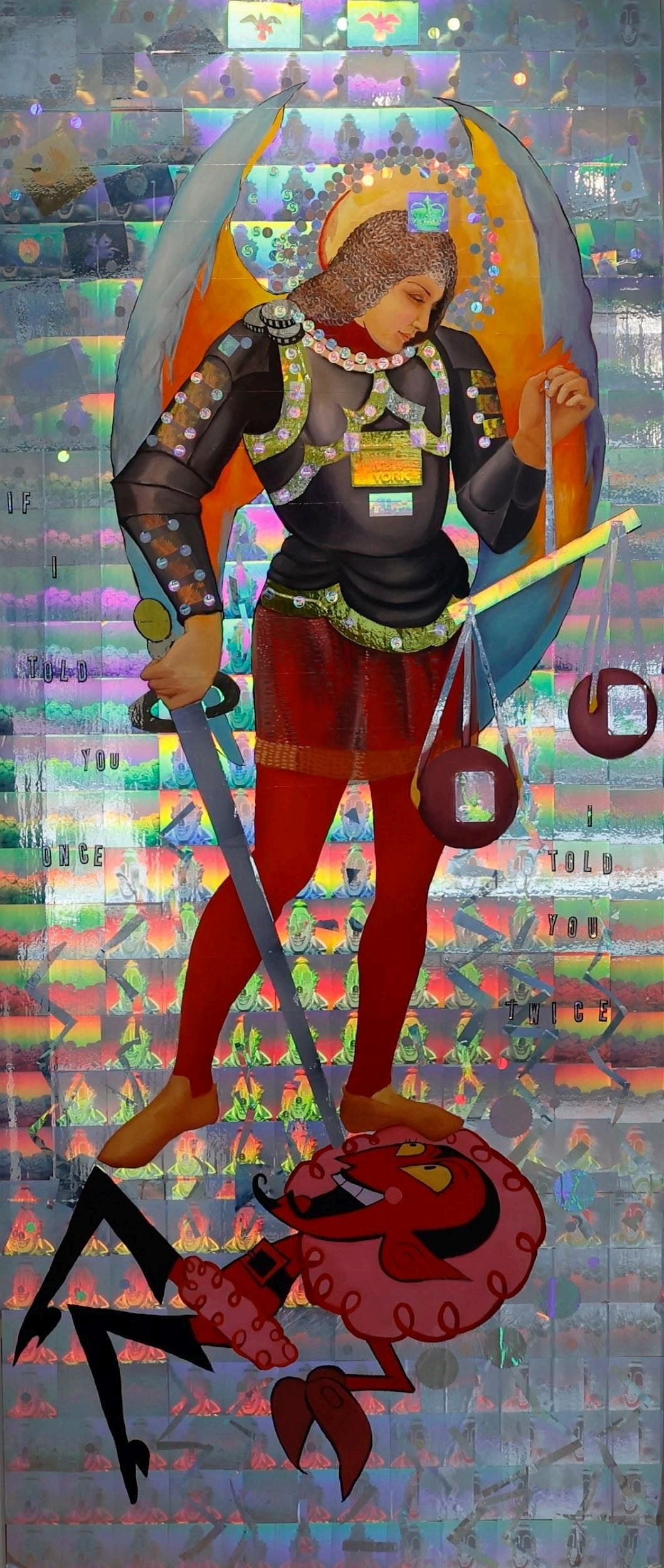
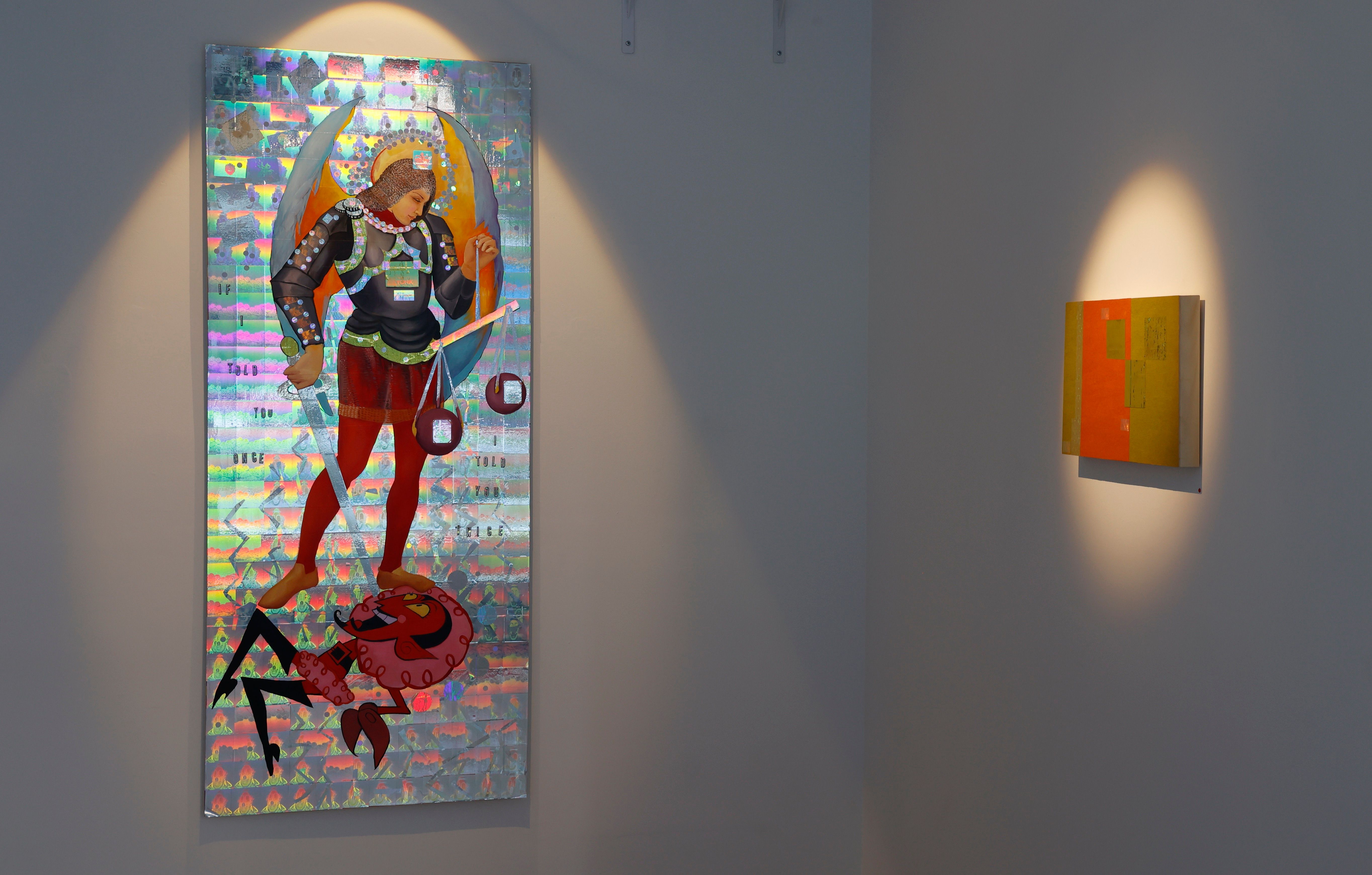
Maggie Lee and Jeanette Hayes were both born during the late 1980s; for them, holograms evoke postmodern tackiness and lowbrow visual culture. Chicago-born Hayes contributes an imposing holographic work to Holo be thy Name that evokes a stained-glass window in a church. The acrylic painting of Archangel Michael, I thought I warned you (2026), features the warring angel of justice with a sword in one hand and a scale in the other, with the devil, in this instance portrayed as The Powerpuff Girls’ villain Him, cowering underfoot. Behind the piece is a collage of silver holographic stickers, mined from the studio’s archives. Once the eyes adjust, shadows and contours reveal an endless grid of a clown’s leering face and the four imposing figures of Mount Rushmore: George Washington, Thomas Jefferson, Theodore Roosevelt and Abraham Lincoln. The piece requires you to move around in order to see the images. “It’s not technically like genuflecting in a cathedral to activate God,” Hayes says, “but it’s not the opposite of that, either.”
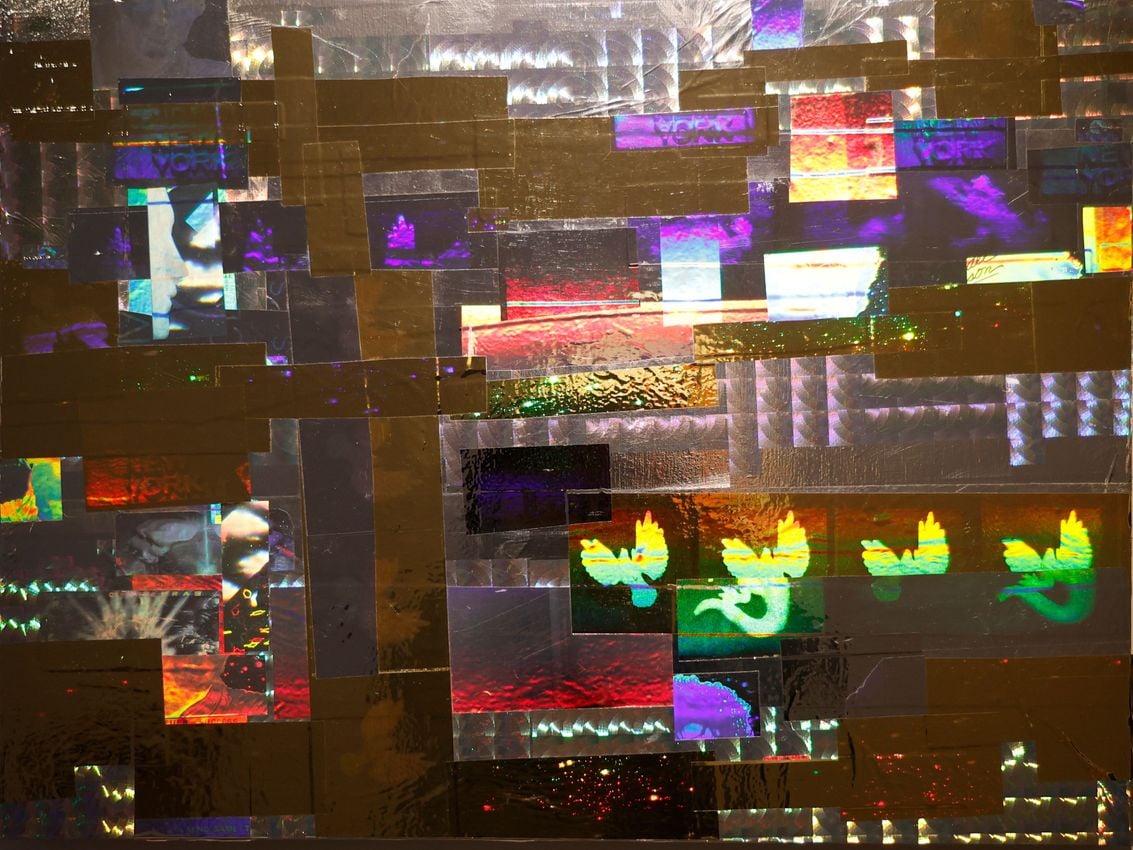
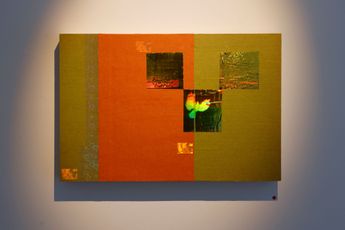
One of Lee’s works on show is a metallic monolith made up of rectangular holographic stickers, grouped in alternating stripes of silver and gold, occasionally misaligned like pixels on a glitchy screen. The images burned into them include the pre-9/11 New York City skyline, silhouetted faces and a dove in flight that recalls one of the most ubiquitous holographic images of all time: the VISA hologram. Again, it takes a lot of close looking and bobbing around from different vantage points to see all the motifs. Lee describes this experience of looking as akin to dreaming. “I think holograms are popular now because there needs to be more dreaming,” she says. “People want to be dreaming.”
“I think holograms are popular now because there needs to be more dreaming. People want to be dreaming”
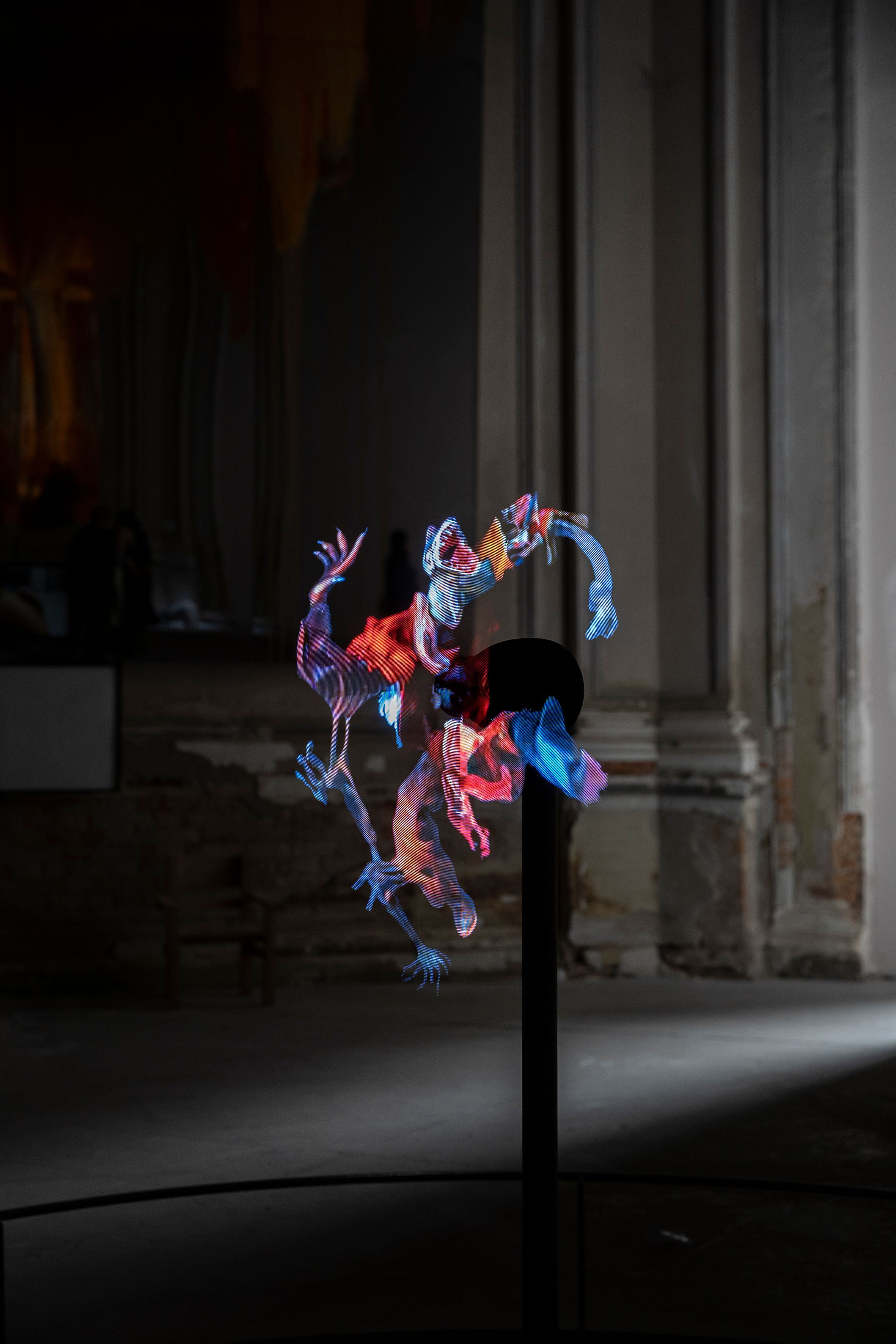
Holographic Studios is not the only institution interested in the medium. At the New Museum grand re-opening, Cyprien Gaillard revived the aesthetics of holography with an LED display titled L’Ange du foyer (Vierte Fassung) (2019), reinterpreting Max Ernst’s Fireside Angels series. Schreiber worked as master technician for Sculpting with Light, the Getty Institute’s 2024 exhibition of contemporary artists working with holography. The show included works by individuals including John Baldessari, Louise Bourgeois and Ed Ruscha, exploring the brief period of the late 1990s that saw a push for fine art holography, primarily through the efforts of C Project (the source of most of the works that were on view). Also included were contemporary works by Deana Lawson, such as her hologram Torus (2021), a geometric circular form that changes shape depending on where the viewer stands. “She started talking about the idea of the hologram as a talisman, like a shard of dark crystal—this magical, optical object,” Schreiber told The New York Times.
Would Kramer have recognised a flash of the sublime in these pieces? I know that as I left Holographic Studios, walking past NYC’s residential buildings with their warped reflective privacy screens, everywhere I looked, Lee and Hayes’ incandescent tributes to holography burned into view. —[O]
Main image: Maggie Lee, Emo Gold Stripe Sweater (2026). Courtesy of Holographic Studios.






A respected voice in contemporary art discourse.
Focusing on ambitious storytelling and insightful art-world commentary. Ocula Magazine publishes in-depth interviews, critical essays and timely analysis on the artists, exhibitions and ideas driving the global art world.
Learn more about Ocula Magazine
Showcasing the best of the art world.
Ocula partners with galleries from around the world to highlight their artists, artworks and exhibitions. Gallery membership is by application and invitation, with each member vetted by an independent panel.
Learn more about Ocula Membership
Specialises in the sale of major artworks.
Led by a team with deep ties to the world’s leading auction houses, galleries and collectors. Ocula’s advisory team offers bespoke services to high-net-worth clients from around the world who are looking to acquire the best of contemporary and modern art.
Learn more about our team and services