





JOHN WESLEY
b. 1928, United StatesA unique voice in the canon of Contemporary art, John Wesley is known for his precise, lyrical, and often deadpan painterly investigations of the American subconscious. With no formal artistic training, two of Wesley’s jobs had a direct impact on his early practice.
At the age of 24, he began working as an illustrator in the Production Engineering Department at Northrop Aircraft in Los Angeles where he translated blueprints into drawings. In 1960, he moved to New York, where he worked as a postal clerk, utilising symbols such as the shield-like postage stamp and his employee badge in his paintings.
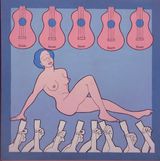
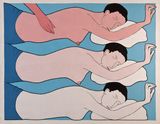
Later, his practice expanded to incorporate varied and enigmatic iconographies such as animals, beguiling women, and portraiture of subjects including Theodore Roosevelt, Rudyard Kipling, and Count Henri de Baillet-Latour, the president of the 1932 International Olympic Committee. Through a carefully refined visual vocabulary of clean lines, solid shapes, and repetition, Wesley imbued everyday scenes and quotidian subjects with humour and wry wit.
Exploring themes relating to trauma, eroticism, innocence, and coyness, paintings within his oeuvre are characterised by a linear stylised formation, similar to comic strips, and are often populated with cartoon characters such as Dagwood Bumstead, Popeye, and Olive Oyl. His series, Searching for Bumstead, which he began in 1974 and continued for the entirety of his career, depicts empty interiors—including a vacant armchair, slippers by a bedside, a bathtub filled with water—and is an exploration of the trauma of losing his father, whose sudden death deeply affected him.
Wesley defies categorisation as an artist. During the 1960s, as the tenets of Pop art began to take shape, he was grouped with the movement due to the basic elements of his style and subject matter. Wesley exhibited alongside Pop artists such as Andy Warhol, Tom Wesselman, and Roy Lichtenstein but ultimately eluded true categorisation both in theory and in practice due to his unique visual language. His first solo exhibition was at the Robert Elkon Gallery, New York, in 1963. Minimalist artist Donald Judd, a lifelong supporter of the artist, reviewed the paintings in the show: “the forms selected and shapes to which they are unobtrusively altered, the order used, and the small details are humorous and goofy. This becomes a cool, psychological oddness.”
Wesley was given his own room at the Documenta 5 Retrospective at Kassel (1972) and by the mid 70s it became clear that his work lay somewhere between Pop, Surrealism, and Minimalism, though no label ever encapsulated his singular style. Wesley’s contributions to painting are undeniable and his work is held in public collections worldwide including the Chinati Foundation, Marfa, Texas; Hirshhorn Museum and Sculpture Garden, Washington D.C.; Kunstmuseum, Basel; The Museum of Modern Art, New York; and the Whitney Museum of American Art, New York, among others.
Courtesy Pace Gallery

Works at Pace Gallery




Recently Exhibited


Works Elsewhere












Explore and Follow Artists Shaping Contemporary Art
A respected voice in contemporary art discourse.
Focusing on ambitious storytelling and insightful art-world commentary. Ocula Magazine publishes in-depth interviews, critical essays and timely analysis on the artists, exhibitions and ideas driving the global art world.
Learn more about Ocula Magazine
Showcasing the best of the art world.
Ocula partners with galleries from around the world to highlight their artists, artworks and exhibitions. Gallery membership is by application and invitation, with each member vetted by an independent panel.
Learn more about Ocula Membership
Specialises in the sale of major artworks.
Led by a team with deep ties to the world’s leading auction houses, galleries and collectors. Ocula’s advisory team offers bespoke services to high-net-worth clients from around the world who are looking to acquire the best of contemporary and modern art.
Learn more about our team and services