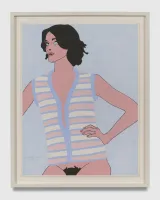
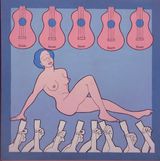
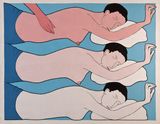
John Wesley’s acrylic paintings show imaginary nude figures set against grass greens, baby blues, and pastel pinks, often accompanied by the artist’s signature white border.
Pop Art
Wesley’s images became well-known in the 1960s for their use of traditional emblems, historical figures, comic book personalities, animals, and sexualised women, drawing from advertising materials such as stock photos and tracing paper.
Maiden, from 11 Pop Artists, Volume I (1965), shows a dark-haired female figure on her knees wearing a Marilyn Monroe-like expression, framed by a black border. Six pairs of hands surround her, reaching towards the figure, halted by the frame.
Just as explicit, the acrylic painting Plague (1967) shows a naked female body on her knees surrounded by a grid of diaper-wearing infants, alluding to the ‘disease’ of mass procreation—pertinent to the production of both artwork and human life.
Surrealism
While Wesley emerged with the 1960s Pop art movement and is often linked to the Minimalist movement through Donald Judd, the artist’s sparse comic strips bear Surrealist influences, evident across his serene but evocative scenes that evade strict classification.
Works like Untitled (Mickey & Minnie) (1983), which features pastel patterns of embryonically attached mouse-eared figures against a blue and green landscape, infuse simple compositions with sexual connotations using detailed shapes.
In Hannah’s Rabbit (1986), a two-dimensional rabbit is seen from the profile outlined in black paint with its ears raised. Its single blue eye looks over to viewers with a hint of confrontation, the same shade of the flattened blue and green landscape.
Erotica
Wesley’s nude paintings often depict naked women against sparse surroundings. Coach (2001) shows a short-haired figure unclothed in front of a green lawn and an open sky, spread in a posture that is at once explicitly expressive and softly evocative.
Untitled (2005), on the other hand, explicitly apprehends the female nude spread open on a blue surface, where the absence of specific context generates a dream-like state.