






JR
b. 1983, FranceJR is a French contemporary artist best known for large-scale black-and-white photographic interventions in public space, which turn cityscapes into platforms for civic dialogue and collective portraiture. A multimedia artist working across photography, muralism, performance, audio, film and installation, he often collaborates with communities to address questions of visibility, prejudice, migration, borders and social justice. Signature projects such as Portrait of a Generation (2004–06), the global participatory platform Inside Out (launched 2011), and border works including Giants, Kikito (2017) at the US–Mexico fence have made him one of the most widely recognised public artists of his generation. His art has been presented at institutions including the Brooklyn Museum, SFMOMA, the Louvre, Centre Pompidou, the NGV Triennial and the Venice Biennale.
Recent projects such as Déplacé∙e∙s (launched 2022), which focuses on refugee communities in Rwanda, Mauritania, Colombia, Greece and Ukraine, and his 2026 solo exhibition Horizons at Perrotin Los Angeles underscore how his practice moves between street, gallery and museum while remaining grounded in questions of who is seen—and how—in public space. JR lives between Paris and New York, maintaining a mobile, project-based practice that operates at the scale of cities and territories.
Early life and Career
JR began as a teenage graffiti artist on the streets and rooftops of Paris, before turning to photography after he found a camera left behind on the Métro. In the early 2000s he began wheat-pasting enlarged photographs in public spaces, an approach he later described as a ‘sidewalk gallery’ that reframed graffiti as exhibition rather than vandalism. This shift from tagging to photographic installation laid the groundwork for projects that took him from self-initiated illegal actions to major institutional collaborations.
Works and Methods
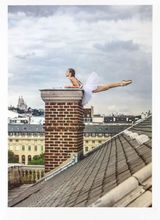
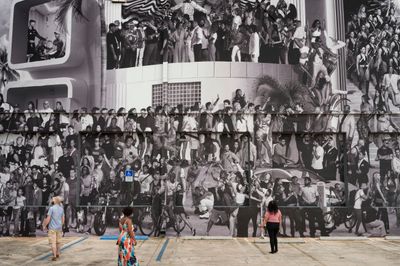
JR’s monumental, pasted photographs on façades, rooftops, staircases and infrastructure, depicting people typically marginalised, stereotyped and excluded from official power, have their roots in the banlieues of Paris, particularly the Les Bosquets housing estate in Clichy-sous-Bois. His first major series to crystallise this approach, Portrait of a Generation (2004–06), pasted tightly framed portraits of young residents of Les Bosquets across Paris, exaggerating their expressions to counter the clichéd media images of banlieue youth that circulated during and after the 2005 riots.
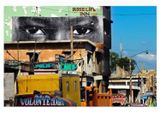
From there JR began to work transnationally. Face 2 Face (2006–07) staged an ‘illegal exhibition’ of paired portraits of Israelis and Palestinians in cities across Israel and the Palestinian territories, insisting on physical resemblance and shared vulnerability in one of the world’s most polarised contexts. With Women Are Heroes (first realised in Rio de Janeiro’s Morro da Providência in 2008), he pasted close-up photographs of local women’s eyes and faces across houses and stairways, drawing attention to their resilience amid violence and precarity; the project later evolved into a feature film that premiered at the Cannes Film Festival in 2010.
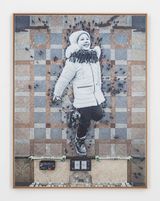
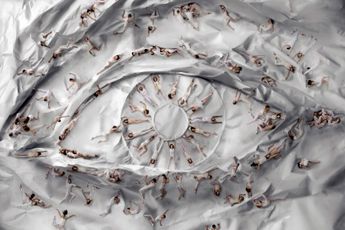
In the ongoing series Déplacé∙e∙s (2022–), JR creates large-scale aerial images of refugee children in countries including Rwanda, Mauritania, Colombia, Greece and Ukraine, printed on vast tarpaulins carried in processions and photographed from above by drones. The project’s major institutional presentation, JR – Déplacé∙e∙s at Gallerie d’Italia in Turin (9 February–16 July 2023), brought together images from these processions in an immersive mechanical installation. Across such works, images exist simultaneously as ephemeral public actions, photographic prints, videos and social media posts, extending their reach from local streets to global audiences.
The Inside Out project
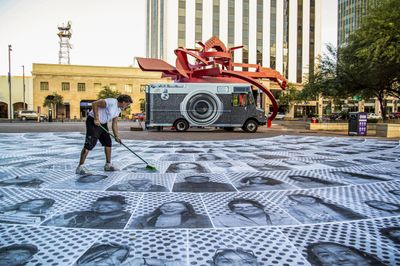
JR frequently integrates performance and participation into his projects, using mobile photo booths and trucks to invite passersby to be photographed and immediately see their portraits pasted nearby. The Inside Out Project, initiated after he received the TED Prize in 2011, turns this method into a global participatory art platform: individuals and groups submit portraits online and receive large-format black-and-white posters to paste in their own communities.
Themes and Context
JR’s work explores how images shape public perception and how representation can redistribute attention to those who are usually overlooked or stereotyped. By installing portraits on monuments, borders and urban infrastructure, he asks who is allowed to appear at scale in public space and what stories are deemed worthy of visibility. His projects foreground themes of migration, displacement, incarceration and protest, while emphasising the individuality and agency of participants rather than reducing them to sociological categories.
Can Art Change the World?
Often discussed in relation to social practice and relational aesthetics, JR frames his works less as static objects than as social situations, in which the act of gathering to make or encounter an image is as important as the image itself. By inviting wide participation—from refugees and prisoners to city residents and museum visitors—he creates temporary communities around the production and display of art, using spectacle to provoke conversation rather than simply to decorate urban space. His non-profit organisation Can Art Change the World? extends these concerns into sustained initiatives, supporting projects such as the Inside Out platform, Casa Amarela, a community centre in Rio de Janeiro’s Morro da Providência, and Refettorio Paris, a social kitchen offering fine dining experiences to people facing social vulnerability.
Exhibitions, Recognition and Recent Projects
Since the mid-2000s JR has moved from unauthorised street works to major institutional exhibitions while continuing to operate outside traditional museum frameworks. His work has appeared at the Venice Biennale, the NGV Triennial in Melbourne (2017 and 2020 editions), SFMOMA, the Brooklyn Museum, Centre Pompidou and Kunsthalle München, among others. The survey JR: Chronicles opened at the Brooklyn Museum in New York in 2019, before travelling to the Saatchi Gallery in London (2021), the Groninger Museum in the Netherlands (2021–22), Kunsthalle München in Germany (26 August 2022–15 January 2023) and the LOTTE Museum of Art in Seoul (2023).
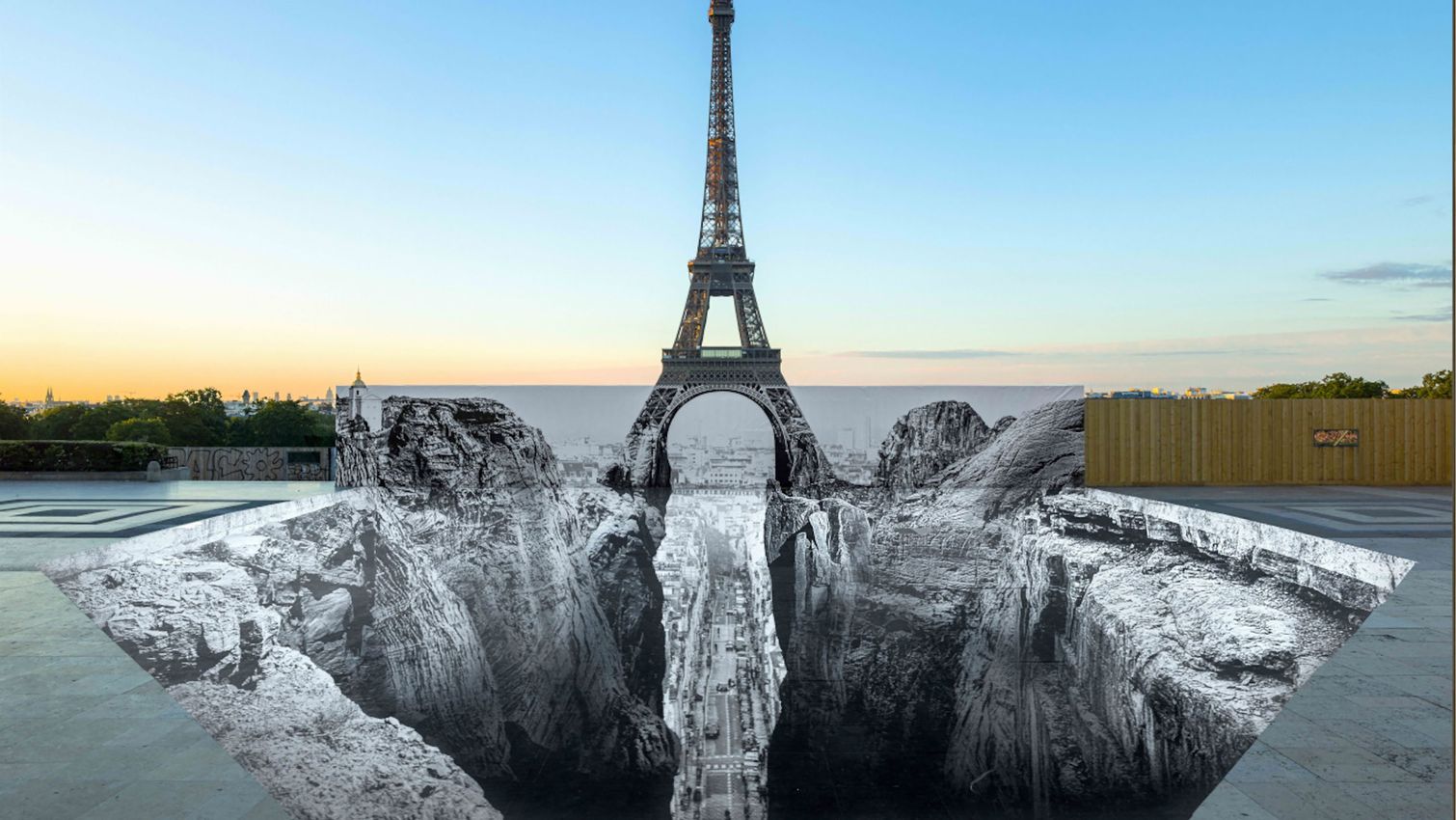
JR has also been commissioned for high-profile public and media projects. His collaborative mural The Gun Chronicles: A Story of America appeared on the cover of Time magazine in October 2018 and featured 245 participants representing diverse positions in the US gun debate. He co-directed the documentary Faces Places with Agnès Varda (released 2017), which received an Academy Award nomination in 2018, and later explored his own process in the Emmy-nominated documentary Paper & Glue (2021). In September 2023 he transformed the façade of the Palais Garnier in Paris with the installation _Retour à la caverne – Act I – L’entrée de la cavern_e, turning renovation scaffolding into an illusionistic cave entrance open to the public from 6 to 25 September 2023.
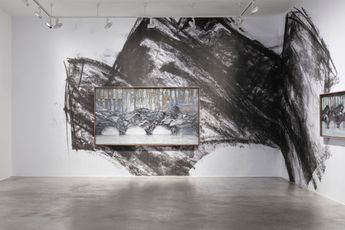
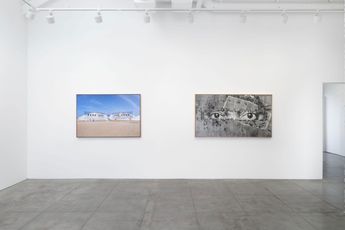
In 2026, JR’s programme extends his socially engaged practice into new gallery and city contexts, notably with Horizons, a solo exhibition at Perrotin Los Angeles from 12 March to 25 April 2026 at 5036 West Pico Boulevard. Presented in the wake of his 2025 exhibition Outposts at Perrotin London, Horizons continues a cycle of projects that meditate on frontiers, thresholds and the viewpoints of those living at their edges. Framed alongside Déplacé∙e∙s, the Los Angeles show positions JR’s work in dialogue with the social and urban landscape of the city, bringing his large-scale photographic language and participatory strategies to a region where questions of visibility, policing and community representation are particularly charged. Together with additional 2026 presentations with Perrotin in Europe, Horizons underscores how his exhibition schedule is increasingly structured around thematic cycles that move fluidly between street, gallery and museum.
JR FAQs
What is JR best known for?
JR is best known for his monumental black-and-white photographic installations in public space, which paste portraits of ordinary people onto buildings, rooftops, staircases and border walls. Series including Portrait of a Generation (2004–06), Face 2 Face (2006–07), Women Are Heroes (2008–10) and Giants, Kikito (2017) have made him a leading figure in socially engaged street art.
What themes does JR explore in his work?
JR’s work explores themes of visibility, identity, migration, displacement and the politics of representation. By collaborating with communities—from refugees and prisoners to residents of favelas and banlieues—he examines how images can challenge stereotypes and reframe public narratives.
Where can I see JR’s art?
JR’s installations often appear temporarily in public spaces worldwide, from city streets and favela hillsides to border zones and historic monuments. His work is also presented in exhibitions at museums such as SFMOMA, the Brooklyn Museum, Centre Pompidou and Kunsthalle München, and at galleries including Perrotin, Pace Gallery, Galleria Continua and Nara Roesler.
What is the Inside Out project by JR?
Inside Out is a global participatory art project initiated by JR after he received the TED Prize in 2011. It invites individuals and groups to submit portraits, which are printed as large posters for participants to paste in their own communities, transforming personal statements into collective public artworks.
What is JR’s real name?
The artist JR was born Jean René.
How does JR fund his large-scale public projects?
JR finances many of his public art initiatives through the sale of studio works, including sculptures, glass pieces, marouflage on canvas and other limited-edition artworks. These works often derive from or conceptually extend his outdoor interventions, allowing the projects’ images and narratives to circulate within the gallery and museum contexts while supporting future public commissions.
What is JR’s Déplacé∙e∙s series about?
Déplacé∙e∙s is an ongoing series, launched in 2022, in which JR creates large-scale aerial images of refugee children on vast tarpaulins carried in public processions and photographed by drones. The project highlights the visibility and resilience of displaced communities in countries including Rwanda, Mauritania, Colombia, Greece and Ukraine.
What is JR’s 2026 exhibition ‘Horizons’ in Los Angeles?
Horizons is JR’s solo exhibition at Perrotin Los Angeles, on view from 12 March to 25 April 2026. The show extends his long-standing interest in borders and migration, bringing his large-scale photographic language into dialogue with the social and urban landscape of Los Angeles.
How does JR’s work relate to social practice and activism?
JR’s projects often involve direct collaboration with local communities and are realised through his non-profit organisation Can Art Change the World?, which supports initiatives such as Inside Out, Casa Amarela in Rio de Janeiro and Refettorio Paris. Through these projects he links large-scale public images to ongoing forms of social support, dialogue and civic engagement.
Ocula | 2026

View JR's Artworks















Explore JR's Exhibitions





JR in Ocula Magazine




Explore and Follow Artists Shaping Contemporary Art
A respected voice in contemporary art discourse.
Focusing on ambitious storytelling and insightful art-world commentary. Ocula Magazine publishes in-depth interviews, critical essays and timely analysis on the artists, exhibitions and ideas driving the global art world.
Learn more about Ocula Magazine
Showcasing the best of the art world.
Ocula partners with galleries from around the world to highlight their artists, artworks and exhibitions. Gallery membership is by application and invitation, with each member vetted by an independent panel.
Learn more about Ocula Membership
Specialises in the sale of major artworks.
Led by a team with deep ties to the world’s leading auction houses, galleries and collectors. Ocula’s advisory team offers bespoke services to high-net-worth clients from around the world who are looking to acquire the best of contemporary and modern art.
Learn more about our team and services