






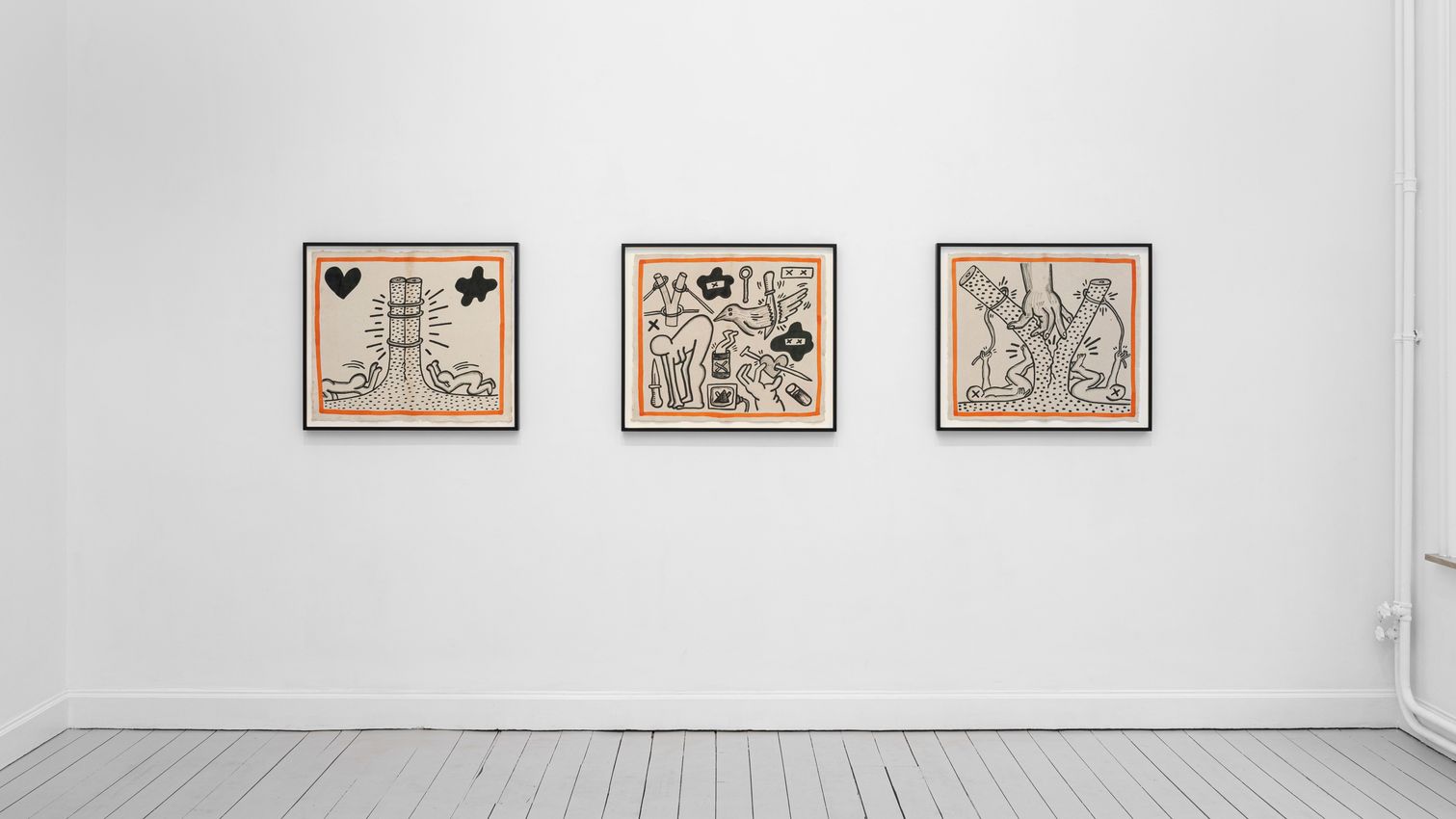
KEITH HARING
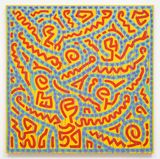
1958-1990, United StatesKeith Haring’s reinvigorated the art of painting in the late 20th century. His energy-filled artworks focused on the primacy of the line and took inspiration from pop culture and graffiti to produce pieces that were as political and playful as they were accessible.
Early Years
Keith Haring was born in 1958 and raised in Kutztown, Pennsylvania. He loved drawing from an early age, copying Dr Seuss and Walt Disney figures, and also learning art skills from his father. After high school, he studied commercial art at the Ivy School of Professional Art in Pittsburgh, but his heart wasn’t in it and he quit after two terms. However, he simultaneously worked on his own practice and had a solo exhibition at the Pittsburgh Arts and Crafts Centre in 1978. At this point, he moved to New York City and enrolled at the School of Visual Arts, getting involved in the city’s alternative art and performance community and befriending Jean-Michel Basquiat.
Keith Haring: Artworks
Keith Haring’s practice was part Pop Art, part neo-expressionism, creating energy through his use of line. Although Haring studied several disciplines at SVA, it was his drawing that brought him to New York City’s attention. In 1980, Haring noticed that unused advertising hoardings in the NYC subway system were covered with matte black paper. He began to create rapid, energetic drawings using white chalk on the black paper—between 1980 and 1985 he made hundreds of drawings on the subway, sometimes as many as 40 in a single day. But it was a partnership with the Tony Shafrazi Gallery in 1982 that drew Haring’s work to a wider audience.
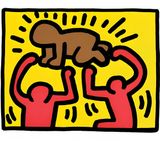
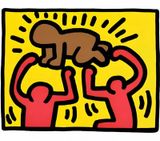
- The Radiant Baby, a crawling infant often depicted with Haring’s familiar “energy lines” around it, first surfaced as part of the artist’s subway drawings. However, it became a regular motif in Haring’s work, even being made into a pull-along toy during the early 1990s.
- 1983’s Fertility Suite brought global attention to HIV infection among pregnant women in sub-Saharan Africa—a story that had been hidden by established global narratives. The figures in his pictures are bright and vibrant, often dancing. Also pictured are Ankh crosses, representing the breath of life.
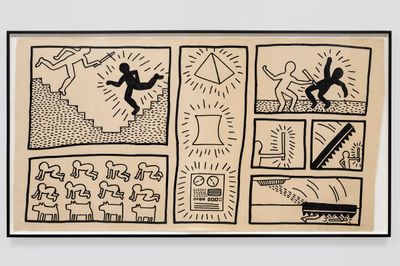
- The Marriage of Heaven and Hell (1984) is a great example of the often paradoxical nature of Haring’s work. Bringing together ideas of good and evil, life and death and innocence and experience, The Marriage of Heaven and Hell is an ink-on-paper drawing featuring dogs, crosses, flying saucers, flames, eyes and angels.
Keith Haring: Select Public Works
- Untitled (1982), Haring’s first major outdoor mural at Houston Street and The Bowery (no longer exists)
- Berlin Mural (1986), a 300-metre mural featuring figures painted in the colours of the German flag (no longer exists—covered by other artists and then the Berlin Wall was destroyed)
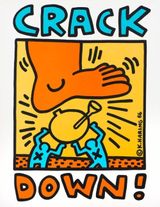
- Crack is Wack (1986), 128th Street and Second Avenue. Although he was ordered to cover this mural, he was commissioned by New York City Parks Department to make a replacement.
- Untitled (1987), café, Museum of Contemporary Art, Antwerp
- Paris Mural (1987), Necker Children’s Hospital, Paris
- Carmine Street Mural, (1987), public swimming pool at Carmine Street and Seventh Avenue
- Barcelona Mural (1989), moved from the Barrio del Chino to the Museum of Contemporary Art
- Monte Carlo Mural (1989), Princess Grace Maternity Hospital
- Untitled (1989), Grant Park, Chicago (divided amongst the school participants)
- Pisa Mural (1989), Church of Sant’Antonio
- Keith Haring on Park Avenue, New York City (1997)
Keith Haring: Select Posthumous Exhibitions
- Keith Haring in 3D, Crystal Bridges Museum of American Art, Arkansas (2026)
- Rising Up: Rocky and the Making of Monuments, Philadelphia Museum of Art (2026)
- Keith Haring, The Brant Foundation, New York City (2025)
- Liberating the Soul: Keith Haring’s Paintings, Gladstone Gallery, New York City (2025)
- Keith Haring: Into 2025, Nakamura Keith Haring Collection (2024)
- To My Friends at Horn: Keith Haring and Iowa City, The Stanley Museum of Art, Iowa City (2024)
- Keith Haring: Amsterdam Notes, Stedelijk Museum, Amsterdam (2023)
- Keith Haring: Art is for Everybody, The Broad, Los Angeles (2023)
- Keith Haring, Museum Folkwang, Essen (2020), Germany
- Keith Haring, Tate Liverpool (2019)
- Keith Haring: Art is Life, Life is Art, Dongdaemun Design Plaza, Seoul (2018), South Korea
- Keith Haring. The Alphabet, Albertina, Vienna (2018)
- Keith Haring: About Art, Palazzo Reale Milan (2017)
- Keith Haring: Multiplexism, National Museum of History, Taipei (2015)
- Keith Haring: The Political Line, Kunsthalle der Hypo-Kulturstiftung, Munich (2015) (and touring)
- Keith Haring: Languages, Fales Library, New York University (2013)
- Keith Haring: The Political Line/Grands Formats, Le Centquatre, Paris (2013)
- The Hieroglyphics of Keith Haring, Musee en Herbe, Paris (2011)
- Keith Haring: Print Retrospective 1982–1990, Collins C Diboll Art Gallery of Loyola University, New Orleans (2009)
- Keith Haring: Early Drawings, Baltic Centre for Contemporary Art, Gateshead (2006)
- The Keith Haring Show, Milan Trienniale (2005)
- Keith Haring: Short Message. Posters 1982–1990, Versicherungskammer Bayern, Munich (2002) (and touring)
- Keith Haring: the SVA Years, School of Visual Arts, New York City (2000)
- Keith Haring: A Retrospective, Whitney Museum of American Art, New York City (1997) (and touring)
- The 10 Commandments, Bruderkirche and Museum Fridericianum, Kassel (1996)
- Keith Haring Altarpiece, Palo Alto Cultural Centre and Museum of Contemporary Religious Art, St Louis (1995)
- Complete Editions on Paper, various galleries around Japan (1994)
- Keith Haring: A Retrospective, Mitsukoshi Museum of Art, Tokyo (1993)
- One Person Show, Tony Shafrazi Gallery, New York City (1992) (and touring)
- Haring, Disney, Warhol, The Corcoran Gallery of Art, Washington DC (1991) (and touring)
Further Reading
- The Keith Haring Foundation
- The Keith Haring Foundation’s Instagram
- 2020 biography from PBS
Keith Haring FAQs
What was Pop Shop?
Keith Haring opened the Pop Shop on Lafayette Street in SoHo in April 1986—it was a retail shop selling merchandise bearing his images because he wanted to facilitate greater access to his artwork. Haring painted the store’s interior with a black-on-white mural and the shop sold T-shirts, magnets, toys and posters. He opened a second Pop Shop in Tokyo in 1987. The New York City store closed in 2005 but in 2009, Tate Modern reconstructed parts of the retail space for the Pop Life exhibition.
Was Keith Haring friends with Andy Warhol?
Keith Haring and Andy Warhol met in 1982 at the Tony Shafrazi Gallery and Warhol acted as a mentor to Haring. Warhol encouraged Haring to open the Pop Shop, and Haring created the Andy Mouse series, in which Warhol was depicted as Mickey Mouse, at a similar time.
What did dogs mean to Keith Haring?
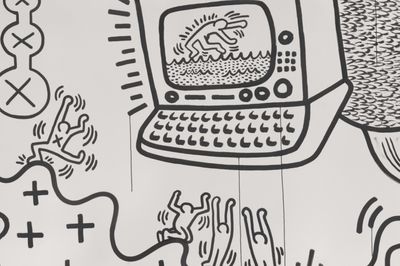
Keith Haring’s barking dog, developed during his subway drawings, is a black-outlined canine motif, but the simplicity of the image belies its versatility. It can be seen as a way of shouting back at political power, and the standing dog prints are filled with a chaos of humans, televisions and animals, suggesting a glimpse into hell.
Ocula

Works at Baldwin Contemporary








Works Elsewhere









Keith Haring in Ocula Magazine








Explore and Follow Artists Shaping Contemporary Art
A respected voice in contemporary art discourse.
Focusing on ambitious storytelling and insightful art-world commentary. Ocula Magazine publishes in-depth interviews, critical essays and timely analysis on the artists, exhibitions and ideas driving the global art world.
Learn more about Ocula Magazine
Showcasing the best of the art world.
Ocula partners with galleries from around the world to highlight their artists, artworks and exhibitions. Gallery membership is by application and invitation, with each member vetted by an independent panel.
Learn more about Ocula Membership
Specialises in the sale of major artworks.
Led by a team with deep ties to the world’s leading auction houses, galleries and collectors. Ocula’s advisory team offers bespoke services to high-net-worth clients from around the world who are looking to acquire the best of contemporary and modern art.
Learn more about our team and services