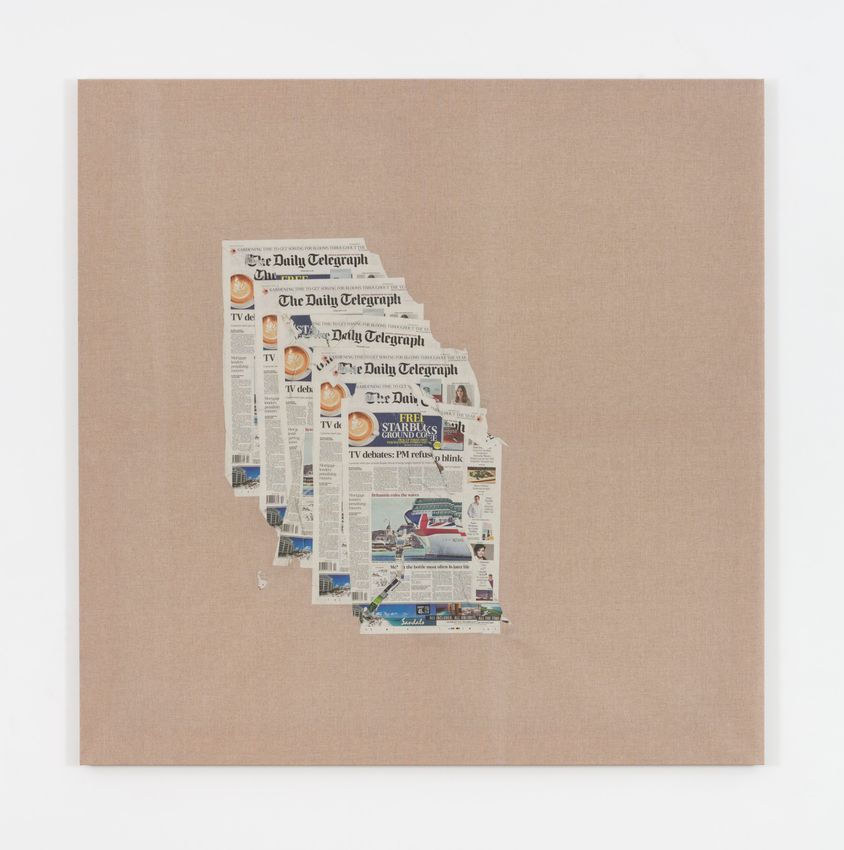
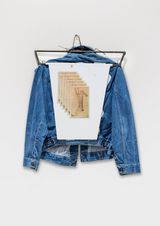
Matias Faldbakken applies the conventional tools of artmaking to ordinary objects—from ink, charcoal and pencil to cardboard boxes, garbage bags, car trunks and jackets, among others—that are altered, deconstructed, combined or subtracted to become abstract sculptures.
Writing and Artmaking
Despite his education in art, Faldbakken was disillusioned with working as an artist and initially gained recognition as a writer. His first novel The Cocka Hola Company (2001), published under the pseudonym Abo Rasul, began the trilogy ‘Scandinavian Misanthropy’ (2001—08). Written in what came to be the artist’s characteristically caustic and satirical style, the trilogy revolves around a range of characters and settings tied together by an underlying contempt for human values.
Compared to his writing, Faldbakken’s artworks have often been described as hermetic, abstract and minimal. Taking mass-produced and commonplace objects, Faldbakken recontextualises them into new situations. In Screen Chairs (Dog Trainer) (2016), a stack of nine chairs becomes a sculptural whole; on the topmost chair, a box with six newsprints attached to one side echoes the chairs’ silhouette.
Negativity
Faldbakken’s artworks and writing, however, are both driven by the artist’s interest in expressions of negation and negativity—‘hate, misanthropy and so on’, as he told Mousse Magazine in 2008. Black Screen (2005), a video work presented at the Nordic Pavilion during the 51st Venice Biennale, follows the camera through a cinema, only to show a black rectangle where there should be the screen. The expectation for entertainment, associated with the cinema, is replaced with blackness or nothingness.
Potent cultural symbols often undergo subversion and manipulation in Faldbakken’s works. The car, for example, stands for movement, freedom, independence and power, but has also been associated with violence—road actions, abduction, illegal trade—in popular culture. In Faldbakken’s Abstracted Car (2009), the vehicle is burnt, decommissioned and strapped to a metal transport frame, while a car trunk has been separated from the rest of the car in Untitled (Car Trunk #5) (2013).
Repeating such gestures of negation over and over, Faldbakken’s work ultimately begins to question the very act of negation itself; whether such an act as antagonism is possible in the contemporary art world. With the history of previous anti-establishment, avant-garde art movements—among them Situationist International and Dada—subversion is already an expectation.