





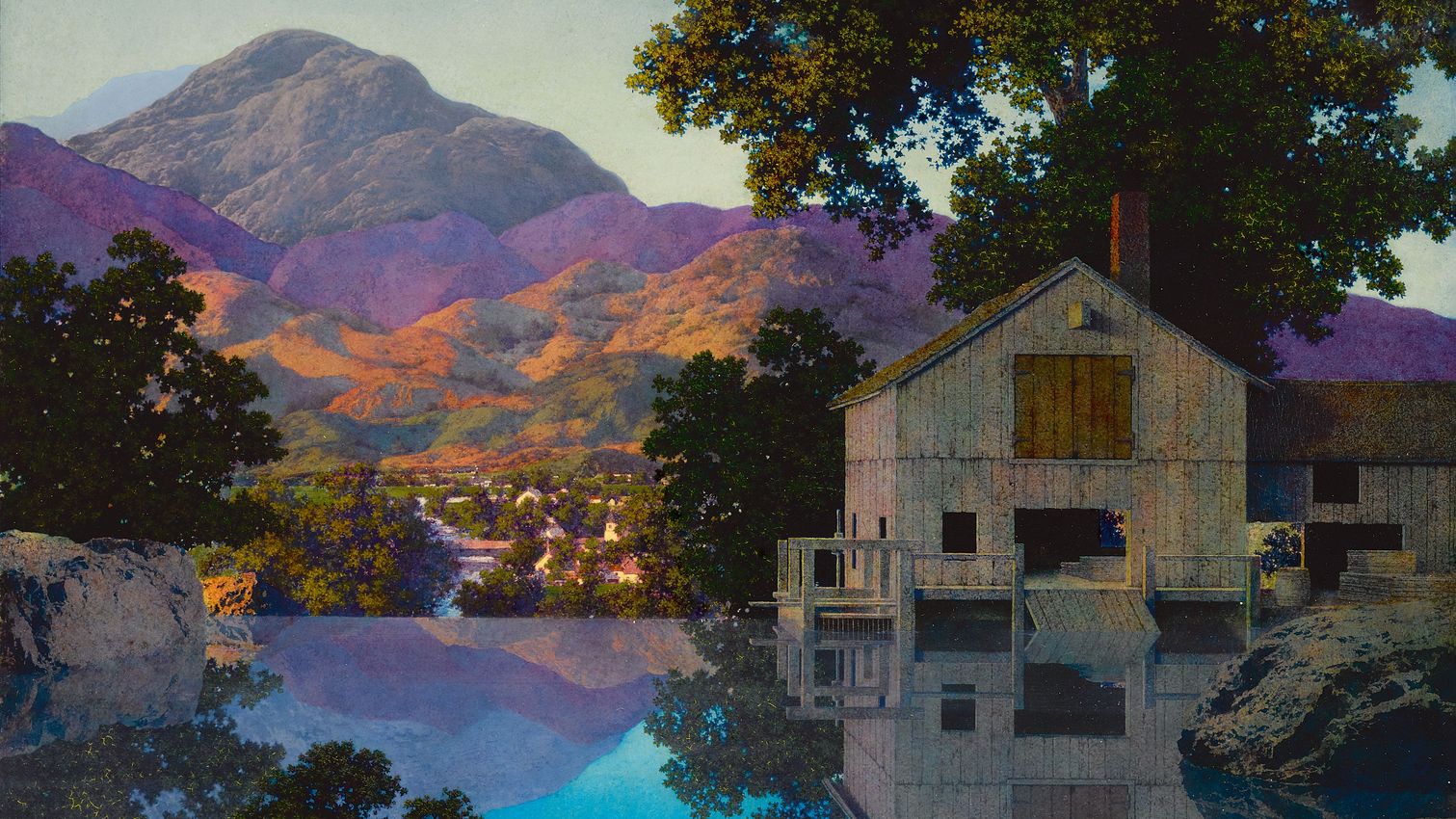
MAXFIELD PARRISH
b. 1870, United StatesKnown for his sublime landscapes, American painter Maxfield Parish’s practice often straddled high art and commercial illustration. His iconic ultramarine skies and gilded classical forms redefined early 20th-century visual culture, merging fine art’s aesthetic appeal with mass-market accessibility.
Early Years
Born in Philadelphia in 1870, Parrish was immersed in creative disciplines from an early age through his father, painter-etcher Stephen Parrish, who mentored him in drawing and nurtured his early artistic sensibilities.
Parrish’s childhood sketching tours across Western Europe (1884–86) immersed him in Renaissance masterworks and Gothic architecture, instilling a lifelong fascination with neoclassical landscapes. Though he briefly studied architecture at Haverford College (1888), he shifted decisively to fine arts at the Pennsylvania Academy of the Fine Arts (1892–95), where he mastered figural precision. In 1896, he extended his training at the Drexel Institute of Art under Howard Pyle, the ‘father of American illustration’, who sharpened his art’s narrative clarity. These dual foundations—Old Masters’ technical rigour and Pyle’s storytelling ethos—forged Parrish’s signature fusion of mythic grandeur and technical mastery.
Maxwell Parrish Artworks
Parrish’s unique style, equal parts commercial charm and fine-art ambition, crafted dreamscapes where light and colour conjured utopian serenity. His ethereal figures that glowed against the skies of his iconic ‘Parrish blue’ transported viewers into dreamlike fantasies - a visual refuge from modernity’s relentless chaos.
Illustration
Parrish’s career began with commercial illustration, blending meticulous draughtsmanship learned during his time studying, with an emerging fascination with light. Early successes like Mother Goose in Prose (1897) showcased his ability to reimagine classic tales, whilst The Dinky Bird (1904), a whimsical children’s book illustration, merged narrative charm with jewel-toned hues. His first major mural commission, Old King Cole (1905) for New York’s Knickerbocker Hotel, revealed a leap in scale and ambition, marrying geometric composition (inspired by his brief architecture studies) with theatrical storytelling. The success of his early works stemmed from his glazing technique - applying up to 30 translucent oil and varnish layers to create luminous depth – transforming his canvases into radiant windows of light, echoing medieval stained glass.
Commercial Success
The 1910s–1920s cemented Parrish as one of America’s most commercially successful artists; this triumph driven by commissions and mass-reproduced prints. The Garden of Allah (1919) epitomised his fusion of Art Nouveau elegance and Persian-inspired architecture, its terraced gardens radiating otherworldly serenity. This era’s apex came with Daybreak (1922), possibly the 20th century’s most reproduced art print. Two nymph-like figures, draped in diaphanous cloth awaken beneath a dawn sky of layered azures (labelled ‘Parrish blue’), embodying his quest for ‘perfect beauty’ through mathematical precision and vibrant colour. These works, alongside advertising campaigns like his design of posters for Edison-Mazda lamps, made Parrish a household name, though critics often dismissed his art as ‘populist’.
Landscapes
Amid 1930s industrialisation, Parrish retreated to his New Hampshire studio, declaring himself ‘done with girls on rocks’ as he pivoted from mythical figures to landscapes. This emotional transition is reflected in Parrish’s Old White Birch (1937) which captures a solitary birch tree with hyper-realistic precision. His intimate bond with the subject emerges in the tree’s details—the textured bark, asymmetrical branches—while warm amber light and deep violet shadows transfigure the scene, exalting an ordinary landscape into a realm of the sublime. Similarly, The Millpond (1942) traded Parish’s typical fantastical narratives for Vermont’s rural tranquillity, whispering a quiet defiance against modernity’s clamour. These works, though less commercially celebrated, signalled Parrish’s late career introspectiveness. His work began to value the contemplative stillness of landscape that offered him a respite amid the chaos of a more industrialising world.
Parrish accepted his last commission in the late 1950s and painted until his death at the age of 95 in 1966.
What Are Some Notable Exhibitions?
Maxwell Parrish has been the subject of both solo exhibition and group exhibitions at important institutions, below are some examples:
Solo Exhibitions
- The Ethereal Worlds of Maxfield Parrish, 2025, Flagler Museum, Palm Beach, FL.
- Maxfield Parrish: The Retrospective, 2012–2013, National Museum of American Illustration, Newport, RI.
- Maxfield Parrish, 1870–1966, 1999, Pennsylvania Academy of the Fine Arts, Philadelphia.
- Maxfield Parrish: A Retrospective, 1996, Norman Rockwell Museum, Stockbridge, MA.
- Master of Make Believe, 1974, Brandywine River Museum, Chadds Ford, PA.
- Maxfield Parrish, A Second Look (1964, Gallery of Modern Art, New York.
Critical Reception
Celebrated as the ‘most successful art print’ by The National Museum of American Illustration, Parrish’s commercial dominance in the 1920s drew mixed critiques: DailyArt Magazine praised his ‘ethereal, whimsical effect’, while contemporaries dismissed his art as kitsch. Posthumously, his technical genius was re-evaluated; Christie’s hailed his 2006 $7.6M Daybreak sale as affirming his ‘enduring alchemy’. Modern journals now recognise his influence on Photorealism and Pop art
Maxfield Parrish FAQs
How did the art market respond to Parrish’s work during his lifetime versus posthumously?
During his lifetime, Parrish commanded unprecedented commercial success, with Daybreak (1922) becoming history’s most reproduced art print. Posthumously, his market value soared - Daybreak fetched $7.6 million at auction in 2006, confirming his transition from illustrator to fine art master.
What unique studio techniques defined Parrish’s practice?
Parrish constructed elaborate dioramas with handmade models, photographed them in theatrical lighting, then transformed these references through his signature glazing technique, applying up to 30 alternating layers of transparent oil and varnish to achieve luminous depth.
How widespread was Parrish’s commercial success?
By 1925, one in four American households displayed a Parrish print. His calendar illustrations for Edison Mazda lamps reached millions, while his advertising work for Fisk Tires, Jell-O, and Colgate generated unprecedented artist fees, making him America’s highest-paid commercial artist.
Which contemporary artists were directly inspired by Parrish?
Modern visionaries including fantasy illustrator Frank Frazetta, photorealist painter Richard Estes, and Surrealist James Gurney cite Parrish’s technical innovations. Contemporary artists like Thomas Kinkade explicitly borrowed his glazing techniques and album artists echo his geometric approach.
Where can significant Parrish originals be viewed today?
Major permanent collections include Philadelphia Museum of Art (featuring Dream Garden mosaic), National Museum of American Illustration in Newport, Pennsylvania Academy of Fine Arts, and Currier Museum in New Hampshire. The St. Regis Hotel in New York displays his Old King Cole mural.
How did Parrish’s work bridge fine art and commercial illustration?
Parrish revolutionised commercial art by applying Renaissance painting techniques to mass-produced imagery. His refusal to distinguish between ‘high’ and ‘commercial’ art established a precedent for Pop Art and anticipated today’s fluid boundaries between gallery art and visual communication.
What was Parrish’s impact on American visual culture?
Parrish’s idealised ‘American Arcadia’ shaped early 20th-century visual identity. His signature cobalt ‘Parrish blue’ skies and nostalgic landscapes influenced Hollywood cinematography, magazine design, and even Walt Disney’s animated aesthetics - establishing a distinctly American visual vocabulary.
Timur Safardiar | Ocula | 2025

Explore and Follow Artists Shaping Contemporary Art
A respected voice in contemporary art discourse.
Focusing on ambitious storytelling and insightful art-world commentary. Ocula Magazine publishes in-depth interviews, critical essays and timely analysis on the artists, exhibitions and ideas driving the global art world.
Learn more about Ocula Magazine
Showcasing the best of the art world.
Ocula partners with galleries from around the world to highlight their artists, artworks and exhibitions. Gallery membership is by application and invitation, with each member vetted by an independent panel.
Learn more about Ocula Membership
Specialises in the sale of major artworks.
Led by a team with deep ties to the world’s leading auction houses, galleries and collectors. Ocula’s advisory team offers bespoke services to high-net-worth clients from around the world who are looking to acquire the best of contemporary and modern art.
Learn more about our team and services