





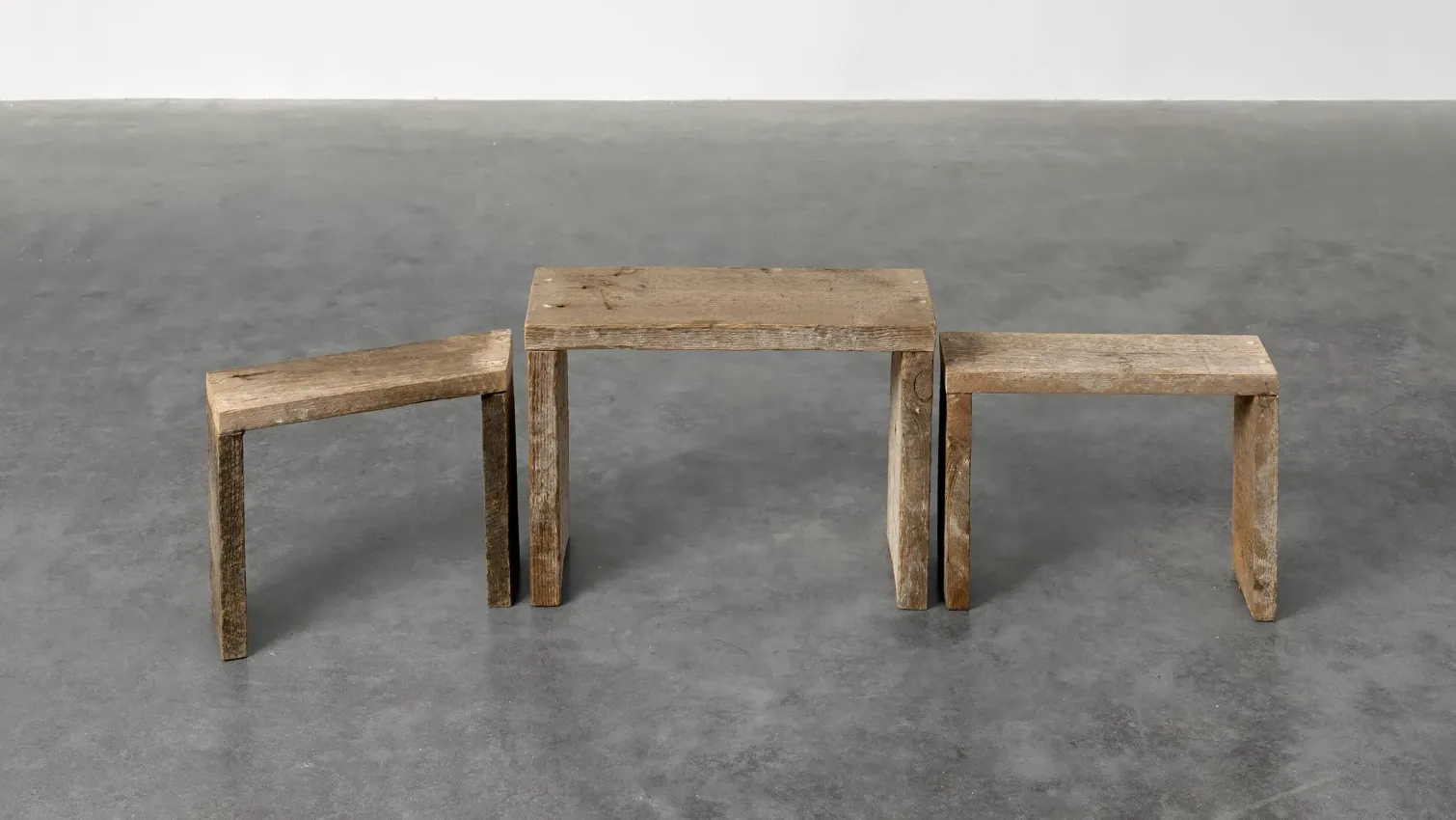
MIROSŁAW BAŁKA
b. 1958, PolandComprising installation, sculpture and video, Miroslaw Balka’s work has a bare and elegiac quality that is underlined by the careful, minimalist placement of objects, as well as the gaps and pauses between them.
Often using his own body and his studio as a template or first point of reference, Balka’s work might incorporate personal or self-referential substances such as ash, felt, salt, hair and soap.
Balka’s work deals with both personal and collective memories, especially as they relate to his Catholic upbringing and the collective experience of Poland’s fractured history. Through this investigation of domestic memories and public catastrophe, Balka explores how subjective traumas are translated into collective histories and vice versa. His materials are simple, everyday objects and things, but also powerfully resonant of ritual, hidden memories and the history of Nazi occupation in Poland.
Miroslaw Balka was born in 1958 in Warsaw, Poland. He lives and works in Otwock, Poland and Oliva, Spain. His work has been exhibited widely, including solo exhibitions at Castello di Ama, Siena (2019); Hangar Bicocca, Milan (2017); Museum Morsbroich, Leverkusen, Germany (2017); British School at Rome (2016); Museum of Art MS1, Lodz, Poland (2015); Foksal Gallery, Warsaw (2014); Freud Museum, London (2014); National Centre For Contemporary Art, Moscow (2013); Akademie Der Kunste, Berlin (2011); Douglas Hyde Gallery, Dublin (2011); Museo Nacional Centre de Arte Reina Sofia, Madrid (2010); Modern Art Oxford, UK (2009); Tate Modern, London (2009); Museum of Contemporary Art, Rijeka (2007); Irish Museum of Modern Art, Dublin (2007); Kunstsammlung Nordrhein-Westfalen, K21, Düsseldorf, Germany (2006); Museum of Contemporary Art, Strasbourg, France (2004); Kroller-Muller Museum, Otterlo, Netherlands (2001); Dundee Contemporary Arts, Scotland (2002); and Stedelijk Museum voor Actuelle Kunst, Ghent, Belgium (2001).
Balka has participated in numerous group exhibitions including Fondazione Berengo Art Space, Murano, Italy; Muzeum Susch, Engadin, Switzerland (both 2019); Mori Art Museum, Tokyo (2018); Museum Moderner Kunst Stiftung Ludwig Wien, Vienna; The National Museum of Art, Osaka, Japan (both 2017); Fundación la Caixa, Barcelona (2016); Museum of Contemporary Art, Krakow (2015); Museum of Modern Art, Warsaw (2014); 55th Venice Biennale (2013); Center for Contemporary Art, Tel Aviv, Israel (2010); Hartware MedienKunstVerein, Dortmund, Germany (2010); Museum Stzuki, Lodz, Poland (2010); 6th SITE Santa Fe Biennale, New Mexico (2006); 15th Biennale of Sydney (2006); 51st Venice Biennale (2005); 45th Venice Biennale (1993); Documenta 9, Kassel, Germany (1992); and 44th Venice Biennale (1990).
Courtesy White Cube

Representative Artworks


Explore and Follow Artists Shaping Contemporary Art
A respected voice in contemporary art discourse.
Focusing on ambitious storytelling and insightful art-world commentary. Ocula Magazine publishes in-depth interviews, critical essays and timely analysis on the artists, exhibitions and ideas driving the global art world.
Learn more about Ocula Magazine
Showcasing the best of the art world.
Ocula partners with galleries from around the world to highlight their artists, artworks and exhibitions. Gallery membership is by application and invitation, with each member vetted by an independent panel.
Learn more about Ocula Membership
Specialises in the sale of major artworks.
Led by a team with deep ties to the world’s leading auction houses, galleries and collectors. Ocula’s advisory team offers bespoke services to high-net-worth clients from around the world who are looking to acquire the best of contemporary and modern art.
Learn more about our team and services