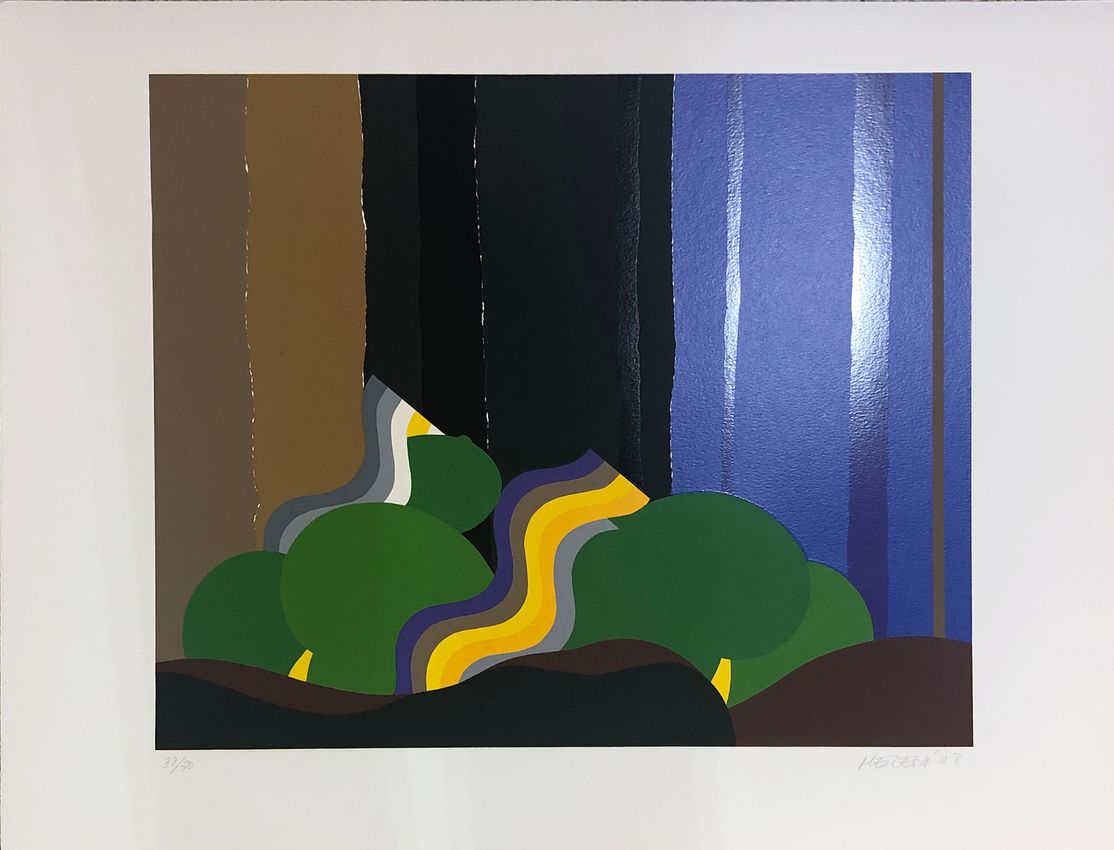
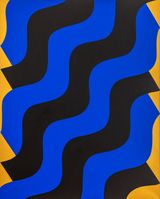
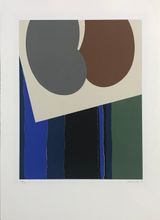
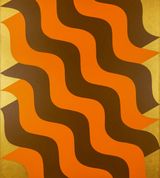
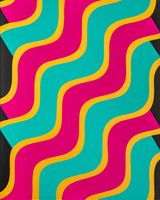
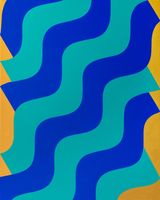
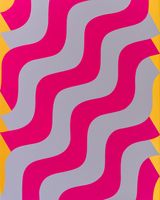
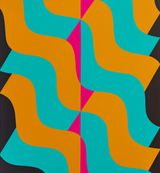
In 1964, Mohamed Melehi took a job teaching at Casablanca’s School of Fine Arts, attracting other Moroccan teachers, artists, and art historians, and building up a research centre and creative collective for promoting Bauhaus design and other modernist projects blended with design attributes of Muslim civilization. He had the ability to make connections between what he discovered in the Arab and North African worlds and his knowledge of New York and Parisian avantgarde painting practices.
Modernist Painting
During his time in New York at Columbia during the early 1960s, Melehi was friends with many of the Leo Castelli Gallery artists, like Frank Stella and Jim Dine. Melehi began to embrace bright colour, abandoning black, and developed his predilection for order, geometry, flat colour, and decorative metaphors: especially, curved wave forms—often descending in a straight line diagonally or vertically—and rainbows, flames, and converging rays. The undulating wave forms first appeared in 1963, and he associated them with video tapes and broadcast television signals.
Technique and Politics
Early on in his painting career, Melehi used acrylic on canvas, but in 1970 he switched to cellulose car lacquer on wood, because it reflected the techniques of working-class tradesmen and not the elitism of fine arts or academia.
In Marrakech, he saw his ribbon-like motifs of colourful geometric abstraction as standing for liberation from draconian oppression, and founded a magazine allied with left-wing causes that promoted opposition to the U.S.-backed Moroccan government of King Hassan II. As restrictions began eventually to ease, Mehlehi acquired influential cultural administration positions in the government.
Examples of Melehi’s artworks include Untitled (1970), Flamme (1975), Untitled (1979), Volcanic (1985), and Moucharabieh in Grey (2020).