






PAUL SIGNAC
1863-1935, FrancePaul Signac (French, 1863–1935) was a painter and printmaker associated with the Neo-Impressionist movement, and known for applying distinct points of colour to his canvases in accordance with colour theories emerging at the time.
Largely self-taught, Signac was first inspired to pursue his career while visiting an Claude Monet (French, 1840-1926) exhibition at La Vie Moderne in 1880. Signac’s early works followed the tradition of Impressionism, but changed drastically after meeting Georges Seurat (French, 1859-1891) in 1884. Signac’s approach transitioned from an intuitive interpretation of the outdoors to a more rigorous examination of paint properties. He was one of the first Parisian artists to settle in St. Tropez on the Mediterranean shore in 1892. Here, Signac’s brushwork became looser and his colours brighter, as he created an idealised vision of rural life that reflected his anarchist sympathies. F
rom 1893 to 1895, he completed the painting Au temps d’harmonie, one of the best examples of Signac’s utopian aspirations, and a prime example of his ability to depict pastoral scenes using his newly-developed Neo-Impressionist brushwork. Signac consolidated his assertion of Neo-Impressionism by writing D’Eugène Delacroix au Néo-Impressionnisme (1899), a text that influenced the work of the Futurists in Italy and the Fauves in France. Although Signac’s work was not widely recognised at the start of his career, by the mid-1880s he had exhibited at the Salon des Indépendants – of which he was a founding member – as well as several other galleries.
Courtesy Bailly Gallery


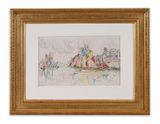
Recently Exhibited





Explore and Follow Artists Shaping Contemporary Art
A respected voice in contemporary art discourse.
Focusing on ambitious storytelling and insightful art-world commentary. Ocula Magazine publishes in-depth interviews, critical essays and timely analysis on the artists, exhibitions and ideas driving the global art world.
Learn more about Ocula Magazine
Showcasing the best of the art world.
Ocula partners with galleries from around the world to highlight their artists, artworks and exhibitions. Gallery membership is by application and invitation, with each member vetted by an independent panel.
Learn more about Ocula Membership
Specialises in the sale of major artworks.
Led by a team with deep ties to the world’s leading auction houses, galleries and collectors. Ocula’s advisory team offers bespoke services to high-net-worth clients from around the world who are looking to acquire the best of contemporary and modern art.
Learn more about our team and services