René Magritte’s paintings often place mundane objects into unusual situations, evoking mysterious connections that question illusion and reality.
Initially dabbling in Futurist and Cubist styles, Magritte shifted to Surrealism after seeing a reproduction of Giorgio de Chirico‘s painting Le chant d’amour (1914) and its tableau of irrational objects. Although he would experiment with various styles throughout his career, Magritte is ultimately remembered for his contribution to Surrealism through ambivalent imagery crisply rendered in muted tones.
In contrast to the abstraction of the Parisian Surrealists, Magritte’s work is more representational, transposing symbolic images—the bowler hat, the apple, the female torso, the bourgeois man, the window—into domestic spaces, urban environments, and sublime landscapes.
The Lovers
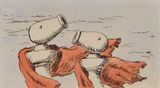
In The Lovers (1928), Magritte paints a cinematic close-up of a couple kissing, each of their heads enshrouded in cloth. The fabric barrier transforms the intimacy of passion into a frustrated and isolating image, suggestive of the hidden, unknowable facets of the human psyche. Motifs of covered figures, objects suspended in space, and obscured identities recur throughout his paintings.
The Treachery of Images
Text and symbol combine to existentially witty effect in Magritte’s The Treachery of Images (1929). The painting of a tobacco pipe is captioned with ‘Ceci n’est pas une pipe’, or ‘This is not a pipe’. This simple provocation, which suggests that the viewer is looking at a picture of a pipe rather than a pipe itself, taps into deeper philosophies of representation. Magritte highlights the distinction between image and reality, exclaiming, ‘Could you stuff my pipe? No, it’s just a representation, is it not?’
The Son of Man
Magritte’s The Son of Man (1964) is one of just four self-portraits he ever painted. The work depicts a man in a bowler hat and coat standing in front of a calm sea, with his face largely obscured by a floating green apple. Like most of Magritte’s art, the meaning behind the enigmatic image is elusive. He suggested that ‘At least it hides the face partly well, so you have the apparent face, the apple, hiding the visible but hidden, the face of the person. It’s something that happens constantly. Everything we see hides another thing, we always want to see what is hidden by what we see.’