





TADASHI KAWAMATA
b. 1953, JapanThe major Japanese artist Tadashi Kawamata — who has participated indocumentas 8 and 9 (1987-1992) and represented Japan at the Venice Biennale in 1982 — is famous for his site-specific interventions using assemblages of wooden planks, chairs, and barrels, with which he creates architectural structures that interrogate the built forms of our cities and the way in which we experience public space.
Working on the permanent tension between the powerful force of landscape and our both vulnerable and destructive civilisation, Tadashi Kawamata mentions that the human need for permanence in spite of the forces of nature has ecologically fatal consequences.
The artist has always worked on architecture, and more particularly on community spaces such as favelas, slums or shelters. For documenta 8, in 1987, he smothered the ruins of a bombed church in Kassel with lengths of timber, ivy-like, as if to counteract the effects of time.
In 1991, in Ottawa and in Houston, he built structures that he called Favelas: “The idea comes from São Paulo and Rio de Janeiro. I was in residence (in São Paulo) close to the favela area; the police came and destroyed everything. After a week they started to rebuild, I found in this nomadic situation, this time cycle, a great influence on the idea of building and destroying while recycling.”
He did this again in Kassel the following year, but this time the installation was called People’s Garden.
These favelas—in both their structure and their organization—gesture toward the idea of community, which is present in all of the artist’s projects. With the Tree huts plans, the models remain as the only material evidence of Kawamata’s installations in situ, as seen with the huts at the Centre Pompidou or in Tremblay for instance.
According to him, huts occur suddenly and unexpectedly in urban space and make everyone rediscovering and question it. Impermanence contributes greatly to the reflection on the social context and human relationships that is present in his work.
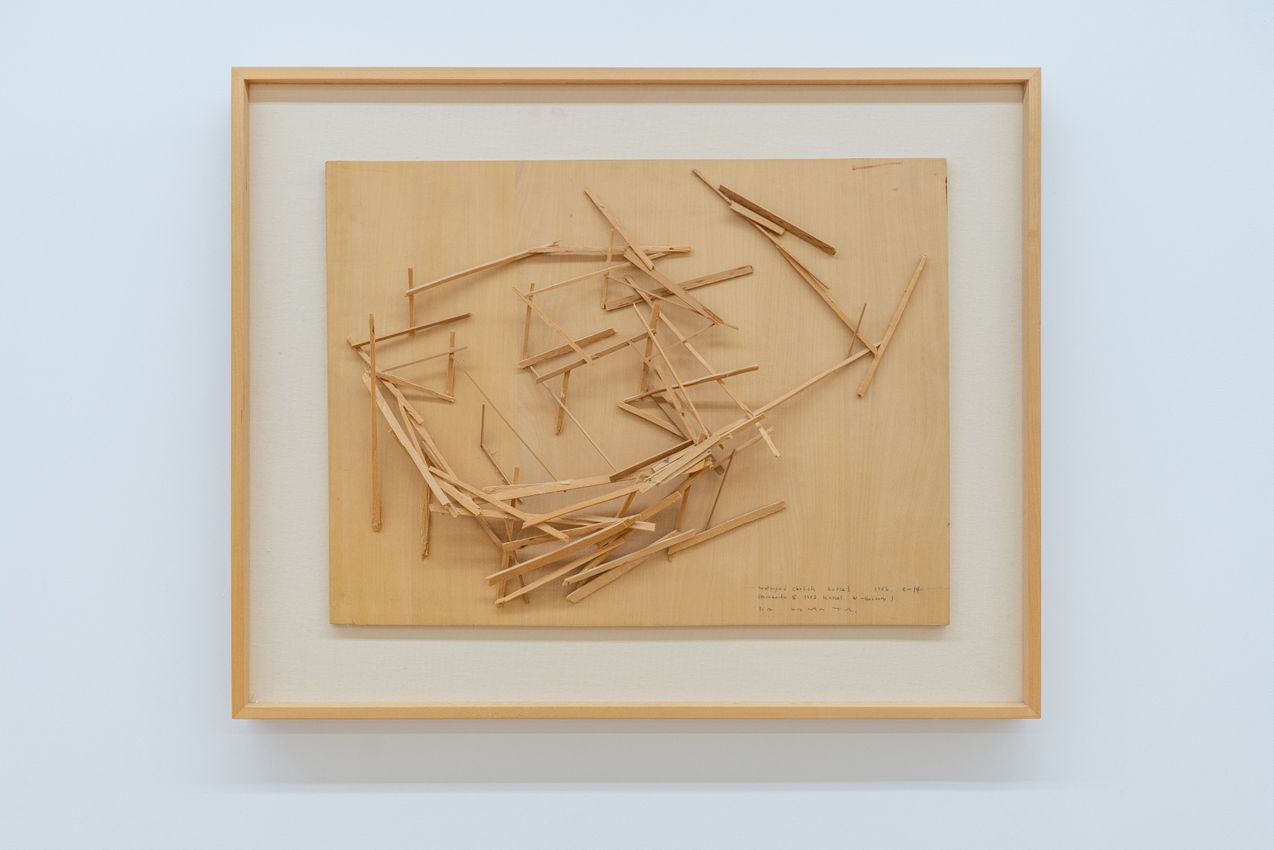
The Site sketches are a series of works on paper that Tadashi Kawamata has been developing for the last 10 years.
He used, in a recycling process, the pieces of wood that have fallen to the ground and the rest of the paint from his installations to create drawings which transmit the quintessence of his thinking on place—space marked by human presence.
These works are autonomous and don’t function as preliminary sketches to future installations, but rather what he calls ‘visions’.
Last step resulting from his artistic research, the Destruction series can be seen as a continuation of Under the Water (presented at the Centre Pompidou-Metz in 2016), although here the eye changes position: it is no longer below the waste, but in front of it looking at the disaster.
The title of the series and the tide of waste refer to a world threatened by ecological disasters but also to the tsunami that struck Japan in 2011 and deeply affected the artist.
The immersive wall-sized panels can be seen as landscape-archives: device for reading the layered history of interactions between humans and their environment.
His work is currently being shown at Japan Society Gallery in New York. Numerous key galleries and museums such as Kunsthaus Zug have featured Tadashi Kawamata‘s work in the past. Tadashi Kawamata‘s work has been offered at auction multiple times, with realized prices ranging from $287 USD to $49,817 USD, depending on the size and medium of the artwork. Since 2010 the record price for this artist at auction is $49,817 USD for Project begijnhof st-elisabeth kproject begijnhof st-elisabeth kortrijk belgie, sold at Mainichi Auction, Tokyo in 2014. Tadashi Kawamata has been featured in articles for The Art Newspaper, Ocula and Juliet Art Magazine. The most recent article is Last Chance to See: Helsinki Biennial 2021 Brings Art and Sustainability to Vallisaari written for Wallpaper in September 2021.
Courtesy Patricia Low Contemporary




Explore and Follow Artists Shaping Contemporary Art
A respected voice in contemporary art discourse.
Focusing on ambitious storytelling and insightful art-world commentary. Ocula Magazine publishes in-depth interviews, critical essays and timely analysis on the artists, exhibitions and ideas driving the global art world.
Learn more about Ocula Magazine
Showcasing the best of the art world.
Ocula partners with galleries from around the world to highlight their artists, artworks and exhibitions. Gallery membership is by application and invitation, with each member vetted by an independent panel.
Learn more about Ocula Membership
Specialises in the sale of major artworks.
Led by a team with deep ties to the world’s leading auction houses, galleries and collectors. Ocula’s advisory team offers bespoke services to high-net-worth clients from around the world who are looking to acquire the best of contemporary and modern art.
Learn more about our team and services