Press Release

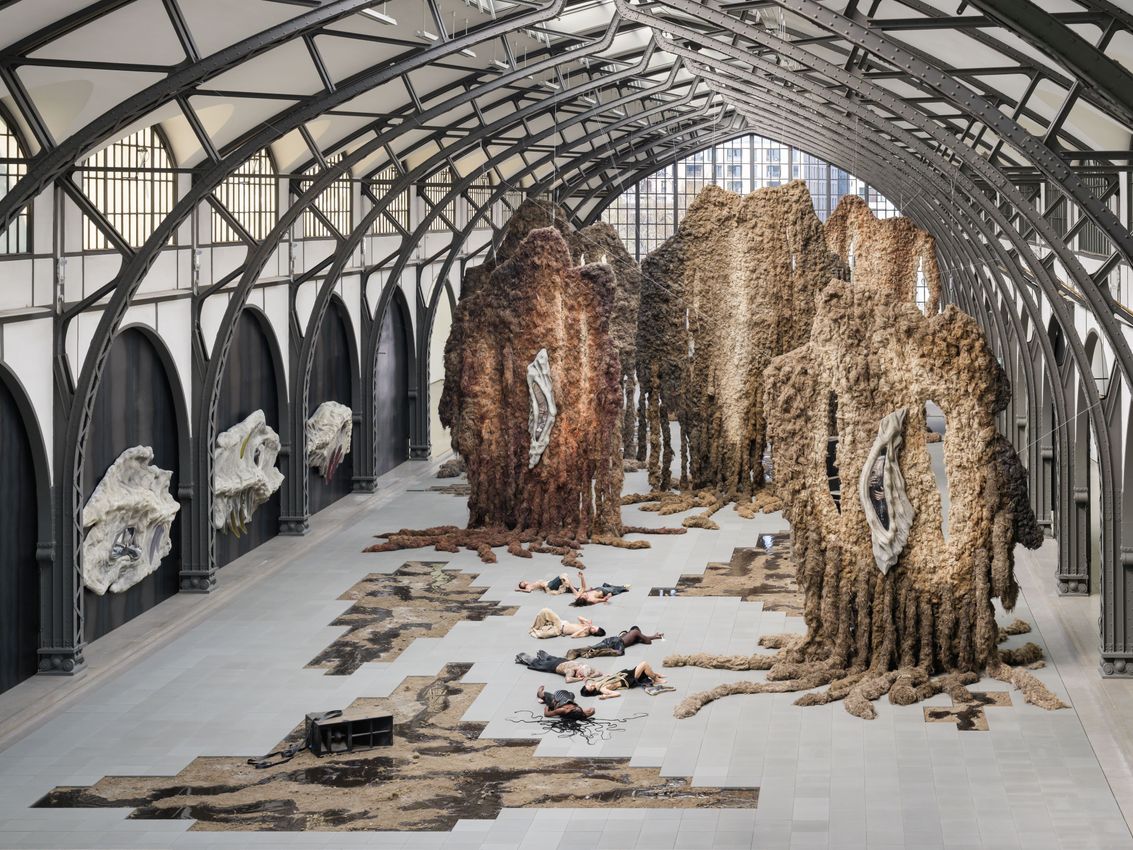
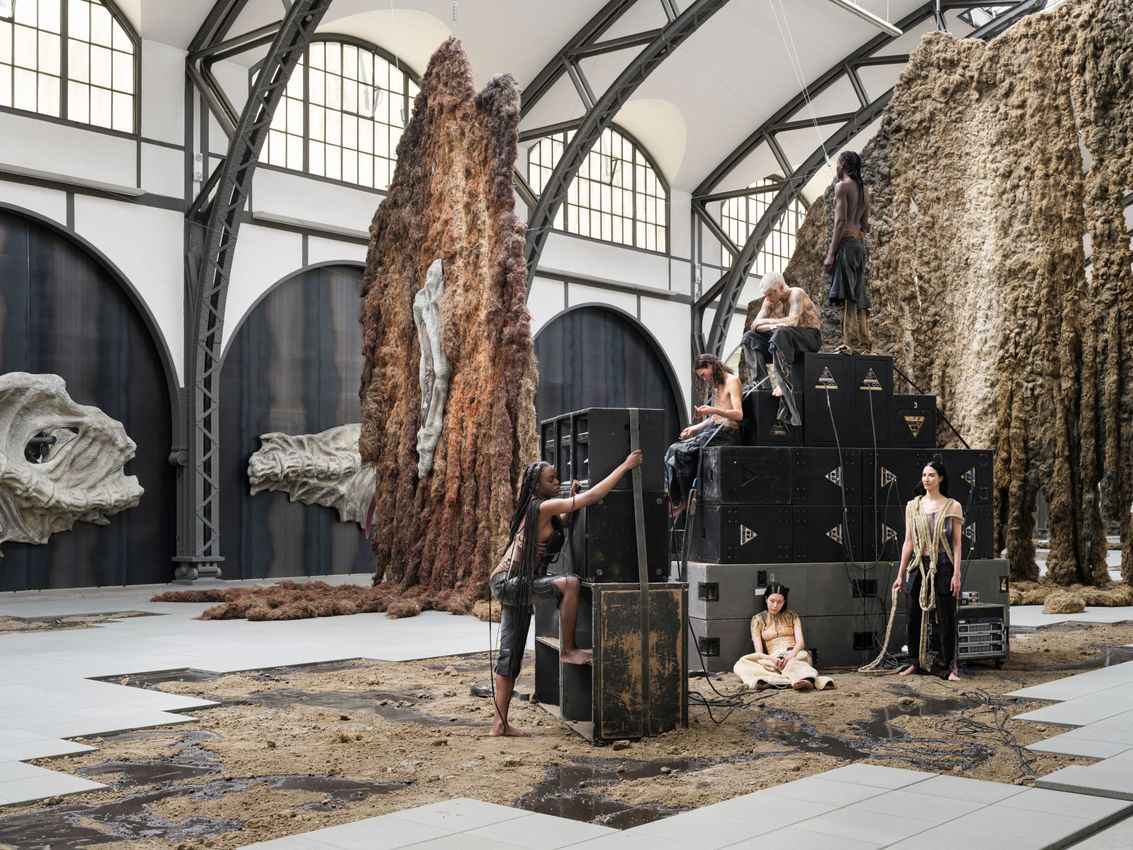
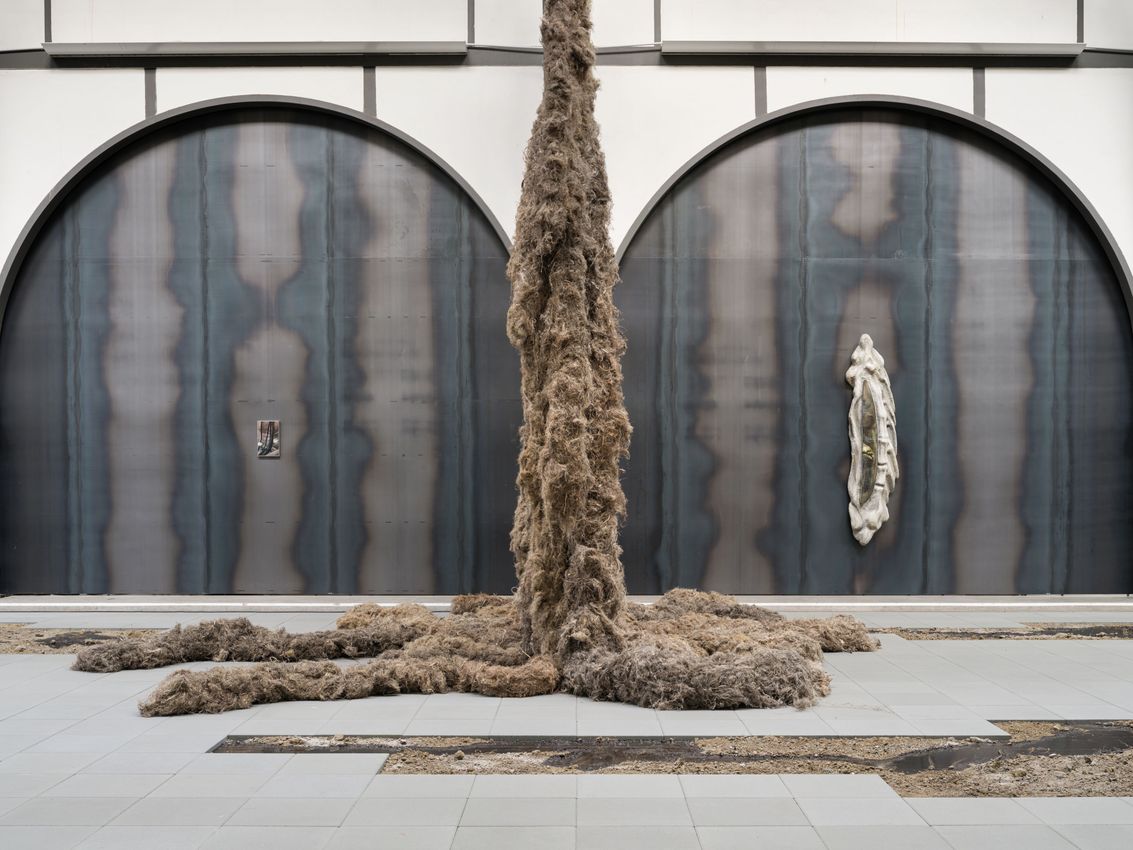
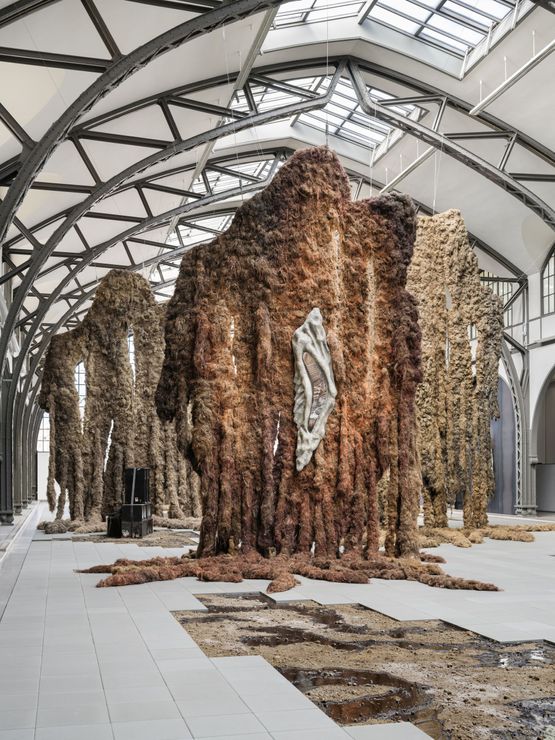
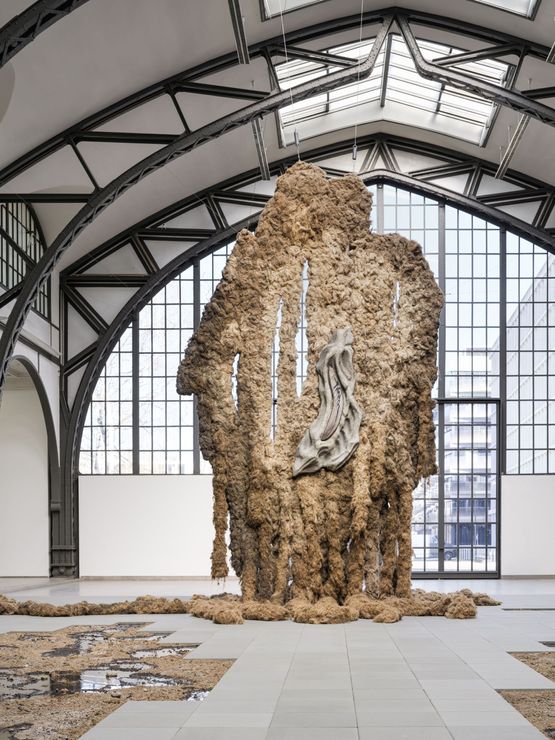
“embrace” in the Historic Hall of the Hamburger Bahnhof is Klára Hosnedlová’s largest expansive sculptural installation to date: nine metre-high flax tapestries with stone reliefs hang above a floor covered with concrete slabs. Speaker towers sourced from Berlin clubs draw visitors deeper into Hosnedlová’s mythical landscape with a sound composition. As visitors make their way past muddy puddles, detailed embroideries of fleeting moments become visible on the fossil-like reliefs. “embrace” combines the organic and inorganic, permanence and decay, handcraft and industrial production. The exhibition marks the start of the annual CHANEL Commission atHamburger Bahnhof.

Klára Hosnedlová (born in 1990 in Uherské Hradiště, Czech Republic; lives in Berlin) works with materials deeply rooted in the regions of pre-sent-day Czech Republic (formerly Bohemia and Moravia). The combination of centuries-old craft traditions, regional folklore, and brutalist architecture unites historical, political, and cultural narratives in expansive installations. Hosnedlová transforms the industrial architecture of the historic hall of the Hamburger Bahnhof into a mythical landscape, opening up a space in which personal childhood memories create a universal language of imagination. “embrace” is made of glass, concrete, flax, hemp, thread, sand, metal, and sound. The materials connect fundamental contrasts such as organic and inorganic, permanence and decay, handcraft and industrial production. The installation shows how landscapes, materials, and cultural practices are constantly changing and reshaping themselves over time.

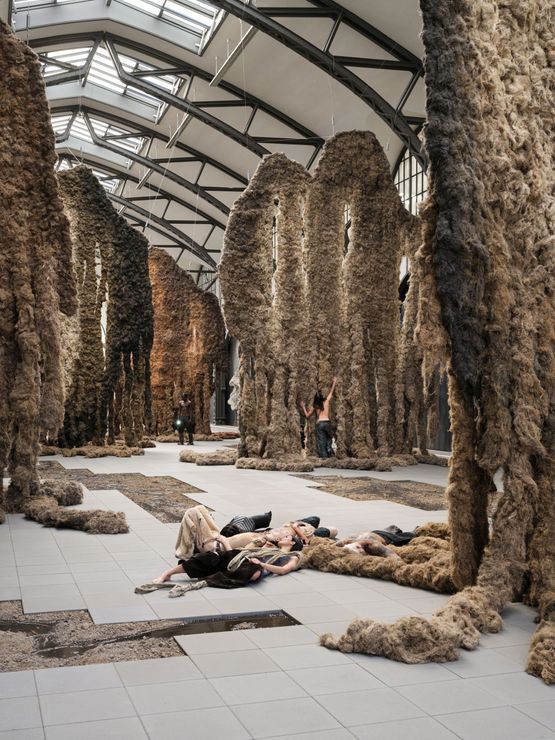
The muted colours, rough textures and branching tendrils of the six tapes-tries are reminiscent of animal skins or creatures from another world. The fabric, made from flax and hemp, was woven by hand and dyed with plant-based dyes. The centuries-old tradition of growing and processing flax and hemp in the Bohemian region of the Czech Republic continued with the advent of industrialisation, with spinning machines and textile factories, but often ended after the Second World War with the import of more productive export crops, often with a colonial background, such as cotton. The artist works with the last remaining flax and hemp processors in the region.

Inside, the tapestries create sheltered zones of peace and security, enveloping the visitors as they walk among them. Three speaker towers are distributed throughout the hall and guide visitors further into the installation with a sound composition: singing by the Lada women’s choir in Mo-ravian micro-dialects, ringing church bells, instrumental passages andCzech lyrics by rapper Yzomandias. The soundtrack was developed byBerlin and Brussels-based composer and performance artist Billy Bultheel. The loudspeakers were sourced from Berlin techno clubs. Dusty, scratched and partially defective, they allude to the theme of decay.

Visitors walk across more than 3,000 square concrete slabs, which remind Hosnedlová of the pavements in her hometown where she played as a child. Nature breaks through the regular surface of the built environment with earth and puddles. The industrial architecture of the hall is reflected in the epoxy puddles. The hard concrete slabs contrast with the hanging, soft flax and hemp sculptures. They refer both to the brutalist concrete architecture of communist Eastern Central Europe in the 1970s and to the urban landscape of Berlin.

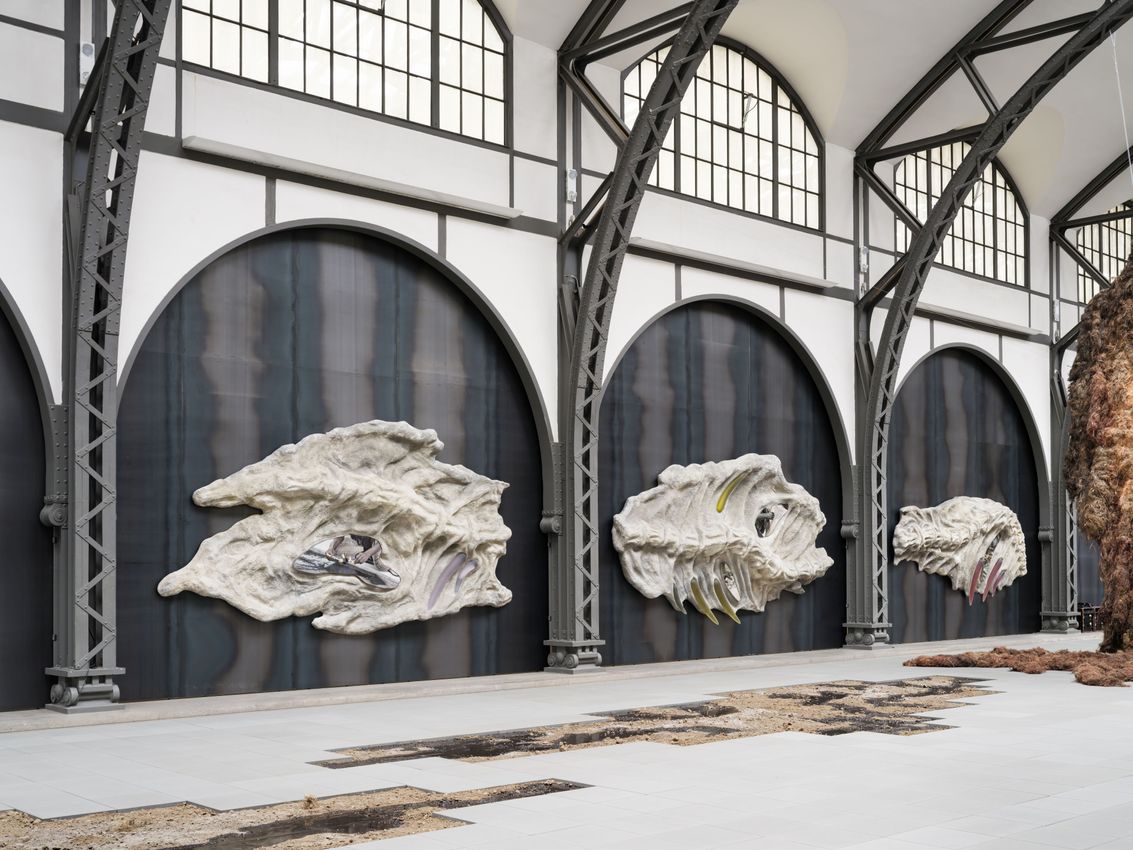
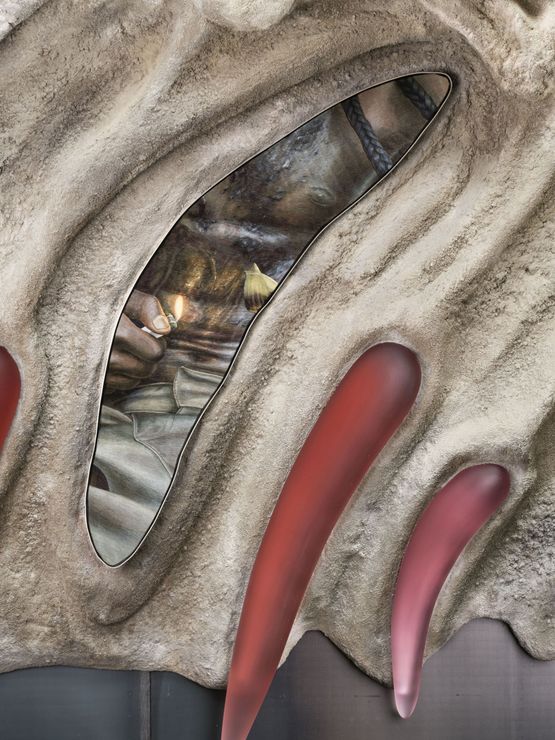
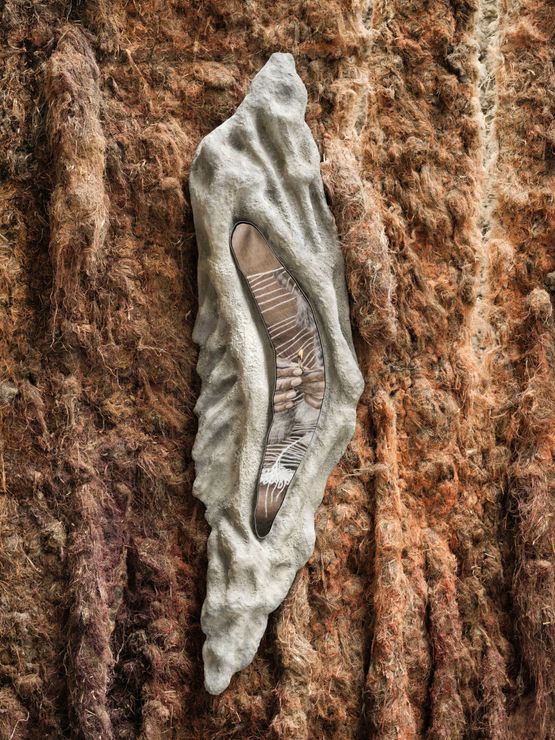
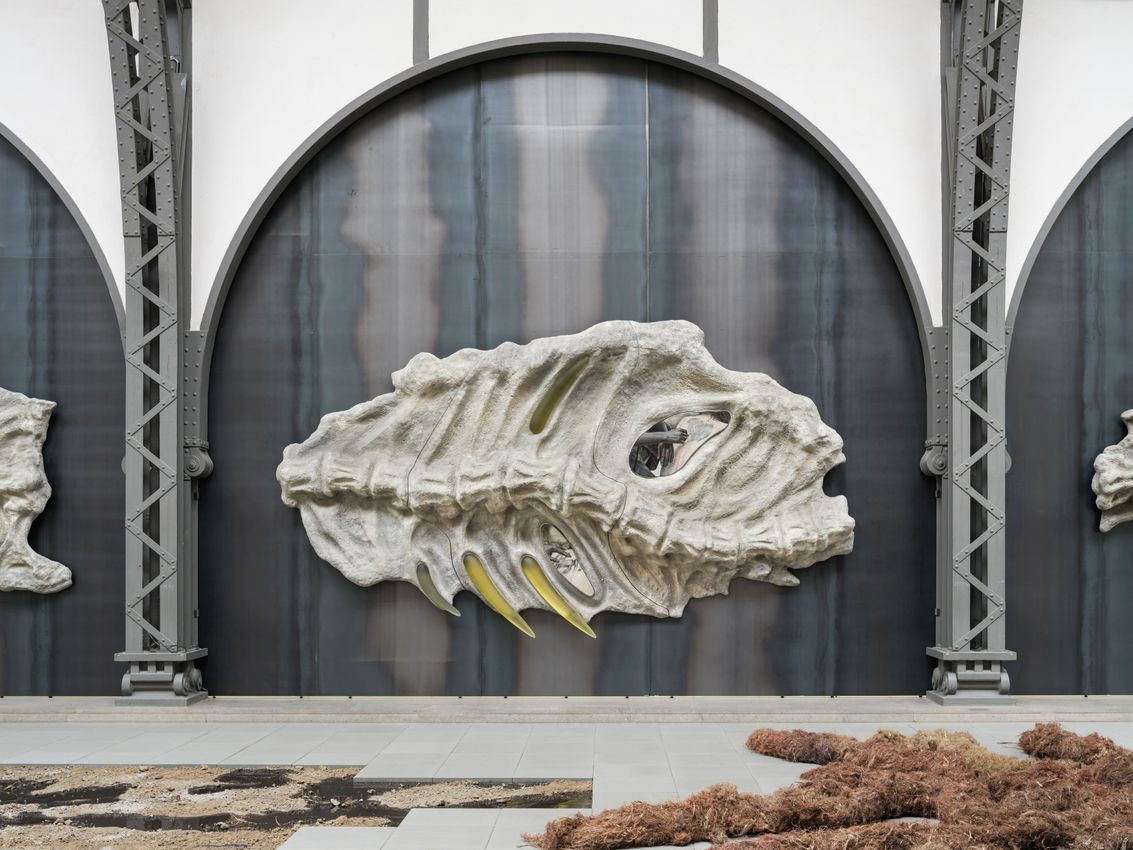
Eight dark metal walls on the long sides of the spacious hall frame the scene. Seven sand-coated reliefs hang on these walls and on the tapes-tries. The textures resemble fossils and refer to Moravia’s prehistoric past. At the same time, they are reminiscent of socialist wall friezes in public buildings in communist Eastern Central Europe. As a child, the artist collected fossils as treasures bearing traces of another world. Elements of coloured, milky glass also protrude sharply from the wall reliefs on the metal walls. The fragile glass and the massive, stone-like sculptures com-bine fragility and strength. To produce the hand-cast glass objects, Hosnedlová works with artisans whose techniques and knowledge have been passed down through generations.

Extremely fine embroidery is incorporated into the reliefs, embroidered images of fleeting moments. They show fragments from performances for the camera that the artist staged and photographed in Berlin and in earlier exhibitions: outstretched fingers, a lighter, a naked back. A performance without an audience, which took place at the Hamburger Bahnhof, serves as the source of images for the artist’s next installation.

An edition of the Hamburger Bahnhof catalogue series, published by Silvana Editoriale Milano (12 euros), will accompany the exhibition.

The exhibition is curated by Sam Bardaouil, Director of the HamburgerBahnhof – Nationalgalerie der Gegenwart, and Anna-Catharina Gebbers,Curator, Hamburger Bahnhof – Nationalgalerie der Gegenwart.

Read More

Installation Views

About the Artist

Klára Hosnedlová (born in 1990 in Uherské Hradiště, Czech Republic; lives in Berlin) works with materials deeply rooted in the regions of pre-sent-day Czech Republic (formerly Bohemia and Moravia). The combination of centuries-old craft traditions, regional folklore, and brutalist architecture unites historical, political, and cultural narratives in expansive installations.

View Artist Profile

Also Exhibiting at Hamburger Bahnhof

About the Gallery
Housed in a former railway station, the Hamburger Bahnhof is the third location of Berlin’s Nationalgalerie. Following extensive renovations the museum was opened in 1996 with a focus on art since 1960. The museum is distinguished by its holdings of seminal 20th Century artists including John Cage, Bill Viola, Peter Campus, Wolf Vostell, Rebecca Horn, Carolee Schneeman, Reinhard Mucha, Marcel Broodthaers, Fritz Rahmann, Hans-Peter Feldmann, Johan Grimonprez and Aernout Mik.

In 2002, the collection was enlarged significantly by the acquisition of Egidio Marzona’s study collection of Conceptual Art and Arte Povera. It is also home to the Joseph Beuys Media Archive. In 2004 the museum was further extended to house the Friedrich Christian Flick collection of contemporary art which includes a large and virtually unique collection of works by Bruce Nauman. The collection is also renowned for its holdings of German painting including works by influential artists such as Gerhard Richter, Sigmar Polke, Georg Baselitz and also younger painters including, Neo Rauch, Daniel Richter and Belgian artist Luc Tuymans.
View Gallery Profile
Address
Invalidenstraße 50-51
Berlin
Germany
Opening Hours
Tuesday – Sunday, 10am – 6pm
Thursday, 10am – 8pm
(1)
Berlin Invalidenstraße 50-51
Hamburger Bahnhof
Invalidenstraße 50-51, Berlin, Germany

Opening hours
Tuesday – Sunday, 10am – 6pm
Thursday, 10am – 8pm
The art world in focus