


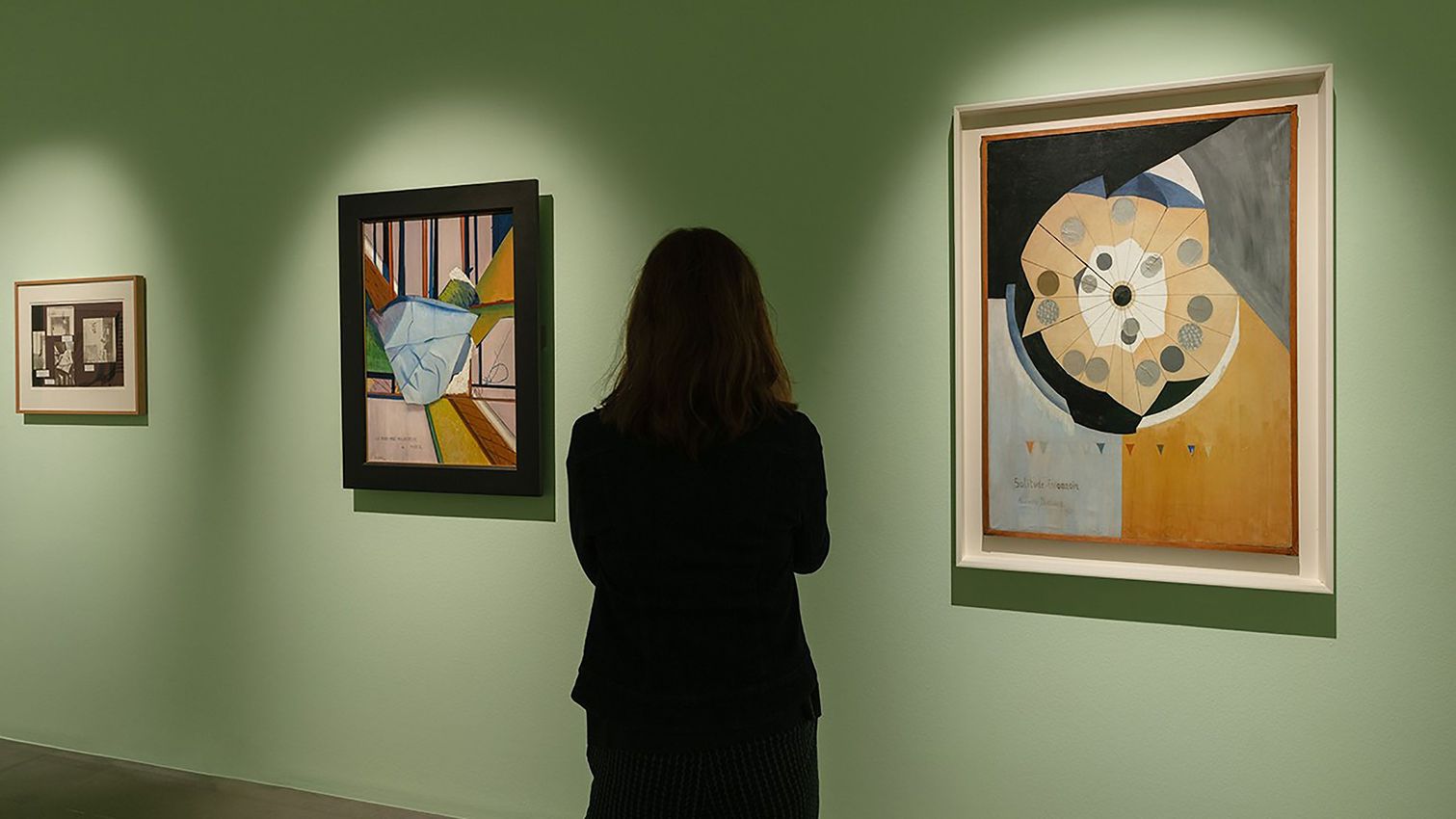
The Dadaist and painter Suzanne Duchamp, sister of Marcel Duchamp, Raymond Duchamp-Villon, and Jacques Villon, was at the forefront of her time and left a lasting impact on art history. For the first time worldwide, Suzanne Duchamp’s work is being presented in a comprehensive retrospective, showcasing all its facets – from her early abstract compositions and Dadaist experiments to the figurative works of her later years.
Suzanne Duchamp (1889, Blainville-Crevon – 1963, Neuilly-sur-Seine) moved at the intersection of painting and wordplay with her art. Her works oscillate between abstraction and figuration, often accompanied by enigmatic titles that evoke new associations. Her friend Katherine S. Dreier described her as a ‘semi-abstract painter’ – an apt characterisation for a body of work that defies art-historical conventions. As part of the Parisian avant-garde, Duchamp explored Cubist fragments of urban landscapes and interiors in her early works before turning to Dadaism. Her pieces merge painting with poetry and experiment with various media and materials. While her painting evolved increasingly towards abstraction in the 1910s, she always maintained visual reference points. In 1922, for reasons unknown, she made an unexpected break with Dada and shifted towards figurative painting, often infused with ironic undertones.
For the first time, the work of Suzanne Duchamp is being presented in a comprehensive retrospective that showcases the full breadth of her artistic output. This includes her Dada works alongside earlier and later creative phases. Thanks to new research, numerous previously unknown or long-overlooked pieces have been rediscovered and are now being presented to the public on this scale for the first time.
With around 50 paintings, 20 works on paper, as well as rare archival materials and vintage photographs, the exhibition presents a wide-ranging overview of Duchamp’s oeuvre. Highlights include rare loans from international museums and private collections, among them the Museum of Modern Art in New York, the Art Institute of Chicago, and the Centre Pompidou in Paris. The retrospective was conceived by guest curator Talia Kwartler in collaboration with Kunsthaus curator Cathérine Hug. It has been realised in close cooperation with the Association Duchamp Villon Crotti and the Schirn Kunsthalle in Frankfurt am Main, where it is being presented under the curatorship of Ingrid Pfeiffer.
The Kunsthaus Zürich is a place for inspiring encounters with art. The Kunsthaus is committed to the freedom of art. It is independent and open to all. The Kunsthaus is a dynamic institution: it proceeds from current issues to shed light on historic developments, and promotes art appreciation through the selection and presentation of artworks and the dissemination of learning about art.

A respected voice in contemporary art discourse.
Focusing on ambitious storytelling and insightful art-world commentary. Ocula Magazine publishes in-depth interviews, critical essays and timely analysis on the artists, exhibitions and ideas driving the global art world.
Learn more about Ocula Magazine
Showcasing the best of the art world.
Ocula partners with galleries from around the world to highlight their artists, artworks and exhibitions. Gallery membership is by application and invitation, with each member vetted by an independent panel.
Learn more about Ocula Membership

Specialises in the sale of major artworks.
Led by a team with deep ties to the world’s leading auction houses, galleries and collectors. Ocula’s advisory team offers bespoke services to high-net-worth clients from around the world who are looking to acquire the best of contemporary and modern art.
Learn more about our team and services