




Press Release

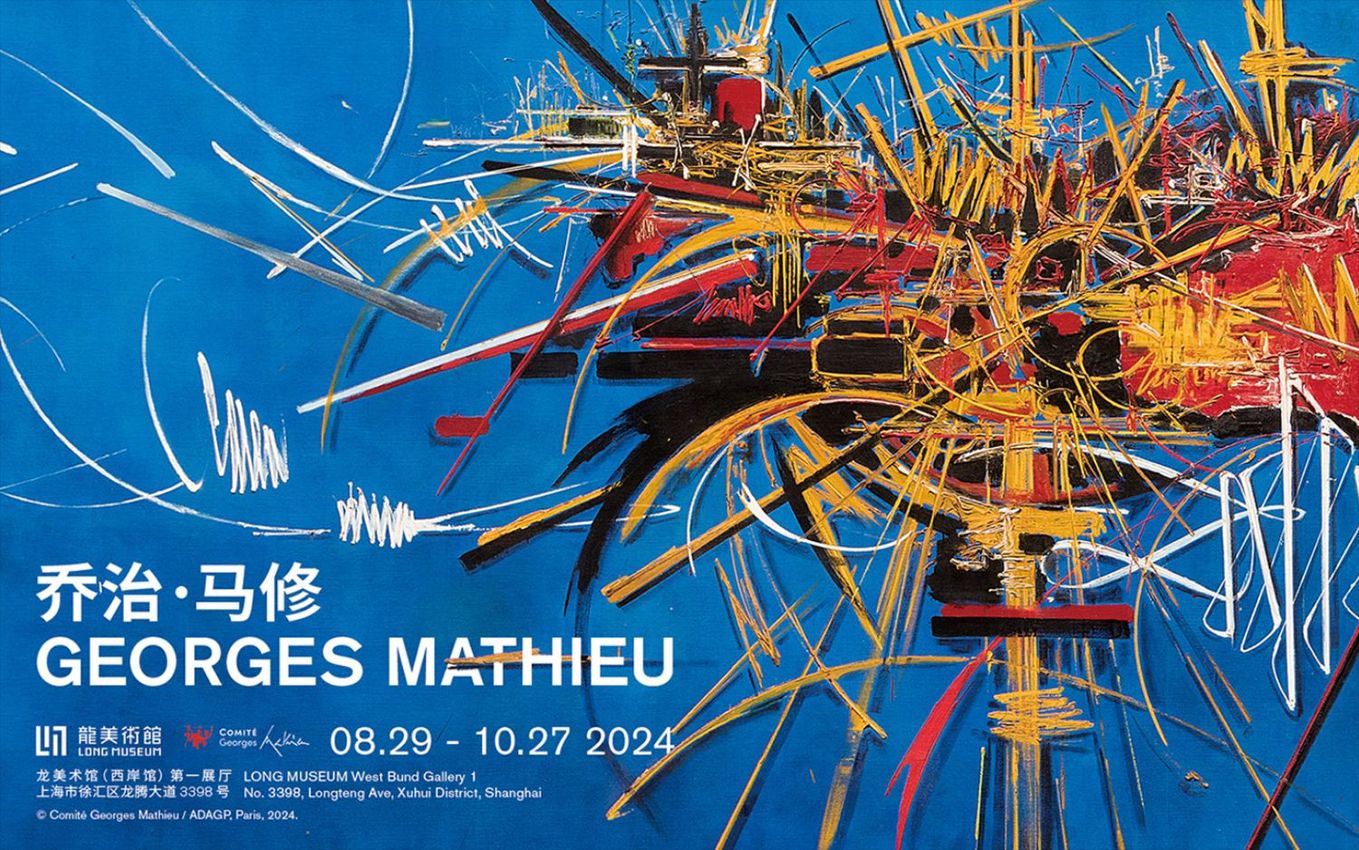
From 29 August to 27 October 2024, Long Museum (West Bund) will host Georges Mathieu’s (1921-2012) first retrospective in China. A key figure in the New School of Paris, Mathieu was one of the most original French painters of his generation, founding Lyrical Abstraction in 1946 and becoming one of its most tireless proponents. He was one of the few European painters who significantly impacted the Abstract Expressionist scene in New York. His now legendary public painting sessions anticipated performance art and, from the 1970s onwards, contributed to the emergence of the urban language of graffiti. On a scale never before seen in Asia, the exhibition will showcase pieces from over four decades of creative activity, offering a unique opportunity to explore Mathieu’s prolific body of work and its vigorous and exhilarating celebration of gesture.

Combining violence and virtuosity, Mathieu’s paintings are instantly recognizable for their calligraphic lyricism and exceptional precision. Despite the speed and spontaneity with which they are executed, every stroke is purposeful.

Mathieu’s abstract grammar, which he developed during the Second World War, merges celebratory fervor with the abyss of disaster. The canvas becomes a projection surface for the energy of this existential struggle, enhanced by the exhilarating effect of speed, which increases the risk involved in his pictorial improvisations. Mathieu’s heroic painting reflects the contradictions and upheavals of its age: the anguish and trauma of war, oppression and compromise, material and moral destruction, as well as the spirit of revolt and the desire to triumph and regain freedom.

The exhibition shows the perpetual antagonism between creation and destruction that defines the monumental works. The painter began creating these large-scale frescoes, measuring between four and nine meters, as early as 1952. The conciliatory reds and yellows of La nécessité de l’espérance contrast with the brutal black and red splashes of L’écartèlement de François Ravaillac, assassin du roi de France Henri IV, le 27 mai 1610, à Paris en place de Grève. The titles – at times sonorous, enigmatic names, at times references to heroic or tragic historical events – place the works in a suggestive mythology. They evoke a past imagination, setting up the painting as an abstract place of drama, a battlefield for the individual in the face of destiny.

This deliberate theatricality culminated in numerous public interventions, veritable tours de force that have gone down in art history as performances avant la lettre. In 1956, Mathieu used eight hundred tubes of paint and a rolling ladder to create a twelve-by-four-meter work at the Théâtre Sarah Bernhardt in Paris.

A year later, he produced twenty-one paintings and a fifteen-meter-long fresco on paper in just three days in Tokyo. In Osaka, he executes six paintings, including Hommage au general Hideyoshi measuring six meters long. The famous images show the artist dressed in a yukata and wearing a hachimaki, painting before a rapt public. They attest to his complete physical dedication to his work, true to his motto: “I am my painting.” Mathieu grew up in various towns in Northern France and Versailles and studied English at the University of Lille. He began experimenting with painting at the age of twenty-one, turning to abstraction in 1944, the same year he was hired as an interpreter for the American Army.

In Paris, he met Wols, Camille Bryen, and Hans Hartung, who became allies in his fierce opposition to geometric abstraction. Despite their different styles, they were all committed to one of the era’s fundamental artistic premises: the rejection of representation and the desire to break free from traditional constraints to assert a new-found freedom, embracing color, impulsive graphic lines, spontaneous pictorial writing, and raw materials. Unlike the haute-pâtes of Jean Fautrier or the earthy iconoclasm of Jean Dubuffet, the sensuality of Mathieu’s works relies more on the body’s gesturality, on dynamic, incisive graphics created with long brushes or by directly applying paint with tubes, fingers or cloth, on mostly plain backgrounds.

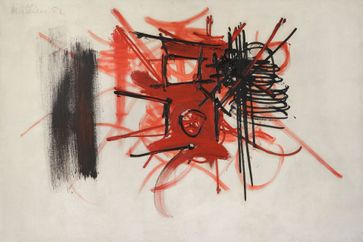
While Jackson Pollock used lacquer or enamel to increase fluidity, the French painter diluted some of his paintings with petrol, producing watercolor-like drips and effects interspersed with opaque agglomerated colors. For Mathieu, painting is rhythm, akin to musical improvisation. Some of his paintings from the 1950s and 1960s juxtapose carnal opulence with radical minimalism, a visual language of Zen-like purity. Based on contrasting harmonies of red, white, and black, works such as Hommage à Louis IX (1957), on display at the Long Museum, reveal Mathieu’s early interest in Far Eastern calligraphy.

Yet, the painter insisted on the autonomy of the sign, detached from any pre-established meaning, corresponding to the Signifiants de l’informel he promoted together with his friend Michel Tapié in an eponymous 1952 group exhibition in Paris. This period saw the rise of structuralism, influenced by Swiss linguist Ferdinand de Saussure’s theory of the sign, which Mathieu likely encountered during his studies. Saussure had identified the arbitrary nature of the linguistic sign, consisting of a signifier, its form, and a signified, the corresponding semantic value or content.

In the realm of painting, a similar dissociation seemed possible, a tangible pre-language has emerged, the form has been released into visual signifiers, liberated from the burden of referencing reality, symbolism, and meaning. Maurice Merleau-Ponty’s Phenomenology of Perception, published in Paris in 1945, also significantly impacted artistic circles, particularly abstract artists. Breaking with positivism, the French philosopher emphasized the importance of “the experience of seeing,” defining perception as the operation of an “open and indefinite power to signify,” which in human life becomes “a vector of freedom.”

For Mathieu and his Parisian peers, the Tachist movement and the promotion of the Art autre reflected this concrete search for a profoundly individual and free expression, what philosopher Roland Barthes, in his eponymous work from 1953, called Writing Degree Zero, represented by the tache in painting and the word in literature. Quickly noticed by French and then American critics, Mathieu established himself as one of the most daring painters, praised for his sensuality and textural richness.

Like Pollock or De Kooning, he helped create an emancipated style of painting that no longer referred to a subject outside itself, outside its own materiality. From 1954, he was under contract to Samuel Kootz and, alongside Pierre Soulages, one of the few European painters whose works were shown alongside those of Robert Motherwell, Adolph Gottlieb, and Hans Hofmann, all represented by the same gallery. With the Abstract Expressionists, Mathieu shared the heroic approach to the act of painting, transforming the canvas into an arena where the body acts and spends itself, inspiring the American critic Harold Rosenberg to coin the term “action painting.”

However, unlike the excess of the American all-overs, Mathieu focused on a concentrated gesture crystallized at the center of each work. In 1954, The New York Times described this as “calligraphy on a grand scale,” conveying “that elegance one associates with the Paris object.” Thanks to his perfect command of the English language and his professional connections as head of public relations for an American steamship company, Mathieu became a pioneer of transatlantic artistic dialogue, bringing together artists from New York and Paris in now-legendary exhibitions.

In 1951, Véhémences confrontées at Galerie Nina Dausset introduced Pollock and De Kooning to France, showing them alongside works by Bryen, Hartung, Riopelle, and Mathieu himself. The following year, he had his first solo exhibition at Alexander Iolas Gallery in New York. Since 1953, his works are included in prestigious collections, such as the Solomon Guggenheim Foundation, the Art Institute of Chicago, and the Museum of Modern Art in Rio de Janeiro.

Read More
About the Artist

Georges Mathieu was born in Boulogne-sur-Mer, France, in 1921. A self-taught painter, he began his artistic career in 1942. Mathieu’s early abstract investigation consisted of amorphous shapes and experimentation with drip techniques. In 1947 he resettled in Paris, and quickly became attracted to the works of artists such as Camille Bryen and Alfred Otto Wolfgang Schulze, which he referred to as Lyrical Abstraction. Within his first year in Paris he had organized L’imaginaire at Galerie du Luxembourg to promote the Lyrical Abstraction movement. Mathieu’s own works were closely associated with Tachiste painters (from the French tache, meaning blot or stain), often squeezing paint directly onto the canvas and emphasizing the necessity of rapid execution to harness intuitive expression. He identified his work as aligned with abstract history painting, as many of his titles refer to events in French history. Mathieu’s artistic experimentation expanded into performance art, often executing large canvases before an audience.

View Artist Profile Georges Mathieu contemporary artist
About the Gallery

Founded by Chinese couple collectors, Mr. Liu Yiqian and his wife, Ms. Wang Wei, the Long Museum owns two huge places for exhibition and related functions: Long Museum Pudong and Long Museum West Bund. Located respectively in Pudong New Area and Binjiang, Xuhui District, they constitute a unique ecosystem of art in Shanghai: “One City, Two Museums.” As the largest private institution of collection in China, the Long Museum boasts of the richest collection nationwide.

View Gallery Profile
Address
3398 Longteng Avenue
Xuhui District
Shanghai
China
Opening Hours
Tuesday – Thursday
10am – 6pm

Friday – Sunday
10am – 8:30

Closed Monday
(1)
Shanghai 3398 Longteng Avenue, Xuhui District
Long Museum West Bund
3398 Longteng Avenue, Xuhui District, Shanghai, China

Opening hours
Tuesday – Thursday
10am – 6pm

Friday – Sunday
10am – 8:30

Closed Monday
The art world in focus
