

The art world in focus
Subscribe to our newsletter for news and insights on artists, galleries and exhibitions.

Le Large – Centre d’art de la Pointe des Arts – Île Seguin. © RCR Arquitectes et CALQ. Photo: Nicolas Trouillard.
More than three decades after Renault stopped making cars on Île Seguin, and following unrealised projects backed by collector François Pinault and art dealer Yves Bouvier, a contemporary art centre has opened on the former factory island west of Paris.
Led by property developer and collector Laurent Dumas, founder of Emerige, Large occupies a 5,000-square-metre building designed by RCR Arquitectes with French practice CALQ. It forms part of the €450 million Pointe des Arts development, alongside a hotel, an eight-screen Pathé cinema, offices, shops and restaurants.
In a statement, Dumas described the space as “an invitation to set sail, to shift our perspectives, and to broaden our horizons”. He continued: “Because art transforms our ways of seeing and understanding the world, it is essential that we share and transmit it.
“Through an interplay of light, materials and circulation, Large proposes a sensory experience where spaces accompany visitors and works alike in a single movement. Open, living, accessible to all, Large will bring about new encounters between artists, artworks and audiences.”
The opening follows decades of contested plans to reinvent this former stronghold of industrial labour and trade union activism. Pinault abandoned his proposed Tadao Ando-designed museum in 2005, taking his collection to Venice.
Bouvier subsequently backed R4, a Jean Nouvel-designed complex combining exhibition spaces, galleries, studios and art storage. His holding company sold its stake to Emerige and financial partner AOG in 2016.
In a statement, Georges Siffredi, president of the Hauts-de-Seine Département, which incorporates Île Seguin, acknowledged that some have described the site as “difficult, or even… ‘cursed’”. However, he added: “The communities of the Hauts-de-Seine can be proud of Le Large: it now belongs to them.”
The wider Pointe des Arts development has also faced organised and legal opposition, centred around environmental concerns, building density, and the commercialisation of a historic industrial site.
In 2023, six local and environmental groups won revisions to a separate scheme for the island’s central section, reducing the number and height of buildings and enlarging the planned park. The association of former workers of Renault-Billancourt Ile Seguin (ATRIS) has also campaigned for a permanent space dedicated to workers’ memory.
Pierre-Christophe Baguet, Mayor of Boulogne-Billancourt, where Le Large is located, said in his own statement that the project represents “a great victory over ignorance and prevailing selfishness”. He continued: “In the face of trials and tribulations, the project called for a great deal of perseverance.
“Over the course of almost 20 years, many succumbed to fatalism and discouragement, and gave up on the site. Others sought to derail the project rather than to see it succeed.”
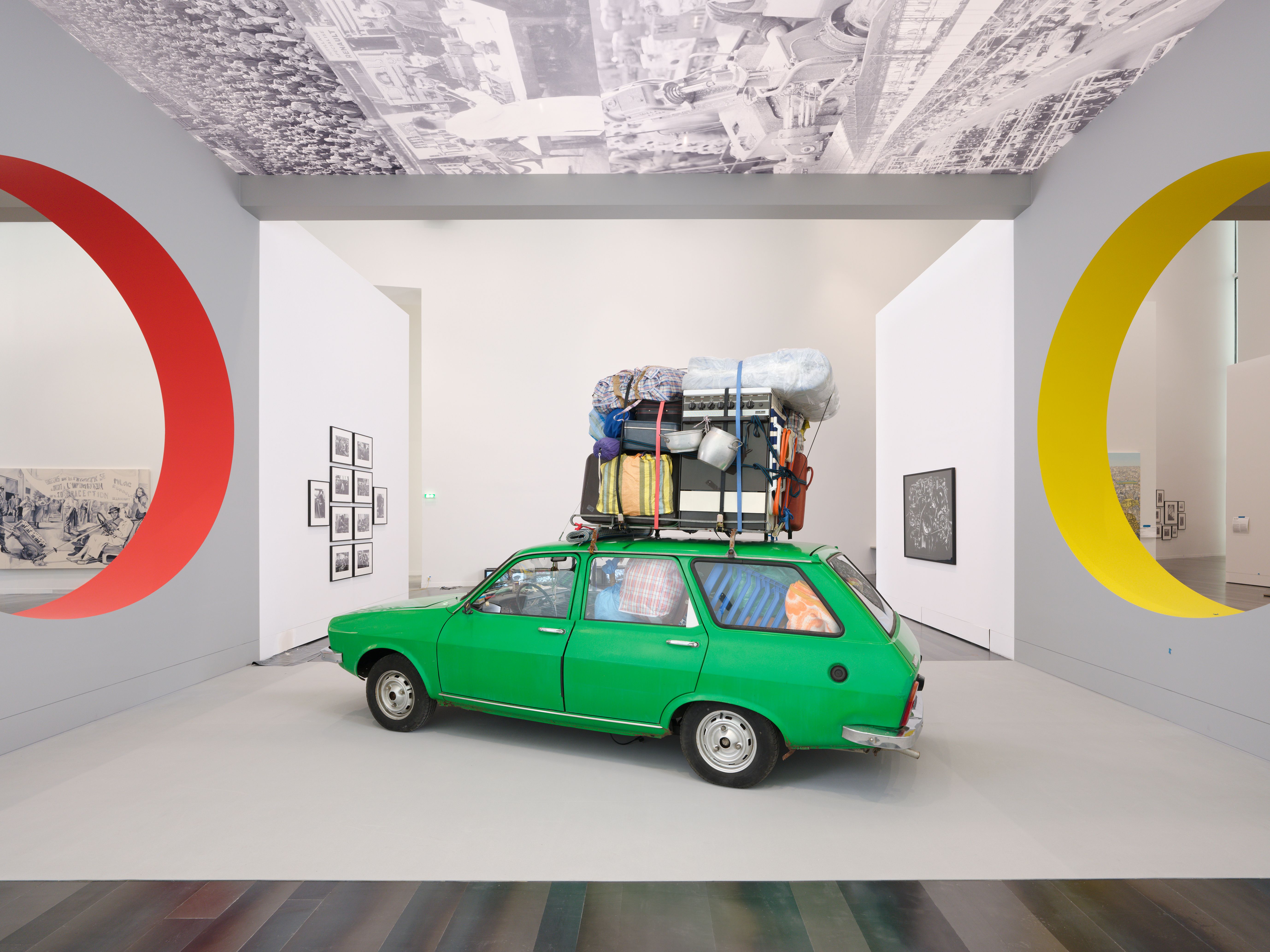
Directed by former La Maison Rouge director Paula Aisemberg, Large will operate without a permanent collection, inviting guest curators and commissioning work, with a focus on artists living and working in France. Its inaugural exhibition, curated by Cecilia Alemani, revisits the island’s industrial history, pairing works from Renault’s collection with new commissions exploring workers’ lives, family memories and the automobile.
Alemani’s Imaginary Engine, on view until 7 March 2027, brings together more than 100 works by 55 artists, including 50 pieces from Renault’s collection and 17 new commissions. It revisits the company’s late-1960s “Recherche, Art et Industrie” programme, which gave artists including Arman, Jean Dubuffet and Jean Tinguely access to factory materials, facilities and workers’ expertise.
Many new commissions explore Renault’s place in working lives and family histories, from factory labour to cars passed between generations. Working with former employees, Bertille Bak explores la perruque: objects workers secretly made for themselves using workshop materials, offering a counterpoint to Renault’s sanctioned artistic collaborations.
Meanwhile Clément Cogitore draws on archival images of women knitting among machinery during a 1947 Renault strike, an activity Alemani has described as “an intimate gesture of refusal, rather than a heroic image of struggle”.
However, former Renault employee Emmanuelle Dupuy, a member of ATRIS, said the exhibition leaves a longstanding demand for a permanent memorial space unanswered. She told AFP that she wanted a “permanent place of living memory”, noting that the opening exhibition would not last indefinitely.
The exhibition brings workers’ histories into an ongoing redevelopment. While Large and the performing arts centre La Seine Musicale now anchor opposite ends of Île Seguin, a planned office complex by Bouygues Immobilier and BIG remains incomplete.
A respected voice in contemporary art discourse.
Focusing on ambitious storytelling and insightful art-world commentary. Ocula Magazine publishes in-depth interviews, critical essays and timely analysis on the artists, exhibitions and ideas driving the global art world.
Learn more about Ocula Magazine
Showcasing the best of the art world.
Ocula partners with galleries from around the world to highlight their artists, artworks and exhibitions. Gallery membership is by application and invitation, with each member vetted by an independent panel.
Learn more about Ocula Membership
Specialises in the sale of major artworks.
Led by a team with deep ties to the world’s leading auction houses, galleries and collectors. Ocula’s advisory team offers bespoke services to high-net-worth clients from around the world who are looking to acquire the best of contemporary and modern art.
Learn more about our team and services


