

The art world in focus
Subscribe to our newsletter for news and insights on artists, galleries and exhibitions.
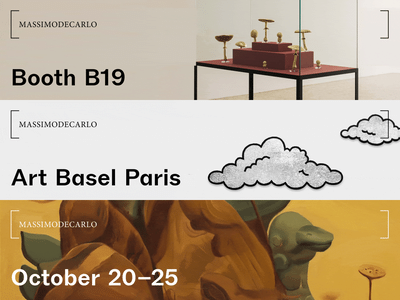

Choi Goeun, Airlock (2024). Stainless steel, pipes, wood. Dimensions variable. Commissioned by the 7th Changwon Sculpture Biennale 2024. Photo: studio SUJIKSUPYUNG (Cheolki Hong). Courtesy Changwon Cultural Foundation · The 7th Changwon Sculpture Biennale 2024.
Korea’s only sculpture biennale opened in the industrial port city of Changwon on Friday with 86 artists and collectives from 16 countries.
The 7th Changwon Sculpture Biennale (27 September–10 November 2024) derives its title, silent apple, from Korean poet Kim Hyesoon’s poem A Well-Ripened Apple: ‘Each time, an apple, as large as my hometown I returned to, / Peels away without a sound’. Artistic director Hyun Seewon, an independent curator and co-director of AVP Lab in Seoul, adopted the line as an entry point into the exploration of the sculptural form, its making and movement, as well as the layered and interlocking spheres of labour, industry, and women workers.
Labour is an inseparable part of Changwon’s history. This old port town began to thrive as an industrial city making machines in the 1970s and is now a major manufacturing site for the defence and chemicals industries. In 2010, it merged with nearby Masan and Jinhae, becoming an even more important industrial centre in Korea.
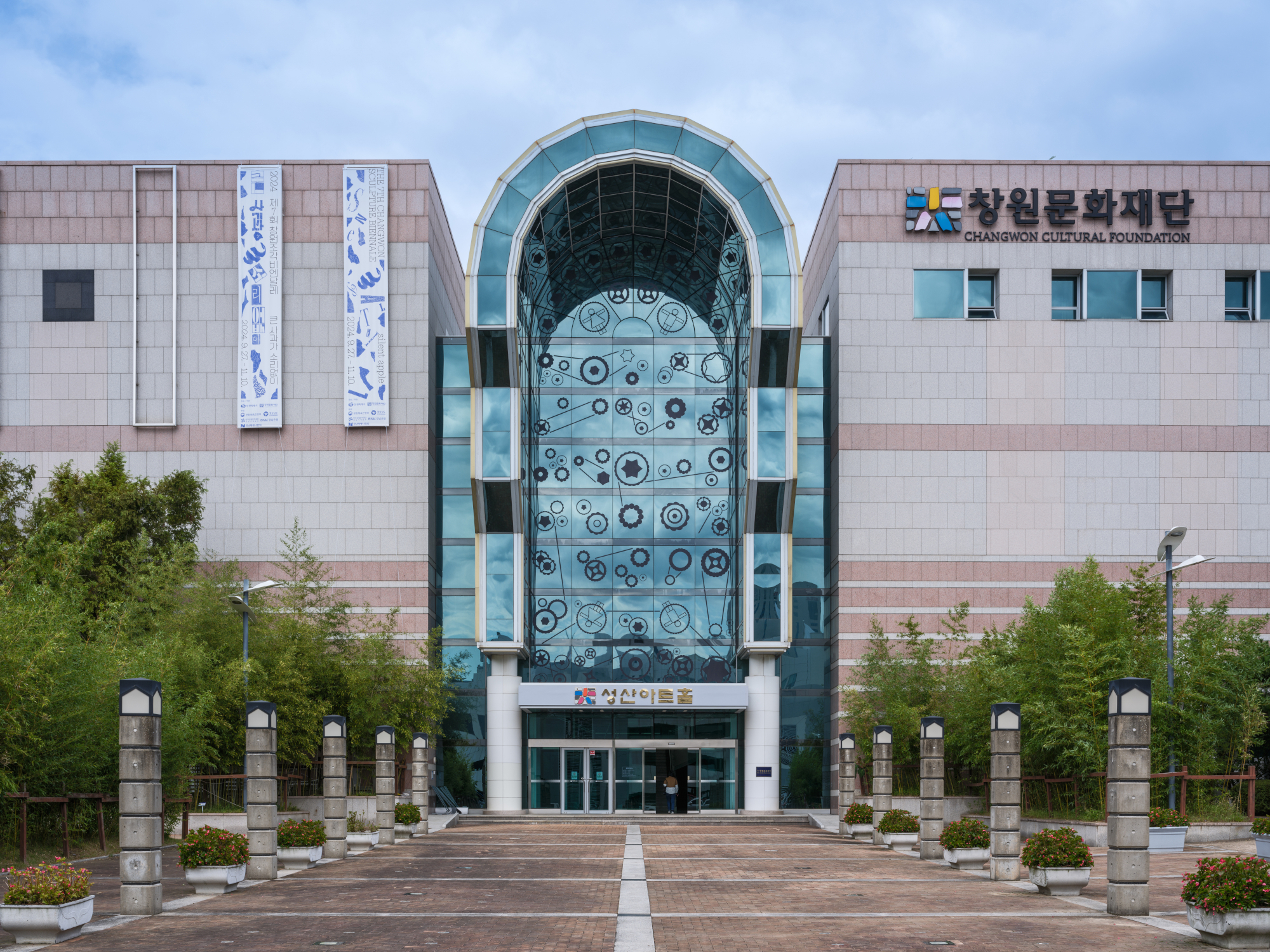
Hong Seung Hye acknowledges the proximity of everyday life and industrial labour in Changwon with Modern Times (2024), a vinyl sticker work on the glass facade of Seongsan Art Hall, the biennial’s main exhibition space. Hong’s flat cogwheels in a rhythmic composition transform the building into a monumental sculpture.
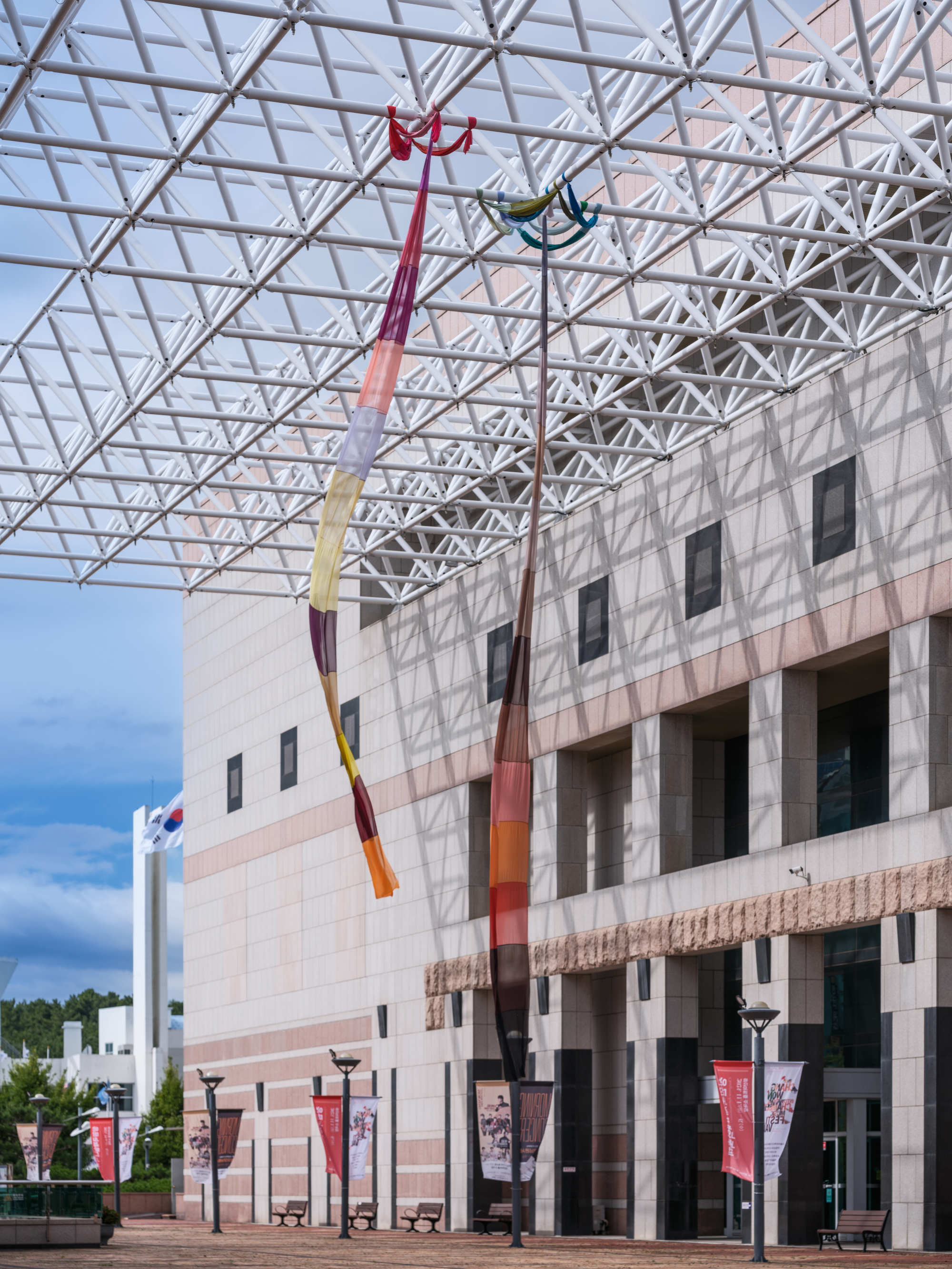
Suspended from an outdoor lattice structure and between the columns inside, Mette Winckelmann’s textile installation Emotions are my Power (2024) consists of colours that the artist encountered in Changwon. When standing near the installation, recordings of a sewing machine at work can be heard.
The labour of creating physical objects—whether sculptures or food—is considered in the basement, where Luo Jr Shin presents slabs of fired sewage sludge and volcanic clay under the purple light that seeps into the Art Hall’s former kitchen from holes in the ceiling (Tomato Seeds Pass Through the Body and Germinate, 2024).
References to the physical form and its production continue in adjacent rooms, which house works such as Shim Jung-soo’s A Buddhist Dance (2003), an angular, sculptural abstraction of traditional clothing worn by Buddhist monks, and Nara Park’s baked fragments of the human body in Kneaded Reflections (2023), which was inspired by the artist’s changing body when she was pregnant.
Several two-dimensional and moving image works feature in the biennial, a decision Hyeon reached based on their treatment of space and movement. Hwayeon Nam’s single-channel video Relentless Enthusiasm (2024), for example, shows a close-up of hands dissecting grapes and pomegranates in an intent manner that emphasises the tactility and sculptural forms of the fruits. Interwoven with the footage are views of machines grinding, pulverising, and combining food waste into one—a sequence that quickly grows hard to stomach.
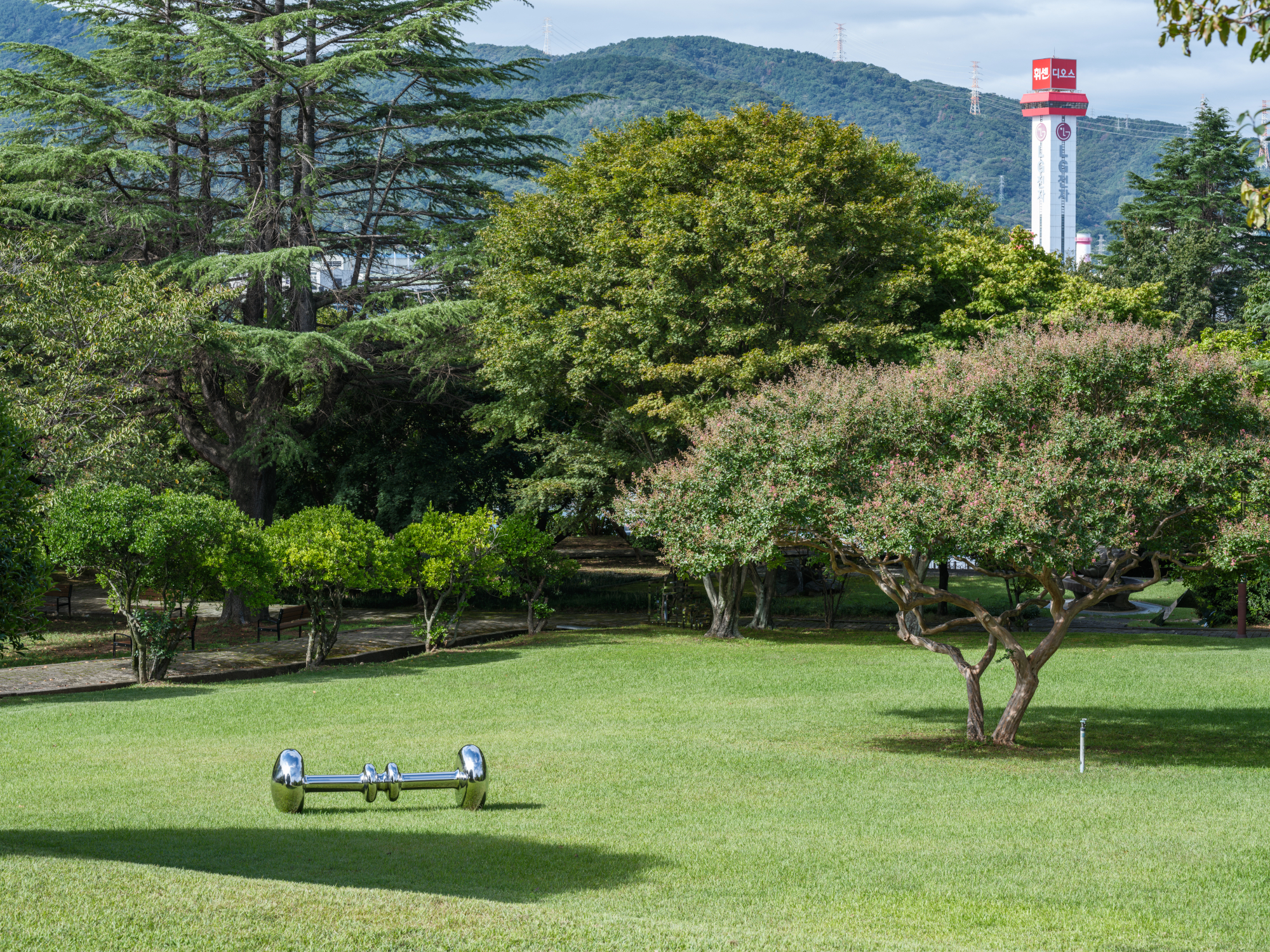
Artists’ responses to domestic labour and food consumption foreshadow the second venue of the biennial, Seongsan Shell Mound, the fifth century BC midden famous for its plentiful remains of mollusc shells discarded by prehistoric people. The site occupies a unique seat in Changwon, having been surrounded by agricultural and industrial facilities built in the early 1970s.
Featuring outdoor works by Park Sukwon and Micaela Benedicto, and Choi Goen‘s large-scale spring lodged between the columns of the museum terrace, Seongsan Shell Mound is an unusual site for contemporary sculptures. Hyeon thinks it is an unusual location in general.
‘I’ve heard that for local residents here, this is a place you visit once on a field trip as children and never return,’ Hyun said. ‘I hope the biennial will encourage them to come back.’
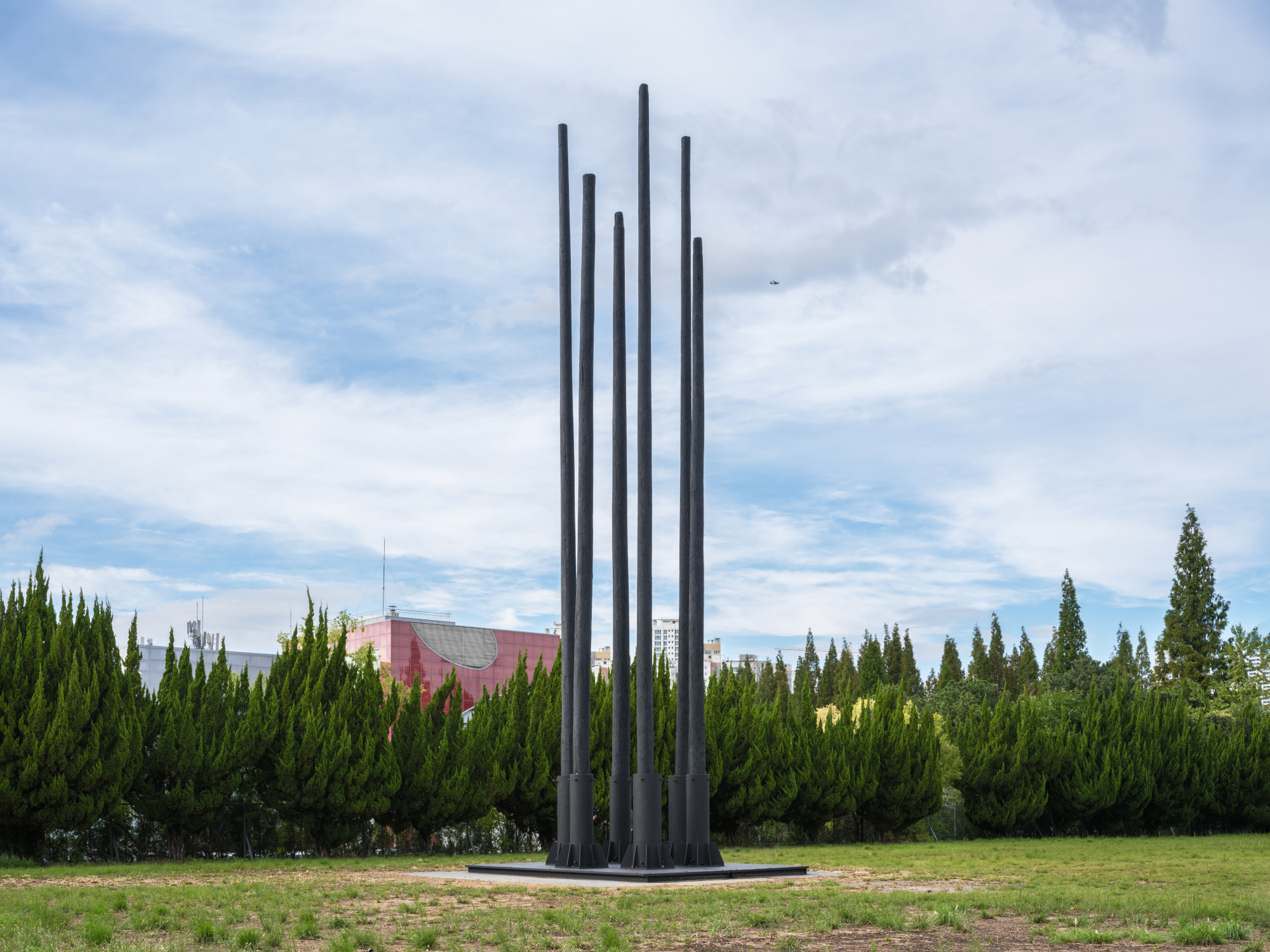
Changwon Sculpture Biennale has previously shown works in popular spots in Changwon, including the island Dotseom and Yongji Park. Like Seongsan Shell Mound, Changwon Cultural Complex Dongnam Ground is a historic but less visited site in the city—originally built for factory workers to hold sports events and wedding ceremonies in 1980, the Ground was left mostly unused in recent years. During the biennial, it presents sculptures by Cho Jeonhwan, Eusung Lee, Hwayeon Nam, Tangerine Collective, and Chung Hyun, whose Wooden Telegraph Pole (2006) has led an itinerant life, comprising wooden poles that were first made in Changwon then moved to Gwacheon and Ansan before their temporary return to the city.
The final venue is ChangwonCity Masan MoonShin Art Museum, in itself a work of art designed and built by Moon Shin. First opened in 1994 as Moon Shin Art Museum, it was donated to the city following the sculptor’s death in 2003.
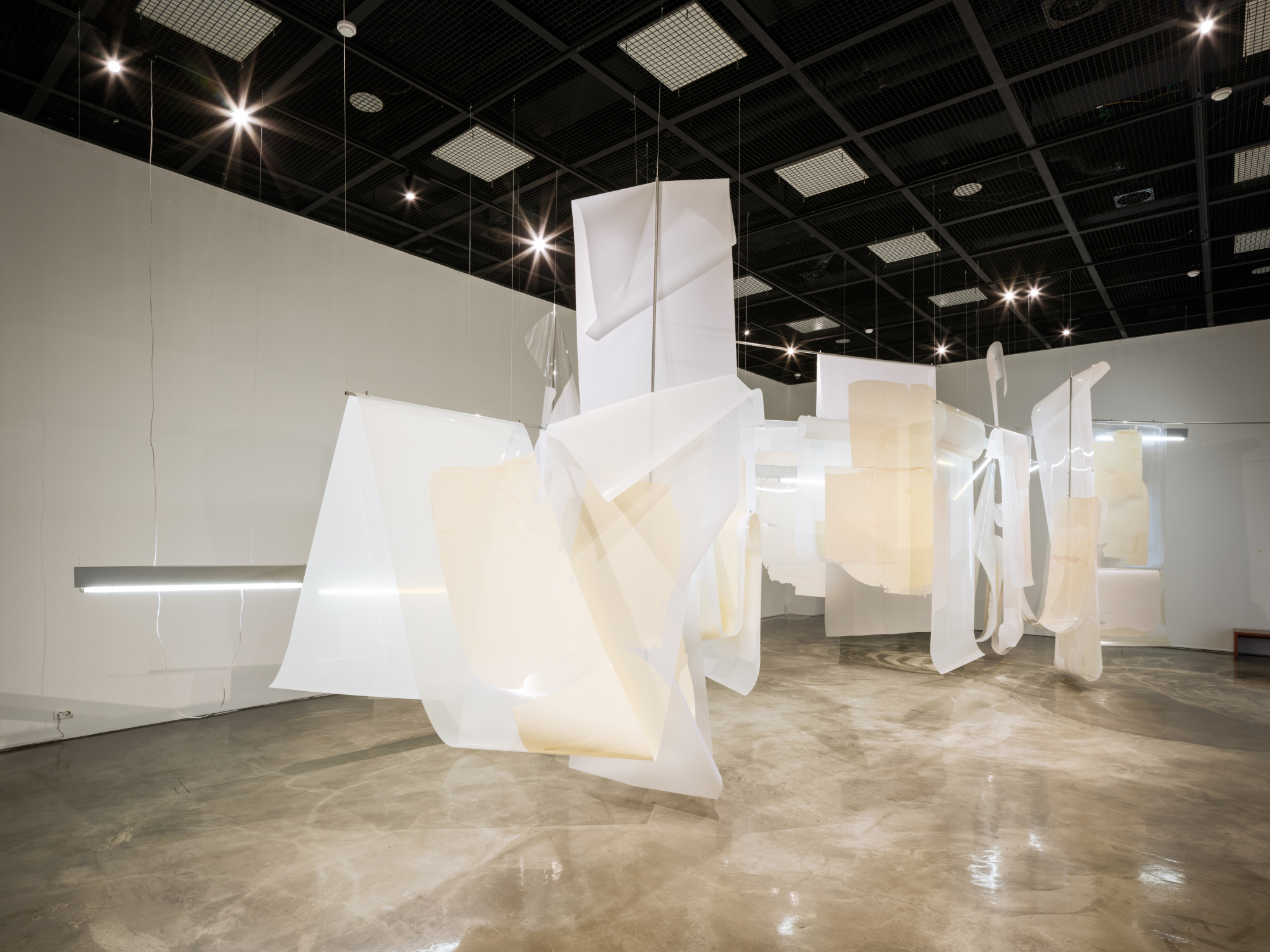
In addition to Gwon Osang and Seoyoung Chung‘s works, the museum is showing Chris Ro’s The Recurring, Prophetic, Lucid Dreams of a Sleeping City That Never Sleeps (2024), a room installation of screen-printed and painted sheets of fabric and vinyl that attempt to capture the negative, in-between spaces in the city.
On the day before the opening, Ro shared his first impression of Changwon—a ‘sleepy city’ that is different from other metropolises. There’s definitely a slower rhythm compared to bigger cities like Busan and Seoul, one that oscillates between intervals of quiet and motion depending on when the factories are in operation. silent apple punctuates these moments with an evolving understanding of sculpture—soft and hard, structural and flat, static and moving—uncovering the physical dimensions of a space and the local stories within. —[O]


A respected voice in contemporary art discourse.
Focusing on ambitious storytelling and insightful art-world commentary. Ocula Magazine publishes in-depth interviews, critical essays and timely analysis on the artists, exhibitions and ideas driving the global art world.
Learn more about Ocula Magazine
Showcasing the best of the art world.
Ocula partners with galleries from around the world to highlight their artists, artworks and exhibitions. Gallery membership is by application and invitation, with each member vetted by an independent panel.
Learn more about Ocula Membership
Specialises in the sale of major artworks.
Led by a team with deep ties to the world’s leading auction houses, galleries and collectors. Ocula’s advisory team offers bespoke services to high-net-worth clients from around the world who are looking to acquire the best of contemporary and modern art.
Learn more about our team and services