





The art world in focus
Subscribe to our newsletter for news and insights on artists, galleries and exhibitions.
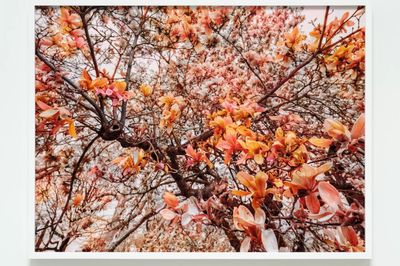
Trevor Paglen, Bloom (#a4826d) (2022). Dye sublimation print. 49.5 x 66 cm. Courtesy Pace Gallery.
William H. Orrick, a judge for the Northern District of California, has dismissed a number of arguments brought against four companies in a case with major implications for artists.
Ten artists have filed a putative class action suit against defendants Stability AI, Midjourney, DeviantArt, and Runway AI.
The complaint centres on the allegation that—by using the LAION training sets, which allegedly scraped some five billion images from the internet—Stable Diffusion used the artists’ artworks as training images, allowing them to create new images in their styles. All four defendants use Stable Diffusion in their products, the plaintiffs say.
The judge dismissed claims that the defendants provided false copyright management information—text embedded in images used to identify its creator—which is prohibited under the Digital Millennium Copyright Act (DMCA).
He also dismissed accusations of ‘unjust enrichment’, whereby the defendants profit from the artists’ work, saying that those claims are already covered by the Copyright Act.
The plaintiffs were allowed to proceed with a claim under the Lanham Act, which prevents use of someone else’s trademark where it would cause consumer confusion, after Midjourney CEO David Holz named 4,700 artists in a Google Doc called the ‘Midjourney Style List’, which he shared on Discord.
Setting aside Holz’s Discord disaster, the case now hinges on two kinds of copyright infringement.
The direct copyright infringement argument suggests copyrighted images can’t be used to train the algorithm without permission. The induced copyright infringement argument suggests freely allowing others to use Stable Diffusion causes them to infringe.
Even if the companies are found to have infringed artists’ copyrights, only a fraction of artists whose works were used to train Stability Diffusion would likely be eligible for compensation.
Under U.S. law, protections are limited to those who have registered their creations with the Copyright Office. —[O]
A respected voice in contemporary art discourse.
Focusing on ambitious storytelling and insightful art-world commentary. Ocula Magazine publishes in-depth interviews, critical essays and timely analysis on the artists, exhibitions and ideas driving the global art world.
Learn more about Ocula Magazine
Showcasing the best of the art world.
Ocula partners with galleries from around the world to highlight their artists, artworks and exhibitions. Gallery membership is by application and invitation, with each member vetted by an independent panel.
Learn more about Ocula Membership
Specialises in the sale of major artworks.
Led by a team with deep ties to the world’s leading auction houses, galleries and collectors. Ocula’s advisory team offers bespoke services to high-net-worth clients from around the world who are looking to acquire the best of contemporary and modern art.
Learn more about our team and services
