





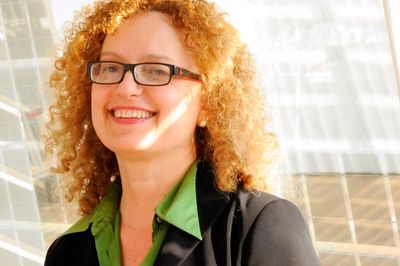
In this Ocula Conversation, curator, author and researcher Carolyn Christov-Bakargiev talks about the 14th Istanbul Biennial: SALTWATER: A Theory of Thought Forms (5 September-1 November 2015). This conversation considers the title of the Biennial, and the themes being addressed, and for what purposes. Christov-Bakargiev describes some of the art works on show, as well as venues that have been included in what is billed to be the most dispersed Istanbul Biennial in this exhibition’s history.
Christov-Bakargiev was artistic director of dOCUMENTA (13) from 2009 to 2012, during which time she held workshops, seminars and exhibitions in Alexandria, Egypt; Kabul, Afghanistan; and Banff, Canada. In 2016, she began her new appointment as the new director of the Castello di Rivoli Museum of Contemporary Art and the Galleria Civica d’Arte Moderna e Contemporanea in Turin. Previously she has served as Artistic Director of the 16th Biennale of Sydney (2008) and Chief Curator at the Castello di Rivoli Museum of Contemporary Art (2002-08). Christov-Bakargiev was also a Senior Curator at MoMA’s PS1 from 1991-2001.
I wanted to begin with the title of the 14th Istanbul Biennial: SALTWATER: A Theory of Thought Forms. How did you get to this title?
In a way, the first part of the title, “Saltwater,” contrasts with the second, “A Theory of Thought Forms,” because salt water is a very precise material, and the theory of thought forms seems very abstract in contrast—an un-materialised title. The word “theory” is in the second part of the title very purposefully to create that contrast between the materiality of life and culture and the attempt to create some sort of super-structure over that materiality of interpretation, which would be a theory of thought forms.
The word thought form comes actually from a theosophy text. The theosophists were a revolutionary group of people in the 19th century. It started with Madame Blavatsky, a Ukrainian woman, and then follows with the great theosophist Annie Besant, who with Charles Leadbeater published a book called Thought Forms in 1905. I find a lot of analogies between the late 1800s and early 1900s and our historical period, both being periods in which there was a great acceleration of so-called progress in technology of communications. Both were great transformative periods, and in both there is a compression of time.
In thinking about the analogy between the period of the 19th century and now, it occurred to me that this book about thought forms would be a good title—a book that prefigures abstraction by many years. Kandinsky and other modernist artists could have been familiar with Thought Forms, perhaps through one of the theosophists who went on to become the founder of a development of theosophy called “Anthroposophy,” Rudolph Steiner.
Can you define what a thought form is and how it relates to salt water?
A thought form is just the manifestation to consciousness of the presence of invisible forms and patterns that one is not usually conscious of unless one enters a kind of meditative state. These forms are not complete imagination of the mind but they are actually an accentuation of invisible patterns that are there, like the currents of wind or movement of branches or things. There is this whole invisible world which began to be looked at in that late 19th century, the time of the invention of the X-ray, and which also leads to the birth of transparent architecture and this sense of the invisible that is very present in our lives today. This invisible world is the coded world: the world of code that is under the surface of our iPads and iPods that determines so much of what we do and are.
This is what brought me to thought forms and salt water. Saltwater is both what keeps our bodies alive because our bodies are mainly water and salt and if we do not have salt, we die immediately because our heart stops to beat because basically the salt provokes in the brain the opening up of the membranes around the neuron cells so that information can pass including information for involuntary actions such as breathing or beating of a heart. It is the most elementary vital need; the only metal that we eat, really. It is basically synonymous with organic life. At the same time, it is also the most dangerous thing to technology because it corrodes—the biggest threat to the digital age is simply salt water. What is interesting is that the same material which is vital to the survival of one system, which is the biological and organic [system], is the most destructive to the other system, which is the mechanical, technological and the digital. I find that contrast very interesting.
Of course, the reference to saltwater is also connected with environmental concerns. There is a huge problem in terms of the oceans, as well as a huge investment into the resources that the oceans provide: the ocean floors for mining, and the ocean waters for desalinised water and so on. So there is a lot going on in terms of competition between different powers around the world for control over the oceans. It is something I was thinking about when I was talking about underwater rivers, and what goes [on] under the water.
Can you talk about the choice of venues and artists for this Biennial?
I come from Arte Povera and my mentors in terms of exhibition-making include Alanna Heiss. I come from a tradition of thinking very widely in terms of where and what an artist’s project is or can be and where it becomes manifest or how long it becomes manifest for. So framing is very important. How you vehicle it is also very important.
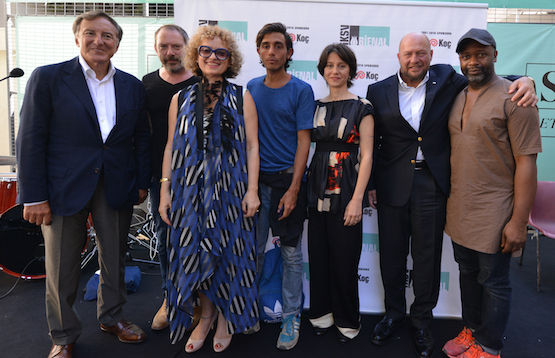
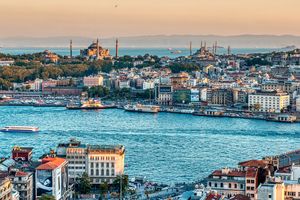
This is a rather dispersed exhibition. I mean, there are four venues that have group exhibitions in them: Istanbul Modern, ARTER, the Galata Greek School, and the Italian High School. And the rest are a series of solo exhibitions basically, one artist in one room, like Heather Phillipson in one room of a small boutique hotel, The House Hotel Galatasaray. I believe that people should get off the roads and onto the water, so I positioned venues on the different islands, too. You have to spend time on water if you want to see the exhibition.
I generally try to imagine alternative propositions. For example, you might locate the public sphere of the political in the small boat or in the hotel room, or in a room that is hidden in an old abandoned house. This idea of temporary spaces of habitation on land and water is something that we are experiencing in our daily lives. More and more we are into car-sharing vehicles or Airbnb rooms, people own less and less, they are becoming more nomadic and less attached to stable homes or apartments or houses. This is one aspect of a transformation of society that is going on which is also causing a great amount of pain in terms of the forced mobility of precarious neighbours, for instance. On the other hand, there is an enormous amount of potential in terms of public space in those small, private places. Think about Edward Snowden: the only way he was able to do what he did was because he was in a hotel room in Hong Kong.
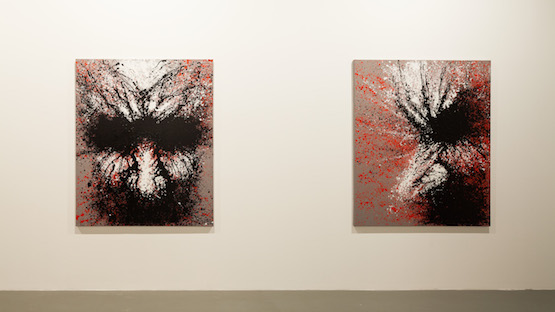
In terms of artists, there’s only maybe one or two works with actual salt in them or reference to salt, one is the young artist called Grace Schwindt from the UK and the other is the mid-career artist from Egypt-Armenian diaspora and also Canadian citizen Anna Boghiguian and so they have salt literally in the work, but it’s not like there’s that much salt in the exhibition or direct references to salt. Saltwater isn’t really the theme of the exhibition, it’s more about having something to talk about with you.
“You” being the journalists and the audience?
It is like a decoy.
That’s interesting, because the framing of this exhibition is structurally similar to the dOCUMENTA (13) you curated in 2012, in which you talked about unfreezing positions through a framing of this vast exhibition as “an unfolding organism, like a vegetable bud. It comes from intuitions, then it forms an instinct, then an opinion, then a knowledge …” To this end, the idea of waves of the Istanbul Biennial allow for that same organic fluidity. In the final line of your statement, for instance, you ask if a wave is ultimately a line trying to become a knot and if so what can be undone—a question you put to physicists, philosophers, and artists. The conceptual frameworks of both exhibitions are similar in that they are broad enough to allow for a kind of fluidity and movement, while structured enough to create certain networks of relations …
I always say that salt water has waves and there also are knots in water, and so there’s a tension between the knot and the wave, as I see it: one is repeated and dispersive movement, which is the wave, and the other is an arrested movement, which is the knot. But actually, there are psychological and historical knots in water, too: the trauma and the layers of killings and war that have to do with the whole history of the region, from well before the Crusades to the demise of the Ottoman Empire and the consequences of it, which still continue today. This includes the ethnic cleansing of Armenians and Greeks from modern Turkey. Those are the waves—or knots—of history.
Water contains the material memory of our history—the sea a graveyard as well as a space for movement …
Of course, you refer to bodies in water and that’s true. You know, I’m thinking of the bodies that cross the Mediterranean now to seek work and a safe haven in Europe and the tragedies of boats sinking and of the slaves who crossed the Atlantic. So you see, salt water is not a literal theme in the way that you might understand a theme to be.
I wanted to hit on the point you made in conversation about the large-scale periodic exhibition and this idea of curating—a word you don’t use—as propositional. I wanted to think about that in relation to how you see an artist’s work as a time capsule for the future to read into the present. If the Istanbul Biennial is one such time capsule, how might you describe it?
I cannot really say; that would be contradictory. Personally, I am not even sure myself. When something is in the state of the propositional it means that it seriously does not know where it is going. It is a form of research, I suppose.
How did you consider the history of the Istanbul Biennial itself?
I’ve seen most of the Istanbul Biennials, actually, and I’m happy to be in this history. This was really the first biennial that had an impact outside of the traditional old venues like Venice, Carnegie, and São Paulo, which is part of the old system, as is documenta. So when the Istanbul Biennial started in the late 1980s, it became a beacon for so many other biennials around the world that started and helped decentralise art from a Eurocentric model. This was a very healthy shift.
How does this relate to your view of how the biennial exhibition functions today? One of the reasons I ask is because the Istanbul Biennial has always had this sort of very productive political approach …
Political yes, the Biennial has been associated with that, as has documenta. I guess to me it’s normal, as is almost every exhibition in the art world nowadays except for art fairs. I don’t think there’s anything really special about that right now. I mean, we live in such dramatic times that almost any curator would really, be embarrassed not to work also on the political in the broadest sense: you know, a Cosmopolitics as Isabelle Stengers would say.
You know, I went through my period of criticising biennials, ten years ago when I though it had to do with some sort of globalisation of art and homogenisation of art. I actually think that they’re very important because they’re spaces of experimentation that still exist that are very rare in museum institutions. And also with art fairs that try to copy the biennials; they are fundamentally market places and therefore they can’t allow for such forms of experimentation.
So I think that the biennial itself is a format that I really believe in as a form of freedom in artistic practice and cultural practice. Where else can I go around mixing scientists and artists and not necessarily producing anything that is sellable? I mean, in the case of Istanbul, I am very grateful to all the people and sponsors, I really am, who have supported and given the money to produce all these works and there are a lot of works that will remain after the exhibition in different places.—[O]
Main image: Carolyn Christov-Bakargiev. Photo: Nils Klinger


A respected voice in contemporary art discourse.
Focusing on ambitious storytelling and insightful art-world commentary. Ocula Magazine publishes in-depth interviews, critical essays and timely analysis on the artists, exhibitions and ideas driving the global art world.
Learn more about Ocula Magazine
Showcasing the best of the art world.
Ocula partners with galleries from around the world to highlight their artists, artworks and exhibitions. Gallery membership is by application and invitation, with each member vetted by an independent panel.
Learn more about Ocula Membership
Specialises in the sale of major artworks.
Led by a team with deep ties to the world’s leading auction houses, galleries and collectors. Ocula’s advisory team offers bespoke services to high-net-worth clients from around the world who are looking to acquire the best of contemporary and modern art.
Learn more about our team and services