





Anton Munar Finds Beauty in the Shadows
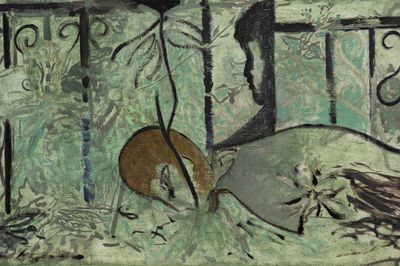
Anton Munar, Vivo estoy. Dejadme así/I am alive. Leave me like this (2023–24). Oil and distemper on linen. 51 x 95 cm. Courtesy Peres Projects.

‘Colour works in a similar way to love,’ Anton Munar explains. ‘To allow love to grow in a relationship you have to take risks. If you tread too cautiously, nothing will happen.’
Munar can best be described as a colourist, an alchemist of sorts. Oil paints, inks, charcoal, pastels, and pigments curdle across his dense surfaces, depicting the figures, landscapes, and folklore that have danced through moments in his life. In the place of conventional linen canvas, he often paints directly on wooden desk drawers, resulting in brushstrokes that reveal every grain beneath.
Next month, Munar makes his South Korean solo debut during Seoul Art Week with Malas Hierbas at Peres Projects (4 September–17 November 2024). He sits down with Rory Mitchell to talk about his childhood, the Spanish music he blasts in his studio, and his newest paintings.

Can you tell me a bit about where you grew up?
I grew up between Copenhagen and Mallorca, a duality which I see as a blessing and has fueled a lot of what I do. However, I do find that when you are from two places you begin to compare your experiences. Whenever I’m back in Spain—where I was brought up until I was nine years old—I notice that the social language I learned as a child really defined the way I move around and interact with people.
In Denmark, you may go to the same bakery every morning and they still won’t know your name, while in Spain you find yourself talking to a stranger about your morning in a coffee shop queue. Perhaps that’s the difference between a city and a small village, but interactions such as these are important to me, especially when the act of painting is such a solitary one.
What is the driving force of your practice?
Making art is deeply rooted in desire: a desire for life and to be present in the moment you’re in. That is what I feel when I’m in the studio. I have a huge love for artists who give me that feeling of being alive.
There’s a huge variety of colours in your work. Do you see yourself as a colourist?

When we were young, my brother was seen as the draughtsman and I was the colourist. As a kid, I felt there was some shade thrown at colourists, but I think being a good colourist is a compliment. The Scottish painter Andrew Cranston speaks beautifully about the totality of colour and the beauty of paint. To seek out colour and its potential is so much about bravery and a willingness to fail.
Understanding colour is almost like love; for love to grow in a relationship or friendship you have to take risks to allow it to grow. If you tread too cautiously to protect yourself, nothing will happen.
How do you work with paint?
If you look at my easel it’s a mess, but each colour has its own history for me. I familiarise myself with the properties of every colour I use. Once I’m down to the last 20% of a tube, I know that it will be drier and harder to tackle, but that’s also when the magic happens.
Sometimes I’m shocked by my desire to work with certain colours. There was a stage when I was having very toxic dreams, which got me thinking about the sour greens that Van Gogh used. That led to a period of using absinthe green in my paintings which, while a bit uncharted, produced interesting results.

A number of the works in your Seoul show are painted on found wooden drawers. Why?
Materials make me feel alive. Every painting I do is on a different type of support, or different type of weave. It enhances the optics of the image and the result is a heightened narrative. Giorgio Morandi did this beautifully—his small paintings had very thick weaves, which means you can see the weave of the canvas and the vibrations of every brushstroke. Robert Ryman achieved similar subtleties. Elizabeth Peyton, on the other hand, often paints on polished surfaces which allows her to achieve these sharp contours and precision in her work.
The figure appears in your work quite regularly, and sometimes elements from landscapes or buildings. But the end result is never too realistic. Where do these images come from? Your imagination? Or experiences?
Many years ago, the Danish artist Alexander Tovborg told me that every artwork has to come from something. That triggered me, as at the time I didn’t care about where things came from. What I’ve learned since is that with painting, you can never run from your emotions. For me, it’s colour that triggers these memories and emotions.
I often realise paintings with my wife. She’s always observing people, while I’m always looking at the environments beyond, such as the texture of foliage or the shadows cast onto walls.
Shadows recur in your work. Why?

Since I was a kid I have been fascinated by the connection between an object and its shadow. The other day in Denmark I was gushing about shadows to a friend who I don’t think quite understood my enthusiasm. I concluded that the shadows are not quite the same there. But in Mallorca, they’re potent—they’re sometimes more real than the object. You can feel the spirit. Pictorially, one of the beauties of the shadow is that it always connects itself to the plane of the world. For me, shadows are very much the paintings of the world.
You’ve likened your painting process to gardening—tending to each painting as if it were a slow blooming plant. Can you expand on this?
It’s a metaphor I borrowed from the author Jamaica Kincaid, who is an avid gardener. At a talk I attended she spoke about how writing for her is similar to the process of gardening. I felt it was the perfect metaphor for desire—wanting something to blossom, but also taking the time to nurture it. Artists such as Brice Marden—who sometimes took ten years to complete a work—taught me that.
What do you like to read?
My wife is a writer so we’re constantly speaking about literature and poetry. Recently, she was reading Karl Ove Knausgårds’ series, ‘My Struggle’ (2009–11). I read the first book and thought it was just incredible. I also love artist interviews and letters between two artists, even if it is just Cézanne writing to Émile Zola to say something like, ‘Please can you lend me 100 francs’. I really love that shit. I’ll sometimes put the book down and think: what am I reading? But those texts make me feel very connected to these artists who I admire.
Do you ever have music on in the studio?
All the time. I want it to be loud. I listen to a lot of Spanish music: Paco de Lucía and Camarón de la Isla. They’ve been with me since I was a little kid—they always fuel me. —[O]
Main image: Anton Munar, Vivo estoy. Dejadme así/I am alive. Leave me like this (2023–24). Oil and distemper on linen. 51 x 95 cm. Courtesy Peres Projects.


A respected voice in contemporary art discourse.
Focusing on ambitious storytelling and insightful art-world commentary. Ocula Magazine publishes in-depth interviews, critical essays and timely analysis on the artists, exhibitions and ideas driving the global art world.
Learn more about Ocula Magazine
Showcasing the best of the art world.
Ocula partners with galleries from around the world to highlight their artists, artworks and exhibitions. Gallery membership is by application and invitation, with each member vetted by an independent panel.
Learn more about Ocula Membership
Specialises in the sale of major artworks.
Led by a team with deep ties to the world’s leading auction houses, galleries and collectors. Ocula’s advisory team offers bespoke services to high-net-worth clients from around the world who are looking to acquire the best of contemporary and modern art.
Learn more about our team and services