





The art world in focus
Subscribe to our newsletter for news and insights on artists, galleries and exhibitions.

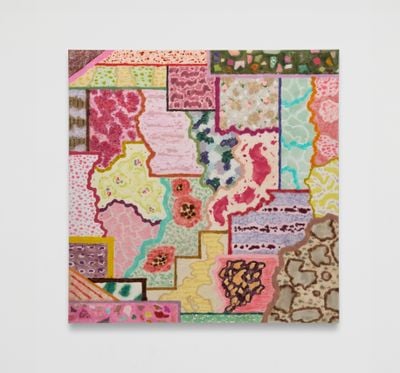
Exhibition view: Rebecca Morris, #33, Trautwein Herleth, Berlin (14 September–26 October 2024). Courtesy the artist and Trautwein Herleth. Photo: Jens Ziehe.
Since emerging in the 2000s, the Los Angeles-based artist has pursued an evolving body of work that plays in the shore break of modernist abstraction in postwar American art. Continuing to mine this rich, contested vein, the exhibition—the artist’s 33rd solo outing, as the show’s title alludes, and her fifth at Trautwein Herleth (until recently named after its legendary founder, Barbara Weiss)—comprises a group of six new, heterogeneous-but-related, oil-on-canvas, large-scale abstractions.
The works revel in Morris’ sumptuous tonality, ranging from dirty pastel to metallic; their jazz compositions veering or riffing off wayward grids, patchwork, visually satisfying impasto, and fuzzy edges. In Untitled (#17-24) (2024) each fluid mark, wiggly line and field suggests the next, with no turning back. The artist meant what she said in her 2005 manifesto: ‘Make work that is so secret, so fantastic, so dramatically old school/new school that it looks like it was found in a shed, locked up since the 1940s’. The silver, black and purple gridded Untitled (#11-24) (2024), for instance, is just off enough to feel meta.
Morris knows how to deliver an old-school aesthetic punch with an unabashed style that Frank Stella would approve of. But much has happened since the early 1970s—the Pattern and Decoration movement, Memphis’ funky shapes, the cool ironic Neo-geo endgames of the 1980s, and, in recent years, the retelling of modernisms along with the wholesale reclaiming of the painterly medium by makers once marginalised from the canon. Since her recent major two-venue survey exhibition,1 it is clear the artist thinks of each new painting as part of the greater developmental whole. In a quantum-like way, Morris’ work seems to be entangled in contemporary art’s rethinking of painting. Her modus reverberates with intertextual formality right on the surface rather than through affixed narratives.
It is right to be picky about a medium that can so easily descend into productive boredom or debased pastiche, like some art in wackadoodle social-media reels. Within the performative cacophony of art that just wants us to watch, the self-possessed presence of Morris’ paintings feels like a relief. —[O]
A respected voice in contemporary art discourse.
Focusing on ambitious storytelling and insightful art-world commentary. Ocula Magazine publishes in-depth interviews, critical essays and timely analysis on the artists, exhibitions and ideas driving the global art world.
Learn more about Ocula Magazine
Showcasing the best of the art world.
Ocula partners with galleries from around the world to highlight their artists, artworks and exhibitions. Gallery membership is by application and invitation, with each member vetted by an independent panel.
Learn more about Ocula Membership
Specialises in the sale of major artworks.
Led by a team with deep ties to the world’s leading auction houses, galleries and collectors. Ocula’s advisory team offers bespoke services to high-net-worth clients from around the world who are looking to acquire the best of contemporary and modern art.
Learn more about our team and services
