





Colin McCahon: A Way Through
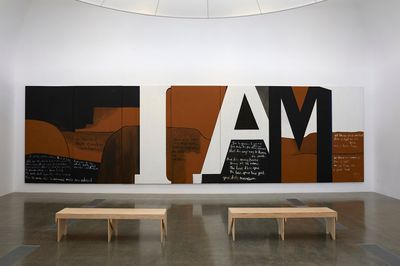
Colin McCahon, Gate III (1970). Acrylic on canvas. Victoria University of Wellington Art Collection, purchased with the assistance of The Queen Elizabeth II Arts Council (1972). Reproduced courtesy of the Colin McCahon Research and Publication Trust. Photo: Sam Hartnett.

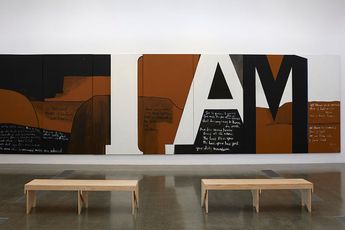
Colin McCahon’s Gate III (1970) has graced the walls of Victoria University of Wellington since 1972. Thousands of students and staff have walked past it over these years, and many remember their first encounter with the towering words ‘I AM’ that dominate its composition.
Gate III was commissioned for the exhibition Ten Big Paintings at Auckland City Art Gallery in 1971. It was Hamish Keith, then Keeper at the gallery, who had the idea to invite ten local artists to make new monumental works for the inaugural exhibition in the institution’s new Edmiston Wing. (The other nine artists included Don Driver, Michael Eaton, Robert Ellis, Pat Hanly, Ralph Hotere, Milan Mrkusich, Don Peebles, Ross Ritchie, and Wong Sing Tai.) As late Director Gil Docking acknowledged in the catalogue of the 1971 exhibition, this was an ‘exercise in positive patronage.’ Each artist was given materials and encouraged to make works of a size that was beyond their usual capacity; far larger than any private buyer could accommodate in their domestic environment.
McCahon painted Gate III over November and December of 1970 in the painting studios at Elam School of Fine Arts in Auckland, after the students had left the university for the summer. At over ten-metres long and three-metres high, the work was the largest in the exhibition, and McCahon himself was unable to find a space large enough to view the painting in its entirety and would see it for the first time in the Edmiston Wing.
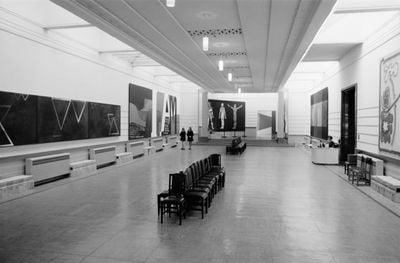
With funding from the Queen Elizabeth II Arts Council, Ten Big Paintings toured New Zealand. The late Tim Beaglehole, an historian at Victoria University, saw Gate III at the New Zealand Academy of Fine Arts in the old museum building at Buckle Street in Wellington 1971 and was immediately struck by it. It took a year for Beaglehole to raise the funds, convincing both the University and the Arts Council to pay NZD 4,000, which was, in August 1972, the highest price yet for a work sold by a living New Zealand artist.
Both the Ten Big Paintings exhibition and the purchase of Gate III augur change in the New Zealand art world. They mark the dawning of a new chapter: a self-awareness and confidence in the contemporary art of New Zealand.
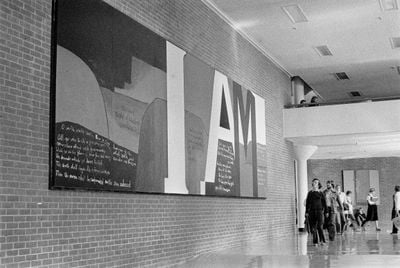
Gate III weaves together several reoccurring themes in McCahon’s work and revisits the intentions he outlined in 1961 to friend and collaborator John Caselberg for a ‘large-scale statement on nuclear warfare’ which, ‘could stand in entrances to town halls, universities . . . having the impact of a hoarding rather than a large painting only . . . The new series goes under the general title of Gate by which I mean a way through.’
Though bearing the ‘Gate’ series title, the work is closer in scale, subject, and contents to Victory over death 2 (1970) and Practical Religion: the resurrection of Lazarus showing Mount Martha (1969–1970), works which are now key collection items in the National Gallery of Australia and Te Papa Tongarewa Museum of New Zealand respectively.
In Gate III, McCahon injects colour and returns to landscape in the hope that the familiar reference points of earth and sky would better communicate his message. The painting is dominated by the huge letters forming the words ‘I AM’, a phrase some now find oppressively assertive of the heroic human subject, but which McCahon invokes as the voice of the Christian God that is the foundation for belief in a higher power in whom humans were to place their trust. This giant statement is framed by biblical texts from Isaiah, Jeremiah, and Psalms to the left, and blessings from Psalms 67 and 90, and Numbers 6 to the right. These lead the reader from fearful dread to hope of redemption. Given McCahon’s fears about a nuclear holocaust, the iconography of Gate III could be showing us ‘a way through’ to a ‘pure land’ or equally a violated wasteland. —[O]
This year marks 100 years since the birth of Colin McCahon, one of New Zealand’s most important painters, in August 1919. For its contribution to the artist’s centenary celebrations, Adam Art Gallery Te Pātaka Toi in Wellington has organised a touring exhibition of Gate III. The exhibition, entitled ‘A way through’: Colin McCahon’s Gate III, is on view at Te Uru Waitākere Contemporary Gallery in Auckland (24 August 2019–20 October 2019) and at Adam Art Gallery Te Pātaka Toi (6 November 2019–22 March 2020). Christina Barton, Nina Dyer, and Sophie Thorn are the curators of the touring exhibition.
Main image: Colin McCahon, Gate III (1970). Acrylic on canvas. Victoria University of Wellington Art Collection, purchased with the assistance of The Queen Elizabeth II Arts Council (1972). Reproduced courtesy of the Colin McCahon Research and Publication Trust. Photo: Sam Hartnett.



A respected voice in contemporary art discourse.
Focusing on ambitious storytelling and insightful art-world commentary. Ocula Magazine publishes in-depth interviews, critical essays and timely analysis on the artists, exhibitions and ideas driving the global art world.
Learn more about Ocula Magazine
Showcasing the best of the art world.
Ocula partners with galleries from around the world to highlight their artists, artworks and exhibitions. Gallery membership is by application and invitation, with each member vetted by an independent panel.
Learn more about Ocula Membership
Specialises in the sale of major artworks.
Led by a team with deep ties to the world’s leading auction houses, galleries and collectors. Ocula’s advisory team offers bespoke services to high-net-worth clients from around the world who are looking to acquire the best of contemporary and modern art.
Learn more about our team and services