






Hyewon Kwon’s Fictional Laboratory

Exhibition view: Hyewon Kwon, Planet Theater, SONGEUN, Seoul (9 June–29 July 2023). Courtesy SONGEUN Art and Cultural Foundation and the Artist.

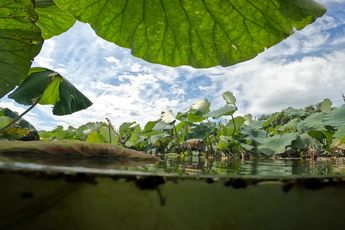
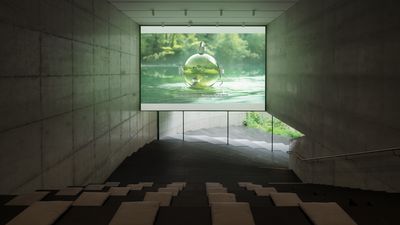
The auditorium leads directly to the gallery’s second floor, where Kwon’s four-channel video installation Sensing Cinema (2023) draws from the artist’s year-long collaboration with the Han River Environment Research Center. The subject of their project was Paldangho, a man-made lake near Namyangju-si created in 1973 to supply water to the Seoul and Gyeonggi-do regions.
The four channels of Sensing Cinema are each projected onto four different walls, making it impossible to view all of them at once. A resulting effect is an experiential distance that is both physical and temporal, whereby the viewer must move between the projected videos while remaining conscious of their immediate neighbours.
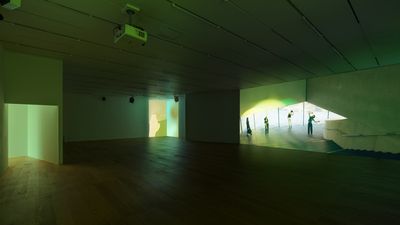
This slowing down of perception aligns with the performance captured in the largest projection, in which the Korean artist duo Mu:p (Hyeongjun Cho and Minsun Son) performs unusual motions with their bodies. They are seen huddling together in different parts of SONGEUN, grabbing and lifting parts of their hair or crouching over the stairs.
These incomprehensible movements derive from conversations with Kwon about the ways human bodies receive information from the world. They ask, what if humans experienced sensation not with sensory organs but with hair and fingernails? What would that look like?

Humans of today’s world are without doubt familiar with the senses, but also with measuring changes in terms of numeric values, subsequently translating them into visual data. Examples of this appear in a narrow projection on an adjacent wall, which depicts graphs of Paldangho’s aquatic and terrestrial data along with footage of the lake. Contrastingly, Mu:p’s performance reorients the language of understanding nature from conventional value systems to one that is interior and bodily.
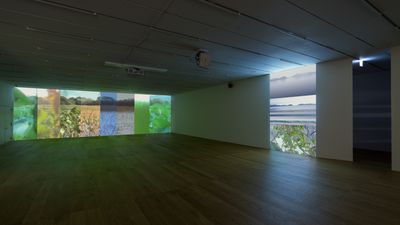
The separation of videos continues upstairs with Impossible World (2023), a three-channel video installation which compels the viewer to hover between its multiple screens and contemplate their subtle connections. The largest projection, for example, consists of footage taken from a single location at the lake over the course of a year. The installation is a collaged portrait of the lake that collapses distances and time, creating what the artist calls ‘an impossible world’.
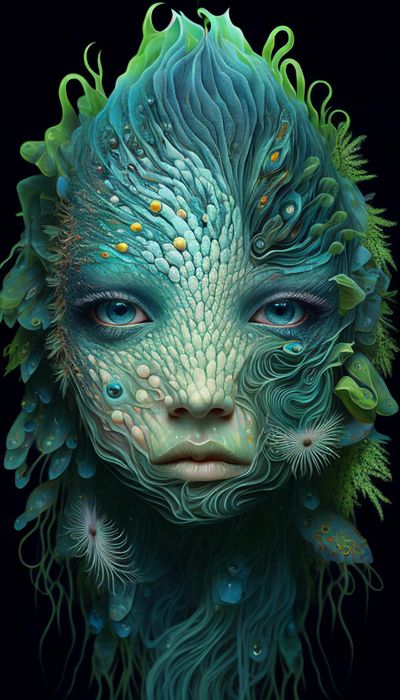
On the opposite wall, a 3D-animated aquatic creature narrates the history of Paldangho and its local population, unveiling stories that cannot be readily gleaned from landscape. The creature was generated through artificial intelligence fed with data collected at Paldangho by the Han River Environment Research Center. With its knowledge of the lake’s environment, it acts as an intermediary between nature and humans, raising the possibility of communication between them.

Considering Kwon’s consistent engagement with technologies and devices in her work around Paldangho, it is no surprise that the artist turns her gaze to space exploration—arguably humanity’s greatest scientific achievement. Ironically, in SONGEUN’s underground basement gallery is In Orbit (2023), a spanning video projection that opens with the 1957 launch of the first artificial satellite, Sputnik 1. Across nine minutes, the video sews together archival material, space simulation video game footage, and text to consider the varied impacts of space technology.

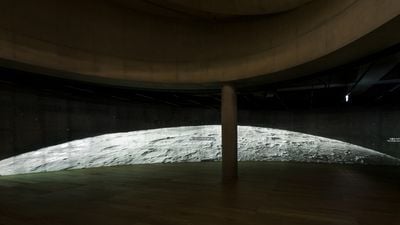
Optical conventions of Earth fall under scrutiny in one scene featuring Earthrise (1968), the historic photograph taken by astronaut William Anders during the Apollo 8 mission to the Moon. In it, Earth appears half-submerged in darkness, floating above the horizon of its moon. Yet, because there is no gravity in space, ‘horizons’ as we understand them on Earth do not exist. The subtitles of In Orbit tell us that in Anders’ original photograph, the surface of the Moon was actually parallel to the longer side of the image, which was later rotated 95 degrees clockwise in accordance with expectations back home.
Planet Theater, true to its proposition as a laboratory, offers a space for experimentation with familiar beliefs about perception. Proposed alternatives, such as receiving stimuli through fingernails or using a computer-generated creature to translate nature for us, sound ludicrous or fanciful. All the while, ingrained conventions and the latest technology march side by side.
Kwon may have more proposals for reconfiguring our beliefs in August, where she will again show at SONGEUN as part of a major group exhibition. As the artist said at the exhibition opening, she may delve deeper into the local history of Paldangho. Further still, she may surprise us with new, unexpected directions, enveloping us in her impossible but enthralling worlds.—[O]
Main image: Exhibition view: Hyewon Kwon, Planet Theater, SONGEUN, Seoul (9 June–29 July 2023). Courtesy SONGEUN Art and Cultural Foundation and the Artist.





A respected voice in contemporary art discourse.
Focusing on ambitious storytelling and insightful art-world commentary. Ocula Magazine publishes in-depth interviews, critical essays and timely analysis on the artists, exhibitions and ideas driving the global art world.
Learn more about Ocula Magazine
Showcasing the best of the art world.
Ocula partners with galleries from around the world to highlight their artists, artworks and exhibitions. Gallery membership is by application and invitation, with each member vetted by an independent panel.
Learn more about Ocula Membership
Specialises in the sale of major artworks.
Led by a team with deep ties to the world’s leading auction houses, galleries and collectors. Ocula’s advisory team offers bespoke services to high-net-worth clients from around the world who are looking to acquire the best of contemporary and modern art.
Learn more about our team and services