






John Waters Skewers Hollywood at Sprüth Magers

Exhibition view: John Waters, Hollywood's Greatest Hits, Sprüth Magers, Los Angeles (16 February–1 May 2021). © John Waters. Courtesy the artist and Sprüth Magers. Photo: Robert Wedemeyer.
From early arthouse wonders like Pink Flamingos (1972) and Polyester (1981), to the relative mainstreamery of Hairspray (1988) and its remakings, the popular trajectory of Waters’ stories about giddy miscreants in dogged pursuit of notoriety built an increasingly effective metanarrative for the evolution of Waters’ own fame.

Throughout the years and across various media, Waters has maintained a benevolent shit-eating grin. For all his provocations, his skewering of the culture in which he is celebrated yields jokes as invitingly good-humoured as they are nasty.


This is as true as ever in Hollywood’s Greatest Hits, Waters’ exhibition at Sprüth Magers in Los Angeles (16 February–1 May 2021). However the socially mediated reality outside the gallery has reconfigured the terms of his themes, Waters still knows how to amuse, gross out, and cultivate a movingly queer sense of recognition via disorientation and displacement.

In a variety of mediums, the show’s pieces display ‘cutting, but loving, critiques of mass media, celebrity and insider art-world knowledge’, as reads the exhibition press release. Referential pranks abound.
There is an eight-and-a-half foot ruler called Fellini’s 8 ½ (2014), and a collage of pimples cut from stills of Pasolini movies called 21 Pasolini Pimples (2006). Art Market Research (2006) features surveys filled out by art collectors about their buying tastes (one says that they will not be getting a Richard Serra because it looks too heavy).

Cancel Ansel (2014) is a photomontage of Ansel Adams pictures with digital additions to the originals: an airplane is about to crash into a landscape, a flamingo perches on a foregrounded tree, a guy in a clown mask gives the finger in the woods.
“Waters still knows how to amuse, gross out, and cultivate a movingly queer sense of recognition via disorientation and displacement.
The guy in the mask is undoubtedly Waters, and it’s not the only time his own image or an image referring to his own work appears in these pieces. Indeed, it is Waters himself, as a character and a cultural icon, that most pointedly represents celebrity and insider art-world knowledge.

Hollywood’s Greatest Hits also includes Kiddie Flamingos (2014), a film of young children doing a table read of (a somewhat redacted) Pink Flamingos. Alley Cat (2003) is a photomontage of stills from one second of Waters’ film Mondo Trasho (1969). Bill’s Stroller (2014) is an homage to San Francisco’s leather bars, their names written across it. The same neighbourhoods where these bars were are now filled with gay couples with children.
In Beverly Hills John (2012), Waters subjects an image of his face to a grotesque, digital mockery of cosmetic surgery; Lassie and Justin Bieber get the same treatment in Reconstructed Lassie (2012) and Justin’s Had Work (2014).
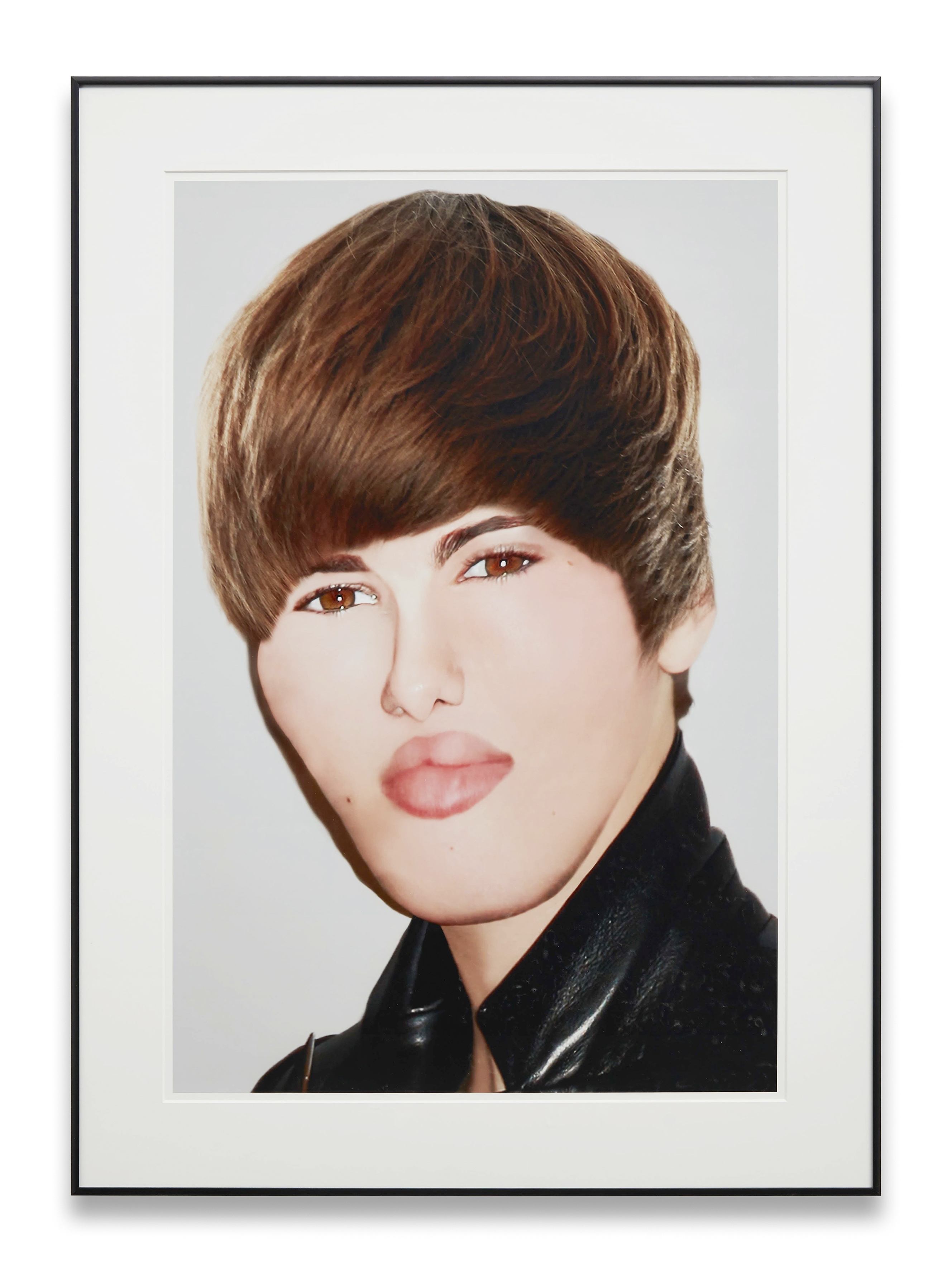
The glee in these works operates at the juncture between disgust with the conditions that produce absurdly exclusionary cultural hierarchies, and pleasure in the possibility that in making a mess of it all one might find a self and forge some community.
This is Waters’ sweet spot. His art seems indifferent to the fact that those hierarchies have become diffuse in a way that confuses the particular value of fame, making it harder than ever to tell where the boundaries of ‘insider knowledge’ lie.

You don’t need to have come anywhere near Hollywood to ‘get’ Bad Director’s Chair (2006), an eponymous folding seat emblasoned with the word ‘HACK’ (you don’t even need to have seen Cecil B. Demented, the 2000 Waters film that most explicitly explodes the themes on display in this show).
To engage media culture at all is to be always already involved in the fates of fame—a queasy truth that’s especially pointed in Shoulda! (2014), a photomontage with pictures of such famously dead women as Whitney Houston and Princess Diana.
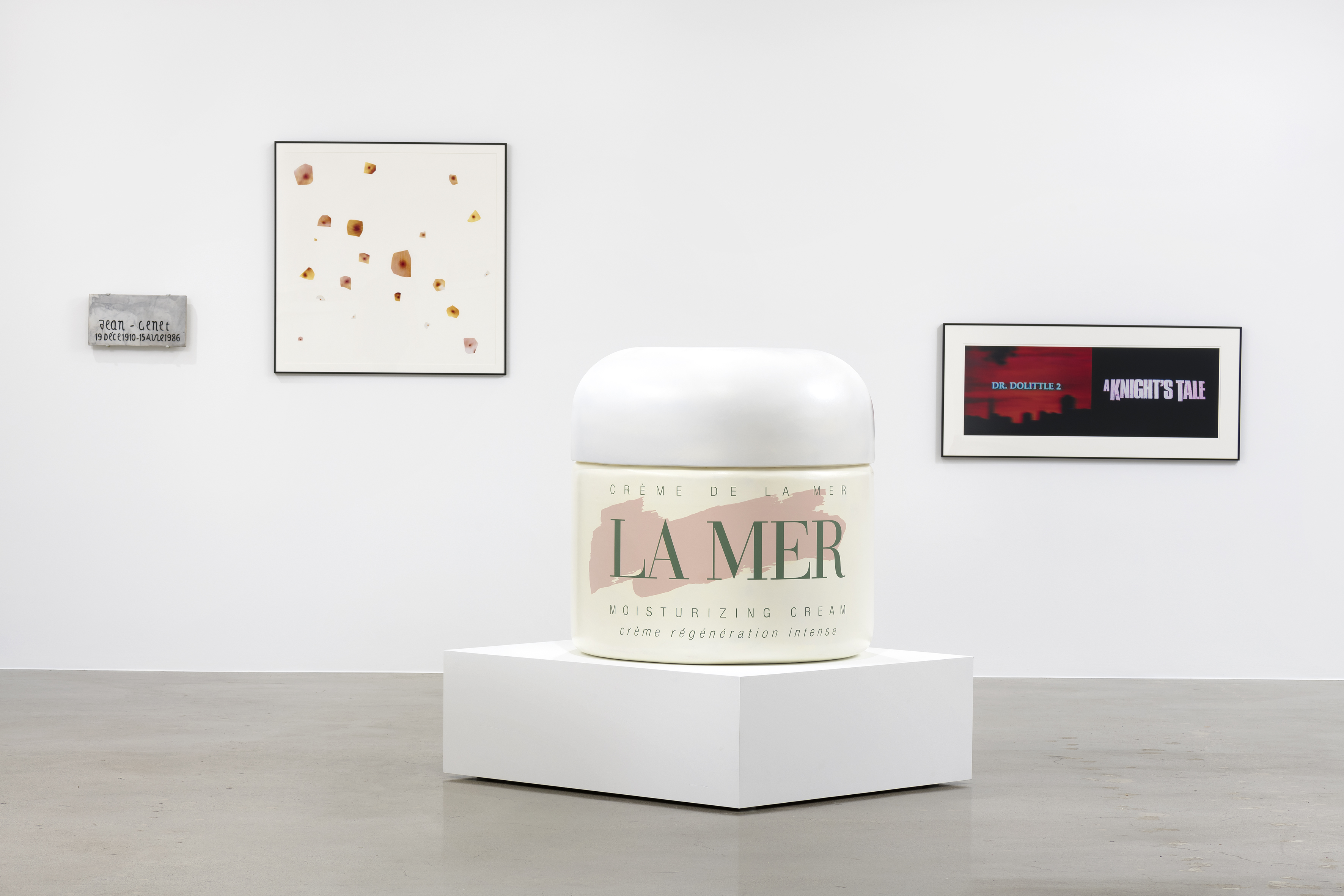

Waters has never shied from flippant reminders that stardom is no salve for death. The largest piece at Sprüth Magers is a scale replica of a jar of La Mer anti-aging cream (La Mer, 2009); one of the smallest is a detailed diorama devoted to the late artist and Waters’ friend, Mike Kelley (RIP Mike Kelley, 2014).
The insistence on holding a threshold, between inside and outside, life and death, humour and horror—a celebration of the cracks between limits—makes Waters’ work an enduringly compelling assertion of queer possibility.
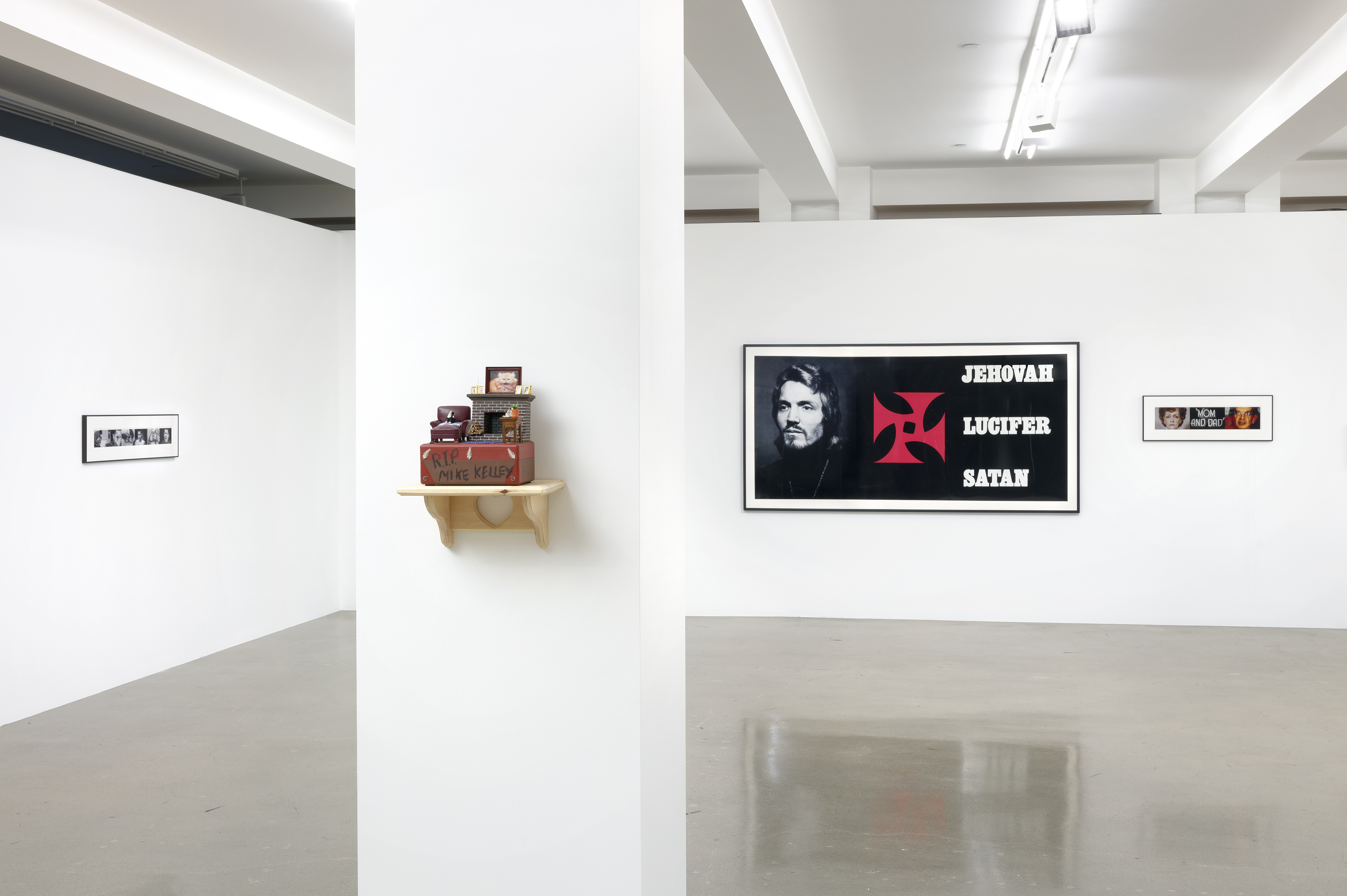
The distortions of the present might overwhelm the premises of celebrity, but Waters’ point was always to highlight busting seams and embrace the loving underbelly of a garbage culture that regularly commodifies the profundity of recognition.
Hollywood’s Greatest Hits beguiles in trademark Waters style. His smile remains famous for good reason, no matter what work gets done in Beverly Hills.—[O]
Main image: Exhibition view: John Waters, Hollywood's Greatest Hits, Sprüth Magers, Los Angeles (16 February–1 May 2021). © John Waters. Courtesy the artist and Sprüth Magers. Photo: Robert Wedemeyer.







A respected voice in contemporary art discourse.
Focusing on ambitious storytelling and insightful art-world commentary. Ocula Magazine publishes in-depth interviews, critical essays and timely analysis on the artists, exhibitions and ideas driving the global art world.
Learn more about Ocula Magazine
Showcasing the best of the art world.
Ocula partners with galleries from around the world to highlight their artists, artworks and exhibitions. Gallery membership is by application and invitation, with each member vetted by an independent panel.
Learn more about Ocula Membership
Specialises in the sale of major artworks.
Led by a team with deep ties to the world’s leading auction houses, galleries and collectors. Ocula’s advisory team offers bespoke services to high-net-worth clients from around the world who are looking to acquire the best of contemporary and modern art.
Learn more about our team and services