





Han Mengyun: A Mind, Is a Mirror, Is a Rose

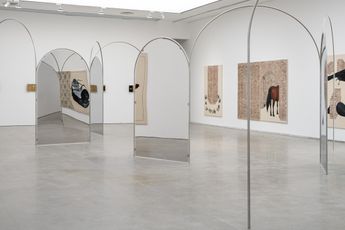
Exhibition view: Han Mengyun, The Unending Rose, ShanghART, Shanghai (5 November 2023–7 January 2024). © Han Mengyun. Courtesy ShanghART.

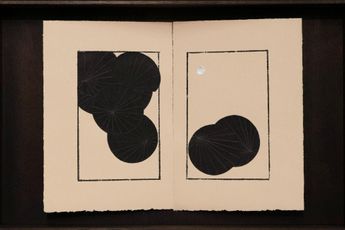
It can be hard to employ a motif as staid, ubiquitous, and cliché as the rose, even while recognising its historic symbolism. The Unending Rose is named after Argentine writer Jorge Luis Borges’ 1975 poem of the same title. In ‘La rosa profunda’, Borges imagines 12th-century Persian mystic poet Farid al-Din speaking to the rose in his mind (‘addressing it in words that had no sound’), acknowledging that its symbolic value is limited by linguistic representation.
Han lives in London, where the rose—a symbol traced back to the 15th-century civil wars—is the national flower. Today it adorns football jerseys, the Labour Party logo, and Valentine’s bouquets. In Alastair Reid’s English translation of Borges’ poem from Spanish, the rose is trapped twofold in the subjective pipeline of literary translation. Dissolving amid divergent historic and cultural referents (‘You, you are music, rivers, / firmaments, palaces, and angels,’), the rose stands in for infinity—a plurality of evolving definitions and interpretations.
Thorny issues around translation—whether technical, ethical, historical, or otherwise—are issues not unfamiliar to Han, who is a bilingual writer (Chinese/English) and has studied Sanskrit. She has described her intent ‘to recognise the difference between cultures, to retrieve and repair lost and damaged episteme by learning languages’.
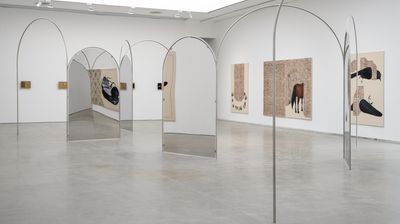
ShanghART‘s main space is transformed into a hall of mirrors and manuscripts. The centrepiece, Mirror Pavilion I, II, III (2023), comprises three tripartite arched pavilions, each encasing a single central steel sheet that is polished to reflect viewers and surrounding paintings.
The installation was inspired by a story retold by 12th-century Persian poet Nizami Ganjavi, in which Alexander the Great summoned a Roman and Chinese painter to compete against each other. In the end, two identical paintings were revealed on opposing walls of the hall: the Chinese painter had polished an entire wall to precisely reflect the realistic Roman painting.
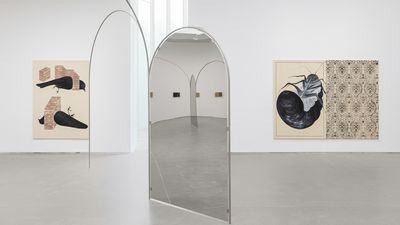
Han has said: ‘When I encounter how Chinese culture is perceived through another lens, in another tradition, such as seeing the Chinese phoenix motif in Islamic manuscript, the strangeness of what is familiar excites me.’
Large parchment-coloured paintings are arranged in pairs like open manuscripts. Literary symbols and cultural motifs abound, pregnant with allegory: a Kafkaesque upside-down cockroach, helplessly lying on its back with its legs flailing in the air; patterned Persian rugs and textiles; thorny rose stems and blood-red petals floating in pictorial space; and a macabre ring of human skulls surrounding a brick column. Together, they might invoke dream analysis, with a direct reference to Freud found in the installation’s collective title, The Interpretation of Dreams (2023).
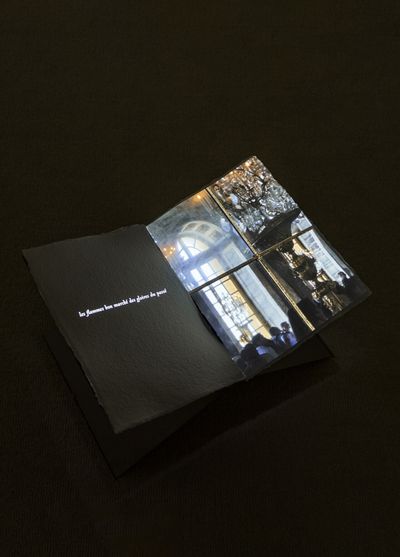
In a separate room, Han’s series of five videos—collectively titled Panchatantra (2023) after the ancient Sanskrit collection of animal fables—are projected onto Indian Khadi handmade paper on custom stainless-steel book stands, with each video exploring different definitions of the mirror. Han has said, ‘The mind is also a form of mirror that reflects the alchemy of the encounter between humans and the outer world.’ Here, she fuses print media and moving image to lure her worlds of signs and symbols into an anachronistic present. —[O]
Han Mengyun: The Unending Rose is on view at ShanghART, Shanghai, from 5 November 2023 to 7 January 2024.
Main image: Exhibition view: Han Mengyun, The Unending Rose, ShanghART, Shanghai (5 November 2023–7 January 2024). © Han Mengyun. Courtesy ShanghART.








A respected voice in contemporary art discourse.
Focusing on ambitious storytelling and insightful art-world commentary. Ocula Magazine publishes in-depth interviews, critical essays and timely analysis on the artists, exhibitions and ideas driving the global art world.
Learn more about Ocula Magazine
Showcasing the best of the art world.
Ocula partners with galleries from around the world to highlight their artists, artworks and exhibitions. Gallery membership is by application and invitation, with each member vetted by an independent panel.
Learn more about Ocula Membership
Specialises in the sale of major artworks.
Led by a team with deep ties to the world’s leading auction houses, galleries and collectors. Ocula’s advisory team offers bespoke services to high-net-worth clients from around the world who are looking to acquire the best of contemporary and modern art.
Learn more about our team and services