






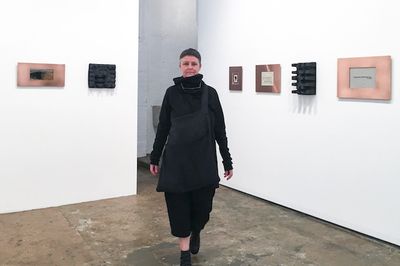

When Australian-born, Madrid-based artist, Narelle Jubelin and I first started chatting some weeks ago she mentioned a quote from Stuart Hall, ‘I can't go back to any one origin—I'd have to go back to five; when I ask people where they're from, I expect to be told an extremely long story'.
It is a quote that appears to perfectly condense the concerns of Jubelin’s practice over the past 30 years. In essence, Jubelin is a storyteller telling an extremely long story—a tale of modernist legacies and of the meeting of minds across time and space. Each work riffs off the past whilst referencing the future, tracing a line of thought and experience in needlepoint.
Her latest exhibition, Flamenca Primitiva, showing at The Commercial in Sydney this April is, in a sense, the second half of an exhibition. Flamenco Primitivo was shown at Marlborough Contemporary in London earlier this year. Originally floated as two exhibitions to be held simultaneously in both hemispheres, Jubelin sees the ultimate timing of their presentations as mirroring a slow boat journey from England to Australia.
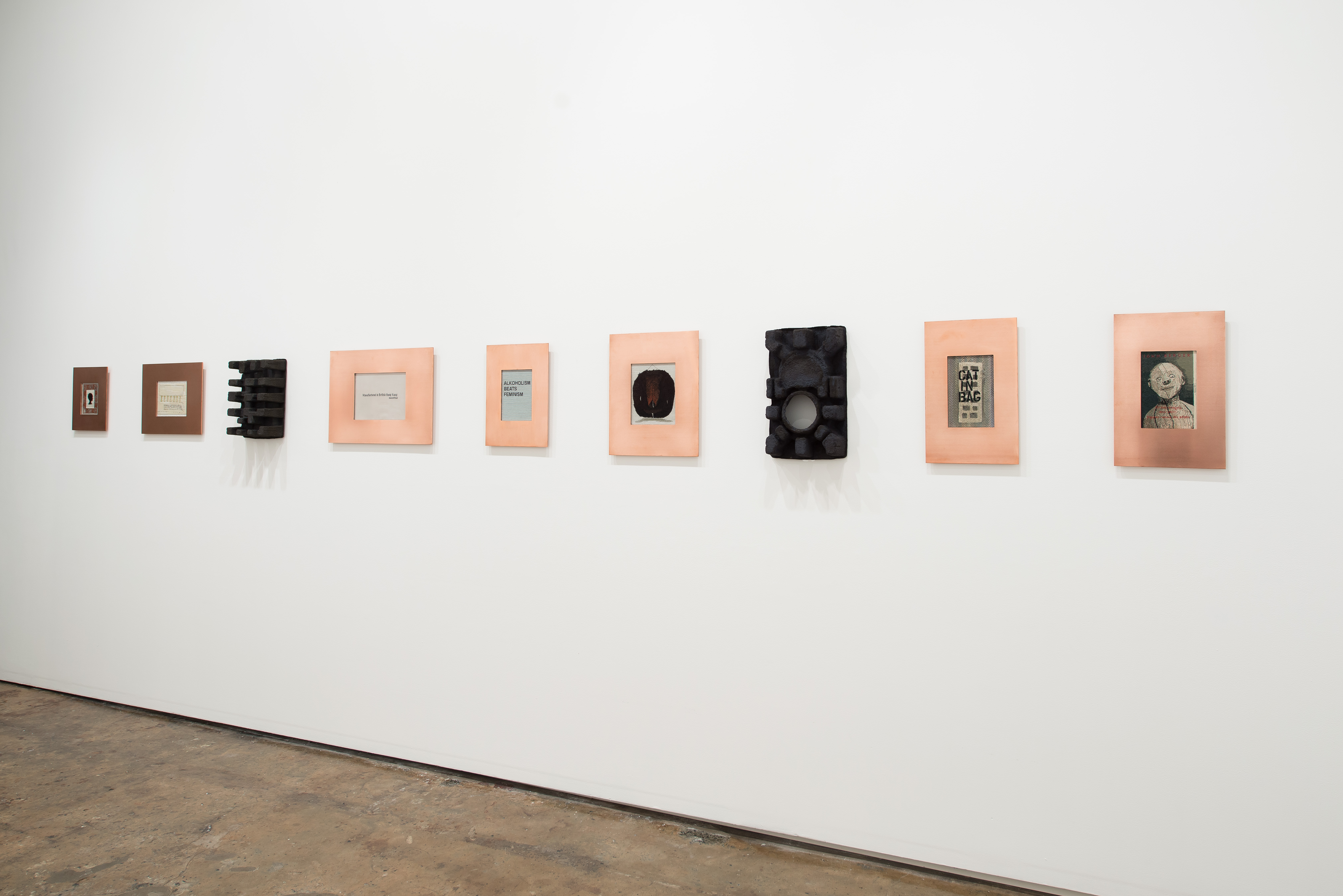
Both exhibitions continue Jubelin's investigation into the translation of visual culture through her trademark use of rendering modernist paintings, architecture, photographs and exhibition ephemera in petit point miniature. The embroidered works are accompanied by the artist's packing ‘buffers’, wall sculptures comprising bronze casts of the cardboard packaging used to protect goods in transit.
We spoke with Jubelin in the weeks leading up to the opening of Flamenca Primitiva in Sydney.
Could you explain how you see the relationship between the two exhibitions: Flamenco Primitivo in London and Flamenca Primitiva in Sydney?
I imagine that some time in the future I could integrate the two bodies of work together, as one body of work that has different components. The framing at Marlborough Contemporary in London was very different to the framing here [in Sydney]; in Sydney we have pushed the materiality of the framing much further. The selection of objects that I rendered in London was very different to Sydney, although there are connections between and they riff off one another.
So, if and when Flamenca Primitiva weaves into Flamenco Primitivo then discursively it is a much more complex panorama. Most of the works rendered in London were modernist ‘touchstones’; the artists are relatively well known, although some are at the peripheries of the modernist canon. I was looking for flashpoints of recognition with the audience as I wanted people to recognise that they had seen that work before, return them to the work, and prompt them to deal with the notion of the rendition that I was making.
In Flamenca Primitiva the artists I am rendering are more of my generation. Here in Australia there are some people who have followed my work for 30 years so those people will already understand that if I make reference to Ângela Ferreira, for instance, our relationship is something that I have made references to before. The artists are closer to me but they also come out of the modernist legacies that I cited in the works for Flamenco Primitivo. So it is a thickening of a referential. It is a reflexive essay about modernism and its legacies within contemporary practice.
In both bodies of work I am also citing directions I am about to head. Each exhibition is a consolidation of where I have been but also where I am beginning to think through upcoming projects. For me, it is a useful way to use a commercial gallery context. You are consolidating and doing the thinking work whilst you are simultaneously introducing your work to new audiences.
Considering there are so many binaries or opposing elements in the two exhibitions it appears to make sense that you chose to split the title of the exhibition into that of the masculine and feminine in Spanish. Could you talk about the origins of the exhibition titles?
Originally the two exhibitions were to be at the same time. When I was talking to Amanda Rowell about whether we would shift the title, she said that an obvious grammatical slip would be Flamenca Primitiva. So we moved it into the feminine, hence there is also a pending gap of comprehension within translation. Flamenco Primitivo resides in the roots of flamenco music. Flamenca Primitiva, in a sense, doesn’t mean anything unless you contextualise it. Obviously, it also plays on the first mistake that everyone makes when learning Spanish, that being the gaff of gender.
Flamenco singers or performers constantly cite their references. They talk about the palo [stick] which goes right down to the roots, so they are constantly going back into the roots of flamenco, and then they pull it back up the stem and re-work. The word rendition, which I have always used when talking about petit point, actually comes from music and when you look at the work installed it should have a music-like intonation. In Sydney, the gaps between the works actually also have the proportion of an A4 sheet of paper. The intervals between the works are integral to the cadence of the piece.
In terms of Flamenca Primitiva one way to explain it would be to apply the title to Flemish painting especially in regards to verisimilitude. The Flemish were as faithful as they could be to the notions of materiality. In Flamenco Primitivo, the first bronze that I unwrapped was so close to the original found object [packing buffer] that I actually said to Andrew Renton, ‘It is so close to the real thing, that I am unsure why I am doing this.’ And he said, ‘Yes, but you can feel the weight.’ And he is right. I think you also feel the weight of references within the works that I am rendering. For example, As yet untitled (Magdalena Abakanowicz, 1978) (2016) within Flamenca Primitiva is a subtle re-working of Magdalena’s massive tapestry work that occupies the entire aperture of the frame. Importantly, it is rendered with an awkward shadow line, a homage, in a sense, to the reach of her intergenerational weight and importance.
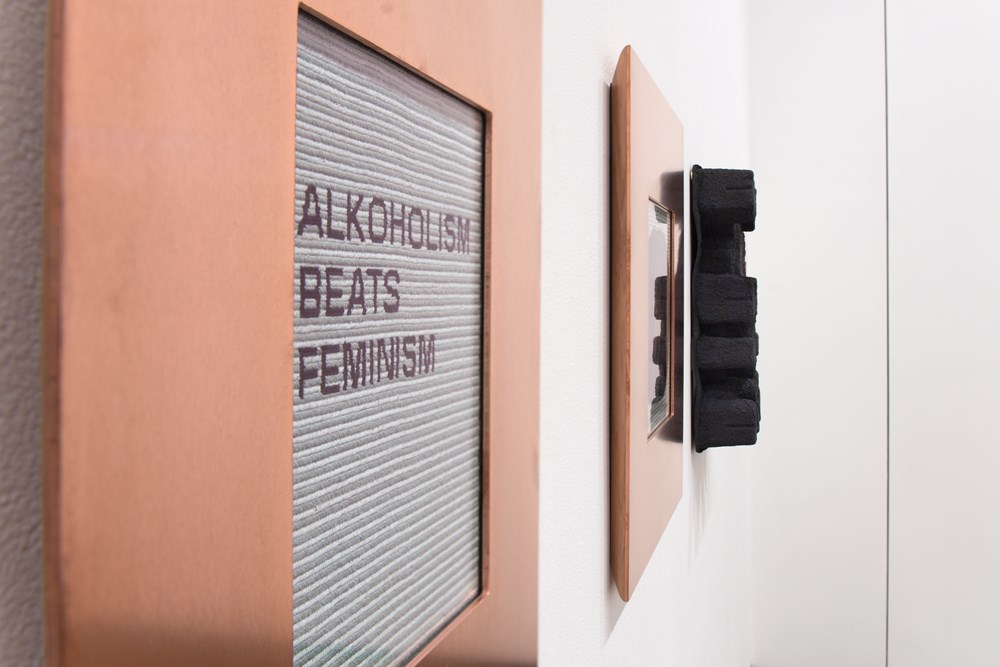
It does feel as though in Sydney the show is 'heavier' than in London, with the use of the blackened bronze packing buffers and the copper frames for the renditions. Although it is interesting to consider the interplay of light with the Bauhaus proportions of the copper frames, the aluminium backing which is exposed in some of the renditions and then the conversation these works will have with the black and blue patina of the bronze works.
Hopefully it will actually look quite light. When the works are installed, the copper of the frames is reflective so it will implicate everything in the room. It could even be quite disorientating, as the surface area of the metal plate is quite large in relation to the sewn renditions. I imagine that there will be quite an animation of the space. We will be conscious that we are captured as we look closely at something. I am pushing the light, the shadows and the discursive reading further than I have pushed before.
With the bronzes, we made the decision to step them up, away from the raw bronze I used in London. This time we’ve blackened to a burnt black. The original packaging buffer is burnt out to make the mould to pour the bronze so the appearance of the patina is almost at the point before they disintegrate, literally burn out. The process production of the bronze is implicit in the new sculptural object. Of the three black bronzes one is unified, but the other two have little fissures because the paper was so thin at those points. If you hold them up to the light you can see through them. Making discrete objects that only just survive their transition to bronze.
All of this work is about negotiating a space. You treat it like reading a landscape. And the wall works remind me of how I am asking people to read. As you move across the work, the frame will follow you but I am also interested to see what happens in terms of the imagery. As we install in Sydney I am seeing a reading akin to a description of the acquisition of language. For example, As yet untitled (Ângela Ferreira, 2015) (2016) is a sewn rendition of an open cut mine from an exhibition invitation and it hangs alongside a rendition of Newell Harry’s DUM/MUM/MAD/DAD (2006). It feels as though it is similar to a pitfall of early speech as the almost primal text of Harry’s piece drops away to Ferreira’s cavernous hole. —[O]
Main image: Image: Narelle Jubelin. Courtesy The Commercial, Sydney.

A respected voice in contemporary art discourse.
Focusing on ambitious storytelling and insightful art-world commentary. Ocula Magazine publishes in-depth interviews, critical essays and timely analysis on the artists, exhibitions and ideas driving the global art world.
Learn more about Ocula Magazine
Showcasing the best of the art world.
Ocula partners with galleries from around the world to highlight their artists, artworks and exhibitions. Gallery membership is by application and invitation, with each member vetted by an independent panel.
Learn more about Ocula Membership
Specialises in the sale of major artworks.
Led by a team with deep ties to the world’s leading auction houses, galleries and collectors. Ocula’s advisory team offers bespoke services to high-net-worth clients from around the world who are looking to acquire the best of contemporary and modern art.
Learn more about our team and services