





David Hammons at The Drawing Center

Bruce W. Talamon, David Hammons making a body print, Slauson Avenue studio, Los Angeles (1974) (detail). Digital silver gelatin print. 40.6 x 50.8 cm. Courtesy the artist.

Rightly considered one of the most influential postwar American artists, David Hammons is the focus of an exquisite exhibition at The Drawing Center in New York (David Hammons: Body Prints, 1968–1979, 5 February–23 May 2021).
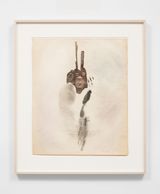
The show is centred around the artist’s acclaimed series of ‘body prints’, which he began in 1968, using grease and pigments to imprint parts of his own body onto paper.
Although heavily influenced by Yves Klein’s ‘Anthropométries’, as Laura Hoptman, executive director at The Drawing Center, notes in her catalogue essay, Hammons’s body prints possess a very personal darkness and finesse, enhanced by the addition of beautifully rendered items of clothing, draped American flags, or even specific objects and symbols, such as the spade, interrogating the cultural significance of a symbol that had had its meaning inverted for use as a racial slur.
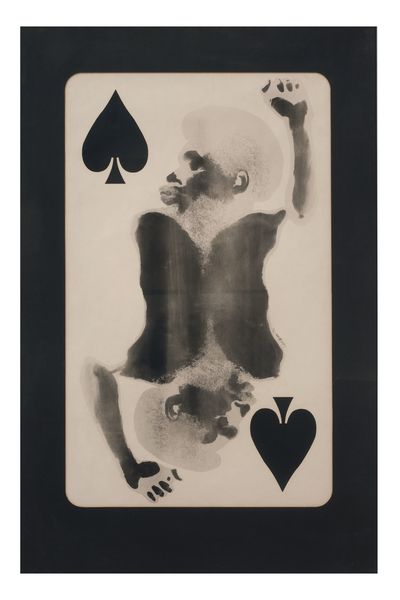
Resembling X-ray images, Hammons’s body prints confront the viewer with such physical immediacy that the images linger with you long after viewing, taking on a spiritual quality.
Hammons has an eye for powerful compositions, but a restrained, almost magical delicacy still permeates these images, out of which emerges a visual language that is at once direct and instantly recognisable as his own.
Hammons’s body prints began in Los Angeles, where the artist lived between 1963 and 1968, attending Los Angeles City College and the Los Angeles Trade and Technical College, later graduating from Chouinard Art Institute.
In 2019, Hauser & Wirth held an exhibition of his work in Los Angeles—more than 45 years since his first in the city. His body prints are now part of a long, multi-faceted and distinguished career, but could they be the most iconic and collectible of all of Hammons’s work?
Now residing in some of the most prestigious American museums, as well as some renowned private collections in the U.S., Hoptman points out they have been popular from the start.
Hammons also gave many away as gifts, writes Hoptman, so there is some degree of mystery around how many actually exist. There is little doubt, however, as to how powerful these images remain decades later.—[O]
WORKS
3
Main image: Bruce W. Talamon, David Hammons making a body print, Slauson Avenue studio, Los Angeles (1974) (detail). Digital silver gelatin print. 40.6 x 50.8 cm. Courtesy the artist.





A respected voice in contemporary art discourse.
Focusing on ambitious storytelling and insightful art-world commentary. Ocula Magazine publishes in-depth interviews, critical essays and timely analysis on the artists, exhibitions and ideas driving the global art world.
Learn more about Ocula Magazine
Showcasing the best of the art world.
Ocula partners with galleries from around the world to highlight their artists, artworks and exhibitions. Gallery membership is by application and invitation, with each member vetted by an independent panel.
Learn more about Ocula Membership
Specialises in the sale of major artworks.
Led by a team with deep ties to the world’s leading auction houses, galleries and collectors. Ocula’s advisory team offers bespoke services to high-net-worth clients from around the world who are looking to acquire the best of contemporary and modern art.
Learn more about our team and services