




JOSH KLINE
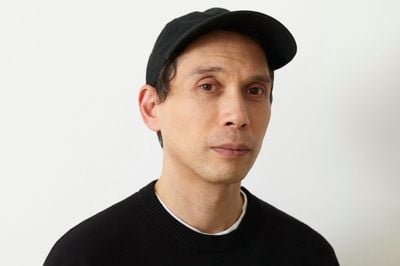
b. 1979, United StatesJosh Kline is an American artist known for creating immersive installations that use video, sculpture, photography, and design to consider how emergent technologies are transforming human life in the 21st century. Working mostly in long-form series and interlocking “chapters” such as Unemployment, Freedom, Civil War, Climate Change, and Social Media, Kline examines creative and service-sector labour, automation and AI, political propaganda, policing and protest, and the social and psychological fallout of climate breakdown. He frequently turns the very technologies and visual languages he scrutinises—digitisation, data collection, image manipulation, 3D printing, and commercial and political advertising—back on themselves, using them as materials and methods within his work.
Kline’s practice has been recognised through a major mid-career museum survey, Josh Kline: Project for a New American Century, at the Whitney Museum of American Art, and a solo exhibition devoted to his “Climate Change” cycle at the Museum of Contemporary Art, Los Angeles. His work has generated extensive critical discussion and is held in leading public collections, including The Museum of Modern Art, New York, and the Solomon R. Guggenheim Museum.
Life and Early Practice
Born in 1979 in Philadelphia, USA, Josh Kline studied film at Temple University in Philadelphia before relocating to New York in 2002, where he continues to live and work. He spent his early years in the city employed across the art and media worlds—as a curator and organiser of video and new‑media programmes at the non‑profit Electronic Arts Intermix in New York, as a studio assistant, and in other art‑adjacent jobs that kept him close to exhibition‑making and technology. During this period he worked with and around artists associated with EAI, including figures such as Dan Graham, gaining firsthand insight into performance, video and conceptual practices that had tested the limits of medium and institution since the 1960s and 70s. Rather than entering the field through a traditional MFA route, Kline emerged alongside a cohort of artists who did not pursue graduate art school but learned in studios, galleries, non‑profits and production houses, a background that informs his sensitivity to class, precarity and the infrastructures underpinning contemporary art.
Artistic Practice
Josh Kline’s practice centres on three interrelated bodies of mixed-media work: Creative Labor (2009–14), Blue Collars (2014–20), and an ongoing installation cycle that began with Freedom (2014–16) and has progressed through Unemployment, Civil War, and Climate Change (2019–). Each chapter comprises standalone works that address economic insecurity, contemporary politics, and the conditions of working life.
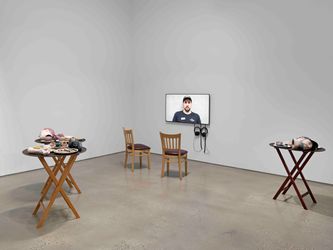
Creative Labor portrays cultural workers in an always-on, post-industrial economy, showing how personality, time and the body are mobilised as resources within digital capitalism, often through advertising formats, stimulants and stylised display. Blue Collars extends this focus to service-sector workers such as delivery drivers, hotel housekeepers and restaurant staff. Here 3D-scanned body fragments and interview videos are displayed in shopping carts, shelving and shrink-wrap, as in In Stock (Walmart Worker’s Arms) (2018) and Cost of Living (Aleyda) (2014), shown in America Is Hard to See at the Whitney Museum of American Art in 2015.
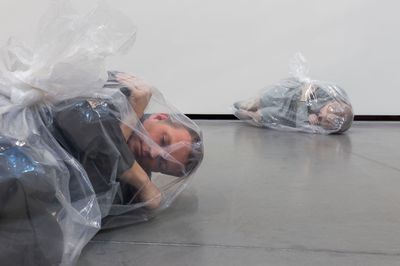
Beginning with Freedom, Kline’s untitled installation cycle considers the politics and economics of the 21st century, from networked protest and militarised policing through mass white-collar unemployment and a fractured United States to climate crisis and its effects on everyday life. Works from Unemployment and Civil War were central to the Whitney Museum survey Josh Kline: Project for a New American Century (2023), which brought together Teletubby police from Freedom, plastic-wrapped office workers from Unemployment, 3D-printed limbs, climate-refugee tents and political-style advertisements to link policy, technology and everyday survival. At the Museum of Contemporary Art, Los Angeles, curators presented Climate Change as an immersive group of installations combining film, sculpture, architecture and lighting, focusing on essential workers and displaced people in a warming world.
In recent projects such as Social Media, shown at Lisson Gallery, New York, Kline applies this critique to his own position as a mid-career artist. Works including Mid-Career Artist (2024), a 3D replica of his body sealed in a bag, and Professional Default Swaps (2024), studio tools overprinted with corporate and credit-card branding, use 3D scanning and office-like display to examine how artists themselves are treated as products within the contemporary art economy.
Alongside his studio practice, Kline has written about the structural conditions of contemporary art. His essay “New York Real Estate and the Ruin of American Art,” published in the Winter 2025–26 issue of October and released online in January 2026, argues that escalating real-estate costs, institutional power and a prolonged market downturn have made New York increasingly difficult for working artists, particularly those using time- and space-intensive media. In 2026, Kline is residence at STPI – Creative Workshop & Gallery in Singapore, developing new print and paper-based works that extend his interest in technology, labour and speculative futures.
Exhibitions
Kline has presented his work in a series of significant solo and group exhibitions that trace the evolution of his major bodies of work across the United States, Europe and Asia.
Select solo exhibitions
- 2024 –2025 Josh Kline: Climate Change, Museum of Contemporary Art, Los Angeles (with catalogue).
- 2024 – Social Media, Lisson Gallery, New York.
- 2023 – Josh Kline: Project for a New American Century, Whitney Museum of American Art, New York (first U.S. museum survey; catalogue).
- 2022 – Adaptation, LAXART, Los Angeles.
- 2020 – Alternative Facts, Various Small Fires, Seoul.
- 2019 – Climate Change: Part One, 47 Canal, New York.
- 2017 – Civil War, Stuart Shave/Modern Art, London.
- 2016 – Unemployment, Fondazione Sandretto Re Rebaudengo, Turin.
- 2016 – Unemployment, 47 Canal, New York.
- 2015 – Freedom, Modern Art Oxford, Oxford.
- 2011 – Dignity and Self-Respect, 47 Canal, New York.
Selected group exhibitions
- 2026–27 – Future Geographies: Art in the Century of Climate Change, Vancouver Art Gallery.
- 2026–27 – Guggenheim Pop: 1960 to Now, Solomon R. Guggenheim Museum, New York.
- 2026 – Studio Visit (curatorial project with Anicka Yi), Performance Space New York / Hauser & Wirth, New York.
- 2024 – 24th Biennale of Sydney, Sydney.
- 2024 – 8th Yokohama Triennale, Yokohama.
- 2019 – Whitney Biennial 2019, Whitney Museum of American Art, New York.
- 2019 – New Order: Art and Technology in the Twenty-First Century, Museum of Modern Art, New York.
- 2019 – The Body Electric, Walker Art Center, Minneapolis; and Yerba Buena Center for the Arts, San Francisco.
- 2016 – 9th Berlin Biennale for Contemporary Art, Berlin.
- 2016 – Suspended Animation, Hirshhorn Museum and Sculpture Garden, Washington, D.C.
- 2015 – 2015 Triennial: Surround Audience, New Museum, New York.
- 2015 – America Is Hard to See, Whitney Museum of American Art, New York.
- 2015 – Office Space: The Modern Workplace Disrupted, Yerba Buena Center for the Arts, San Francisco.
- 2013 – New Pictures of Common Objects, MoMA PS1, New York.
Josh Kline FAQs
Who is Josh Kline and what is his work about?
Josh Kline is an American artist, born in 1979 in Philadelphia and based in New York, known for immersive installations that use video, sculpture, photography and design to examine how emerging technologies, automation, and climate change affect work, class and everyday life.
What are Josh Kline’s major series or bodies of work?
Josh Kline’s practice centres on several interlocking series: Creative Labor (2009–14), Blue Collars (2014–20), and an ongoing installation cycle with chapters including Freedom, Unemployment, Civil War and Climate Change, all exploring labour, politics, and speculative near-futures.
What is ‘Josh Kline: Project for a New American Century’?
Josh Kline: Project for a New American Century was the artist’s first U.S. museum survey, presented at the Whitney Museum of American Art in 2023, covering more than a decade of work and highlighting themes of automation, climate crisis, propaganda and the future of the labour force.
What was Josh Kline’s ‘Climate Change’ exhibition about?
Josh Kline: Climate Change at MOCA Los Angeles (2024–25) included the artist’s fourth chapter in his installation cycle, using sculpture, video, photography, architectural sets and atmospheric lighting to imagine a hotter, more dangerous future shaped by the climate crisis, viewed through the lives of essential workers and climate refugees.
Why does Josh Kline talk about real estate and the art world?
In Josh Kline’s widely discussed essay “New York Real Estate and the Ruin of American Art,” published in October (Winter 2025–26), Kline argues that soaring real-estate costs, institutional consolidation and a weak market have made New York increasingly hostile to working artists, especially those whose practices require time, space and technical infrastructure.
Ocula | 2026



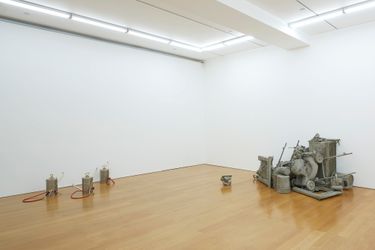
Representative Artworks









Explore and Follow Artists Shaping Contemporary Art
A respected voice in contemporary art discourse.
Focusing on ambitious storytelling and insightful art-world commentary. Ocula Magazine publishes in-depth interviews, critical essays and timely analysis on the artists, exhibitions and ideas driving the global art world.
Learn more about Ocula Magazine
Showcasing the best of the art world.
Ocula partners with galleries from around the world to highlight their artists, artworks and exhibitions. Gallery membership is by application and invitation, with each member vetted by an independent panel.
Learn more about Ocula Membership
Specialises in the sale of major artworks.
Led by a team with deep ties to the world’s leading auction houses, galleries and collectors. Ocula’s advisory team offers bespoke services to high-net-worth clients from around the world who are looking to acquire the best of contemporary and modern art.
Learn more about our team and services