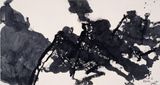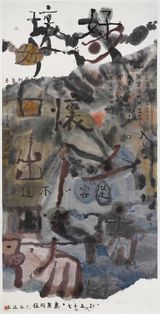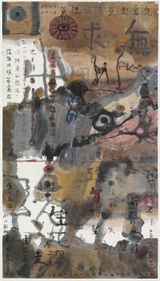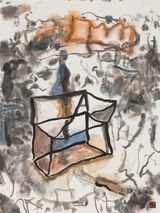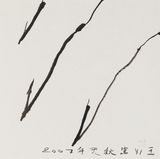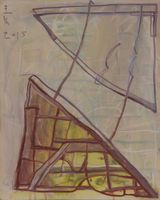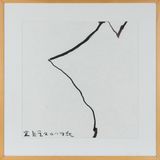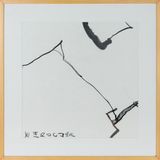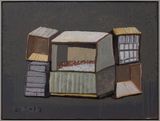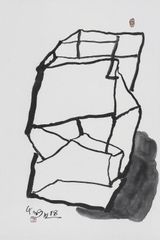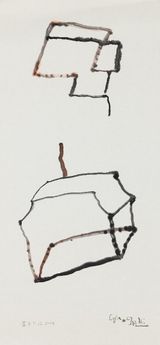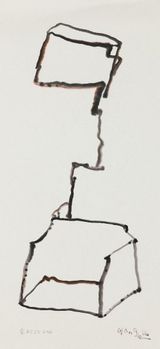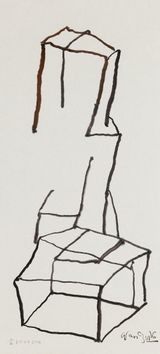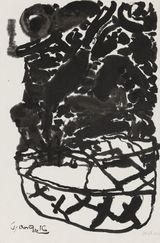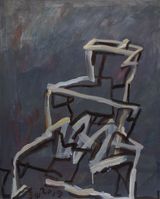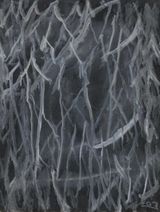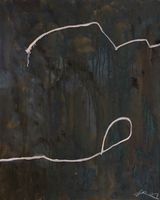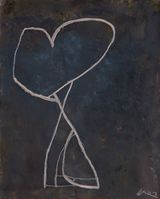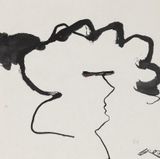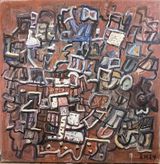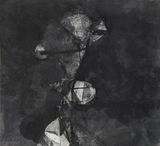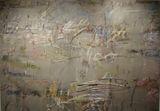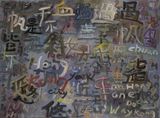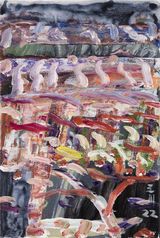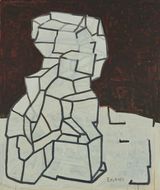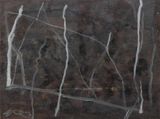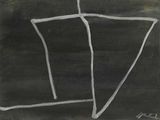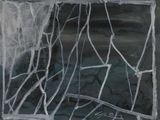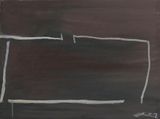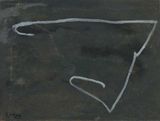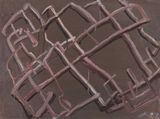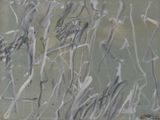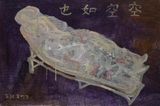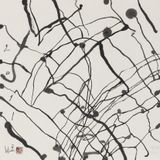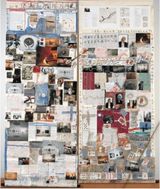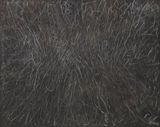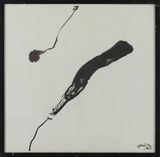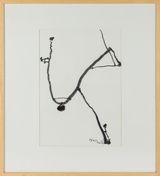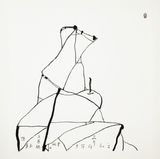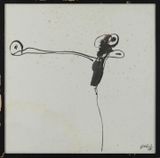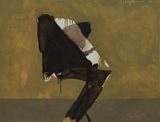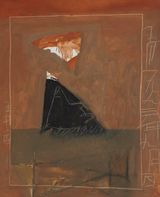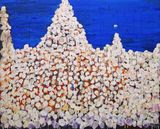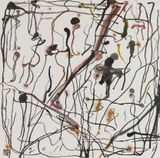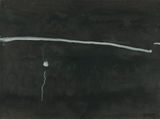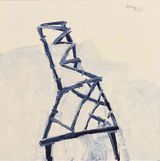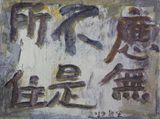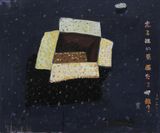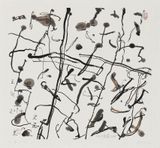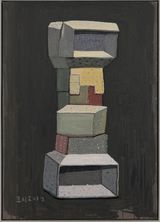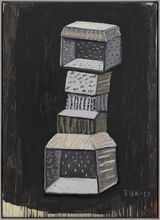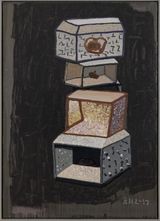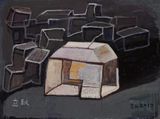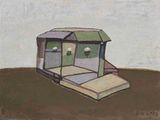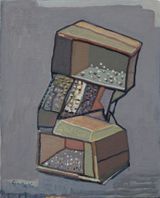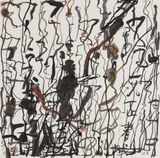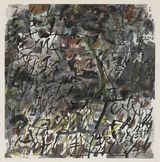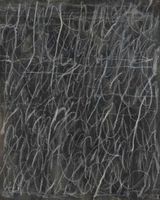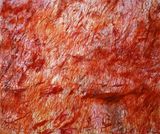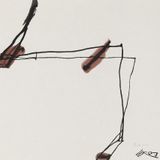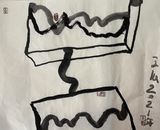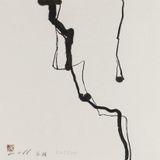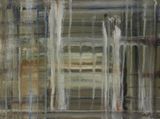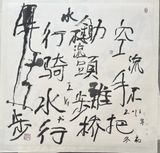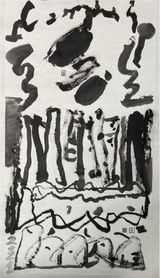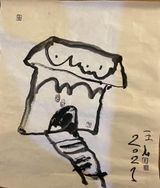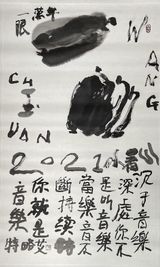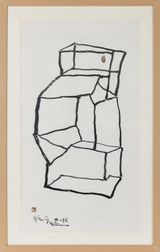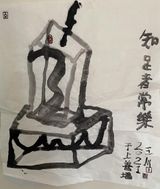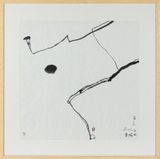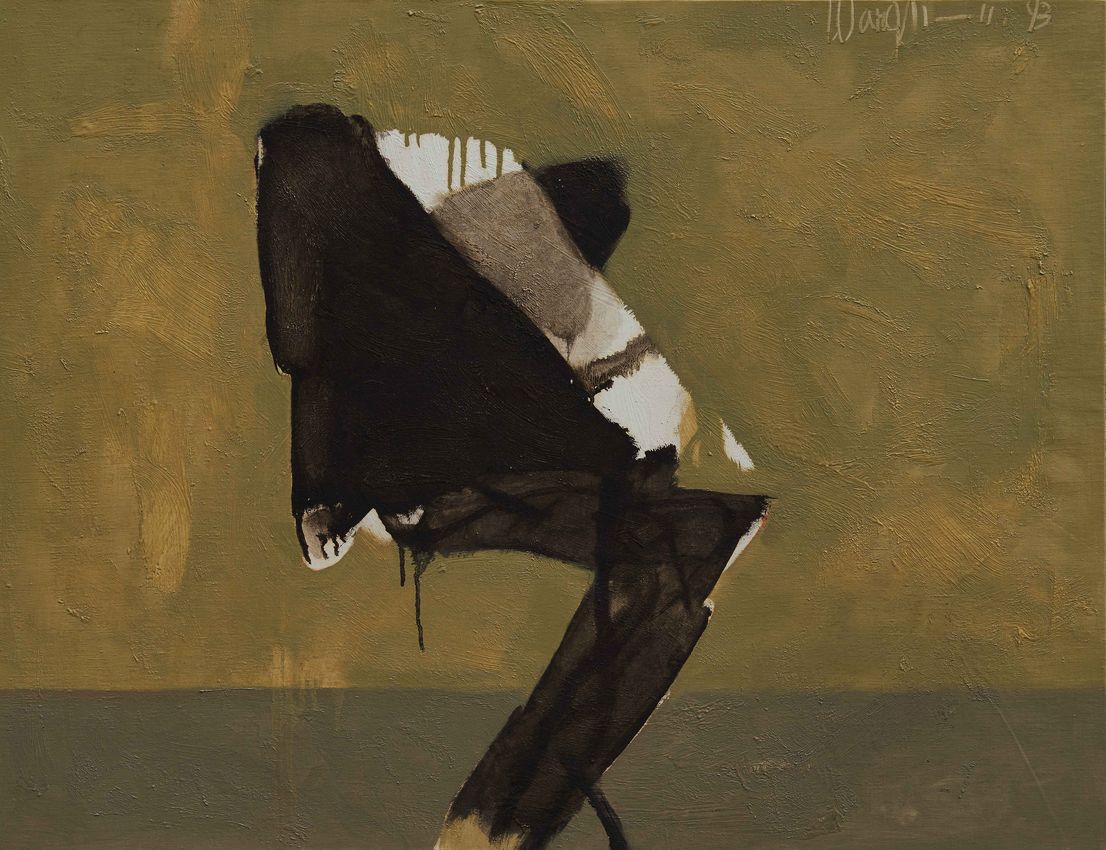
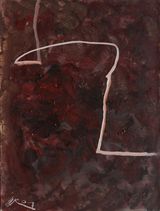
A Thousand Plateaus Art Space is pleased to announce the inauguration of Wang Chuan’s solo exhibition, The Path of Line on October 12, 2024, and continuing through December 20th. The exhibition will feature a selection of Wang Chuan’s works on paper and canvas created over the past decades, comparing them with each other, and using “line”, the basic element common to all forms of artistic expression, as the key clue of the exhibition. Throughout Wang Chuan’s works, his lines on paper and geometry on canvas echo each other, and his repeated practice of “line” always runs through and reflects his creative vein. In such a mutual relationship, the exhibition comprehensively presents Wang Chuan’s high-level experimentation in multiple mediums such as “画笔(brush)” / “毛笔(chinagraph)”, “布面(canvas)” / “纸面(paper)”, “框架(frame)” / “装裱(mounting)” and so on. It explores the alienation, complementarity, implementation and integration of Eastern and Western paintings, and conveys the artist’s attempt to dissociate the concepts of East and West, break the illusion of duality, respect the equality of mediums, and return to the simple inquiry into the essence of painting and the deep-seated inertia of personal consciousness by means of lines. Therefore, the attributes of lines are free from the artificially-added concepts, and lines can become a kind of joyful game.
Roger Fried has categorised “line” into “structural” and “calligraphic”. Western artists often use line as a turning point for “surface” to construct or break down a pictorial plane. It is structural, accurate and modifiable, whereas the “line” in Chinese painting is more of a natural push of the brushstrokes, withered and wet, thick and thin, starting and ending, it is calligraphic, self-contained, not overly accurate, non-modifiable and non-replicable. It is true that both the Chinese and the Western have different perceptions of “line”, and painters are trying to break out of their cocoons: to find a true “structure” and “unity” while making the relationship between line and form more fluid.
Wang Chuan has also respected this structure and the four borders of the picture for many years, although he never points to a specific object. He runs along the frame, and his awareness of boundaries enhances the impact of the central image. Wang Chuan’s perception of structure does not come from calligraphy per se, but rather a calligraphic fashion. One reason is that the fluidity of lines is naturally linked to handwriting. Wang Chuan’s images are composed of a variety of dots, and the dots are connected to each other, giving the lines an indeterminate sense of movement in space. The singular lines span the entire surface of the painting, and if we look closely, we can determine the order brought about by the dots. Lines overlap, interpenetrate and pause in space as the body’s rhythm changes and moves slowly, all of which require the artist to have an entire master of the structure. Then there is Wang Chuan’s belief that the essence of handwriting is the movement of the body to tell the inner impulses, and that this outpouring is one-time and instantaneous. Painting is even a physiological drive for Wang Chuan, maintaining a constant movement over time, forming a muscle memory and returning to a state of creation that requires extreme labor. Therefore, Wang Chuan’s calligraphic linearity is not necessarily causally related to calligraphy per se.
At the same time, for Wang Chuan, geometric culture is not directly related to the West. Briefly speaking, the ink wash is concerned about the back and forth of the tip of the brush, such as zhongfeng technique (literally as “centered-tip”) and cefeng technique (literally as “slanted-tip”). However, drawing or painting the line on canvas can be really free and easy, and its hardness and thickness are able to write out. In contrast, things on paper are more concerned about the thickness of the ink and brush, so how to master these two things mainly depends on how the artist thinks about the possibility of painting, the possibility of language.
Therefore, it is meaningless to roughly attribute Wang Chuan’s creative style to East or West, abstract or figurative. His painstaking exercise is a pure expression that strives for a state of unconsciousness that is infinitely close to that of a child. Adults, through their elaborate empiricism and acquired conceptualizations, are constantly corrected to achieve inner “rightness,” while immediacy is seen as an error that contradicts the primordial vitality of the child’s world. Painting requires a sense of vividness, and to go deeper you have to go beyond, otherwise you can’t constitute its thickness. At the same time, the process of painting releases many private personal experiences, and this privacy is exactly what Wang Chuan wants his works to present.
Born 1967 in Beijing, Wang Chuan (王川) graduated in 1990 from the Book Design Department of the Central Academy of Art and Design in Beijing. In 2000 he completed a Master of Arts in Visual Art from a joint program between the Central Academy of Fine Arts (CAFA) and Griffith University’s Queensland College of Art (QCA) in Australia. He is currently Director of the Photography Department in the School of Design, China Central Academy of Fine Arts.
A Thousand Plateaus Art Space was founded in 2007 in Chengdu, China. It is a professional gallery committed to present and promote China’s contemporary art. Equipped with exhibition hall for artworks and collection and screening room for video data, it is mainly on researching, presenting and promoting outstanding works and experimental projects of China’s contemporary art and culture, actively carries out domestic and international cooperation projects.

A respected voice in contemporary art discourse.
Focusing on ambitious storytelling and insightful art-world commentary. Ocula Magazine publishes in-depth interviews, critical essays and timely analysis on the artists, exhibitions and ideas driving the global art world.
Learn more about Ocula Magazine
Showcasing the best of the art world.
Ocula partners with galleries from around the world to highlight their artists, artworks and exhibitions. Gallery membership is by application and invitation, with each member vetted by an independent panel.
Learn more about Ocula Membership

Specialises in the sale of major artworks.
Led by a team with deep ties to the world’s leading auction houses, galleries and collectors. Ocula’s advisory team offers bespoke services to high-net-worth clients from around the world who are looking to acquire the best of contemporary and modern art.
Learn more about our team and services