Press Release

At the heart of Kaleab Abate’s debut solo exhibition you will encouter Addisalem, a fictional female character whose name means ‘new world’ in Amharic. The Addis Ababa-born artist invents Addisalem as a way of expressing his feelings towards the rapid change taking place in his city. Both an imagined lover and a reflection of Addis Ababa, Addisalem gives these complex emotions a place to reside, someone who can be loved, questioned and mourned.

Ethiopia’s capital, where urban development is reshaping the structures of the city and as a result the social relationships, everyday rituals, and collective memories embedded within it at a blistering pace. As neighbourhoods disappear and familiar gathering places give way to new structures, the city becomes increasingly recognisable in its ambitions for modernisation, but increasingly unfamiliar in its spirit. Addisalem is the soul of city: the neighbourhood café where conversations once unfolded, the streets that hold traces of childhood, the gathering places that have disappeared and the familiar rhythms of a city that no longer feels the same.

Abate’s artworks in this exhibition are intimate expressions of love and longing for his city. Through his artworks and accompanying handwritten letters addressed to Addisalem, he explores the growing distance between the Addis Ababa he remembers and the one taking shape around him. There is something almost like heartbreak in his relationship with Addis Ababa, and in the question that runs through the work: who am I without the city I know? Without the streets, places and everyday encounters that have shaped my sense of who I am?

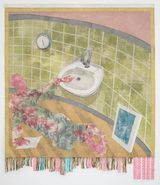
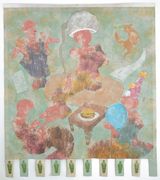
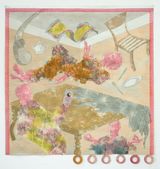
The artist approaches this question through images shaped by the visual and emotional textures of the city: its streets, buildings, faded walls, and fleeting encounters. Ordinary details become repositories of lived experience, carrying the accumulated presence of time and human connection. Against the increasingly polished surfaces of the modernising city, their imperfections are traces of life.

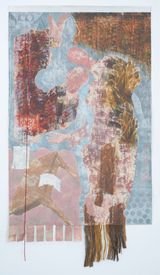
Layers of prints, overlapping forms, and fragmented shapes distort familiar structures, while faded colours and faces dissolve into hazy backgrounds. The compositions evoke the uncertain territory of memory, where fragments gather into stories whose details remain elusive. Like a half-remembered dream, the images hover between recognition and disappearance, inviting us to question whether what we see belongs to the present, the past, or somewhere in between.

Memory complicates Abate’s relationship with his city. Nostalgia can soften imperfections and turn ordinary moments into cherished memories, yet this does not make the experience of loss any less real. In Ethiopia, there is a word that holds much of what Abate expresses through his work: Tizita.

Often translated from Amharic as memory, remembrance or nostalgia, Tizita has no exact equivalent in English. Over generations, it has taken on a depth of meaning through the songs, stories and lived experiences of the Ethiopian people. It speaks of the tenderness with which we remember, the pain of absence and the ways in which the past continues to live in the present. It is within this cultural understanding of memory and longing that Abate’s relationship with Addis Ababa can be situated.

Rooted in the musical and oral traditions of the Ethiopian highlands, Tizita is also one of the four principal pentatonic modes of traditional Ethiopian highland music. Throughout the twentieth century, artists such as Mahmoud Ahmed, Alemayehu Eshete, and Tilahun Gessesse brought Tizita into popular music. Musicians such as Mulatu Astatke explored its melodic possibilities within Ethio-Jazz. Though, its significance extends far beyond its musical structure. Passed down through generations of musicians, Tizita has become a deeply embedded form of cultural expression.

Tizita evokes not simply a longing for the past, but an awareness of the distance that separates the present from what once was. Like a Tizita melody, Abate’s work lingers with what cannot be retrieved. It acknowledges that affection for the past can coexist with the knowledge that it has changed irreversibly.

While Tizita provides a culturally rooted emotional framework, the love letter, in its literal sense and metaphorically in form of artworks, materializes these emotions. We often write love letters when feelings become too overwhelming to be spoken out directly, when distance separates us from our loved one, or when we fear losing a connection that matters deeply. In a love letter we make ourselves vulnerable; tenderness, disappointment, gratitude and grief might coexist. In Love Letters to Addisalem, this intimate gesture becomes a way of addressing a city.

Lara Buchmann, Curator

Read More

Installation Views

Selected Works

Loading...
About the Artist

Kaleab Abate works across different media and techniques, with a focus on printmaking. His intuitive process allows materials, textures, and printmaking patterns to guide each composition. Bodily forms fragment, deform, and overlap into layered structures, some dense, others fragile or translucent, infused with a distinctive surreal sensibility.

View Artist Profile Kaleab Abate contemporary artist
About the Gallery

Founded in 2002 and located in Kampala, Afriart Gallery (AAG) is one of the leading international contemporary art galleries representing artists who live and work on the African continent. Our mission is to connect African artists to the global art market and audience, creating a fair and supportive environment where creativity thrives, and powerful ideas find their voice.

View Gallery Profile
Address
110-112 Seventh Street
Industrial Area
Kampala
Uganda
Opening Hours
Monday – Saturday
10am – 6pm
(1)
Kampala 110-112 Seventh Street, Industrial Area
Afriart Gallery
110-112 Seventh Street, Industrial Area, Kampala, Uganda

Opening hours
Monday – Saturday
10am – 6pm
The art world in focus