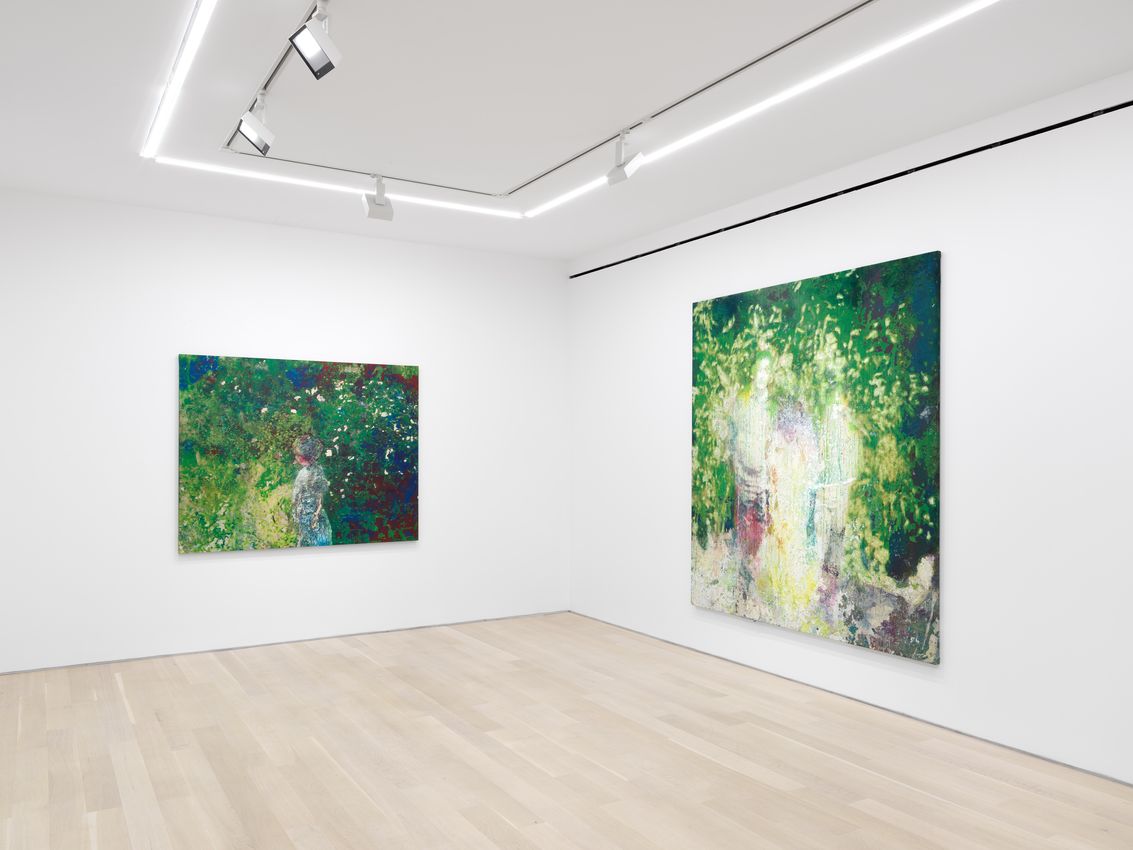
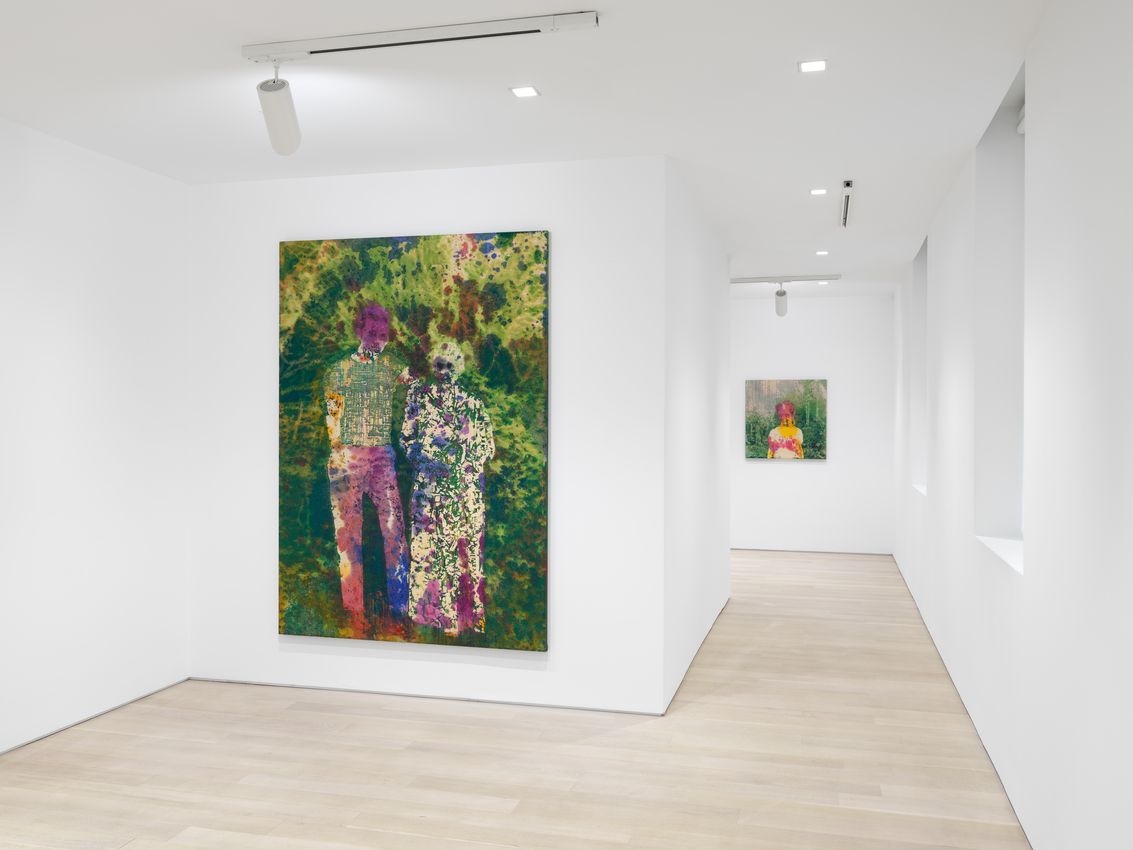
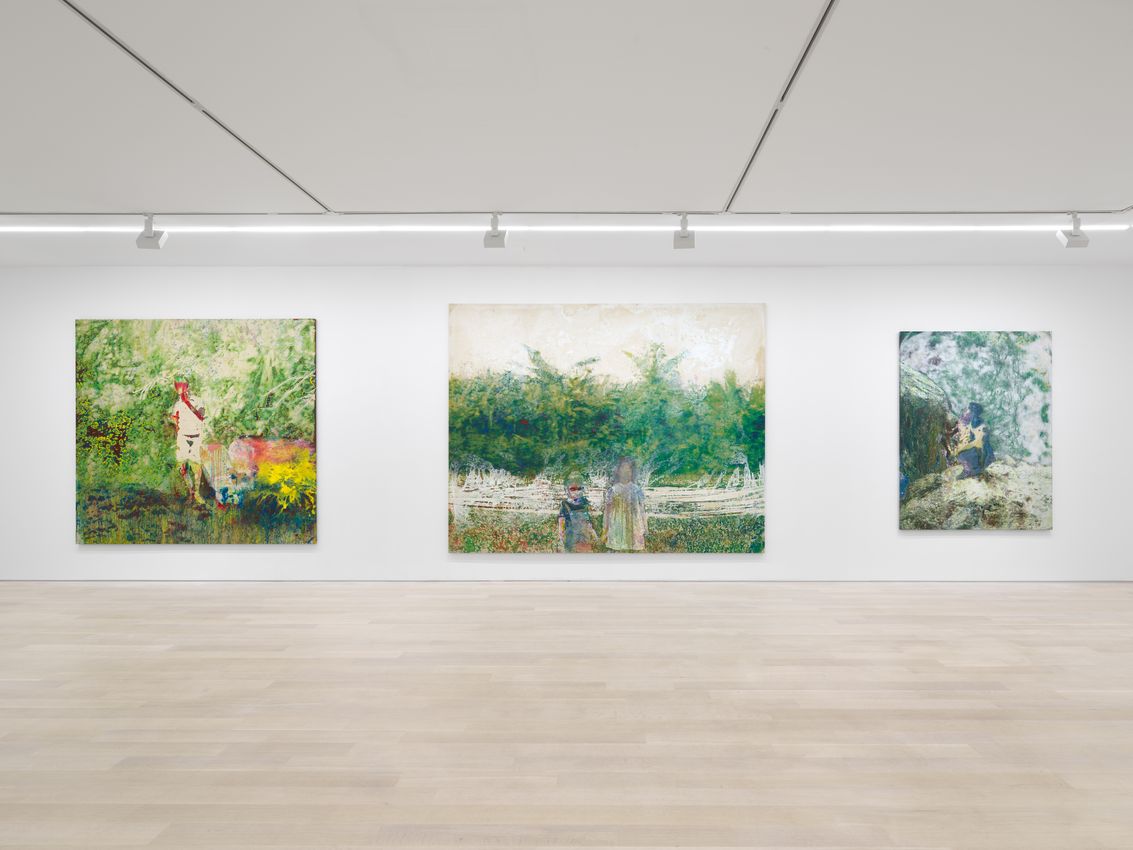
Memories are slippery and fickle. They can be both vivid and hazy, make us feel simultaneously closer and farther away from a certain time and place, and be shared by many while also remaining intensely personal. These inherent contradictions are at the heart of Alexandre Lenoir’s first solo show in the United States, Trois Rivières which comprises nearly a dozen paintings based on old black-and-white and sepia toned photographs belonging to his grandmother. Although Lenoir never met most of the people in these pictures, the photographs themselves are quite familiar to him as they have decorated the walls and shelves of his grandparents ‘house in Guadeloupe for as long as he can remember. Translating these fading photographs into large-scale paintings, Lenoir captures the ephemerality of disparate memories while emphasising their collective resonance.
The tension between distance and immediacy is a palpable in Lenoir’s paintings. Ethereal figures seem to shift in and out of focus as they vie for prominence with their verdant backgrounds. Human presence is strong, but also approximative due to blotchy and faint features that sometimes flirt with abstraction. Lenoir’s treatment of faces and bodies recalls the experience of seeing a negative image after looking at intense colors or a bright light for an extended period of time. The afterimage, itself a kind of memory, is a fleeting impression on the retina that lets us to see something that isn’t actually there. Lenoir, having looked at the figures in the photos with great intensity, captures their phantom afterimages in paint.
Behind the vaporous figures, Lenoir creates an illusion of depth through a labour-intensive process which involves many layers of paint, but notably creates barely any texture on the surface of the canvas. Working with acrylic and oil, Lenoir has adopted a technique that is perhaps more similar to printmaking than traditional painting. Before applying paint to the canvas, the artist covers certain areas with tape so that these masked forms remain untouched by that particular layer of colour. This process is repeated again and again, creating multiple colour separations directly on the canvas. Each finished work comprises anywhere between twenty and one-hundred coats of paint and likely required thousands of pieces of masking tape.
But for all this meticulousness, Lenoir also allows chance and experimentation inform his paintings. Like the distant memories they represent, Lenoir’s canvases are marked by holes and stains. These are the results of chemical reactions between various types of paints and solvents (which he applies liberally to the front and back of each canvas) and the rather violent process of removing the layers of tape from the surface. If the finished paintings bear traces of forces beyond the artist’s immediate control, this only underscores the imperfect and sometimes brutal activity of remembering.
Text by Mara Hoberman. Press release courtesy Almine Rech.

Representing landscapes of luxurious vegetation, interiors and buildings, Lenoir’s works often include characters as ephemeral as memories. Like flashbacks or dreamscapes, an ambiguous hedonism inhabits these visions, drawing on the multiple identities of the artist himself: one of Caribbean ancestry from his Guadalupian mother and where he lived during his youth; to Morocco and his formative artistic years; and finally to the industrial neighbourhood of Paris where today his studio is located.


Almine Rech opened its doors on April 1st, 1997 in the 13th arrondissement in Paris. The gallery was founded on an axis of California Minimal, Perceptual art and Conceptual art, representing artists such as James Turrell, John McCracken and Joseph Kosuth.

A respected voice in contemporary art discourse.
Focusing on ambitious storytelling and insightful art-world commentary. Ocula Magazine publishes in-depth interviews, critical essays and timely analysis on the artists, exhibitions and ideas driving the global art world.
Learn more about Ocula Magazine
Showcasing the best of the art world.
Ocula partners with galleries from around the world to highlight their artists, artworks and exhibitions. Gallery membership is by application and invitation, with each member vetted by an independent panel.
Learn more about Ocula Membership

Specialises in the sale of major artworks.
Led by a team with deep ties to the world’s leading auction houses, galleries and collectors. Ocula’s advisory team offers bespoke services to high-net-worth clients from around the world who are looking to acquire the best of contemporary and modern art.
Learn more about our team and services