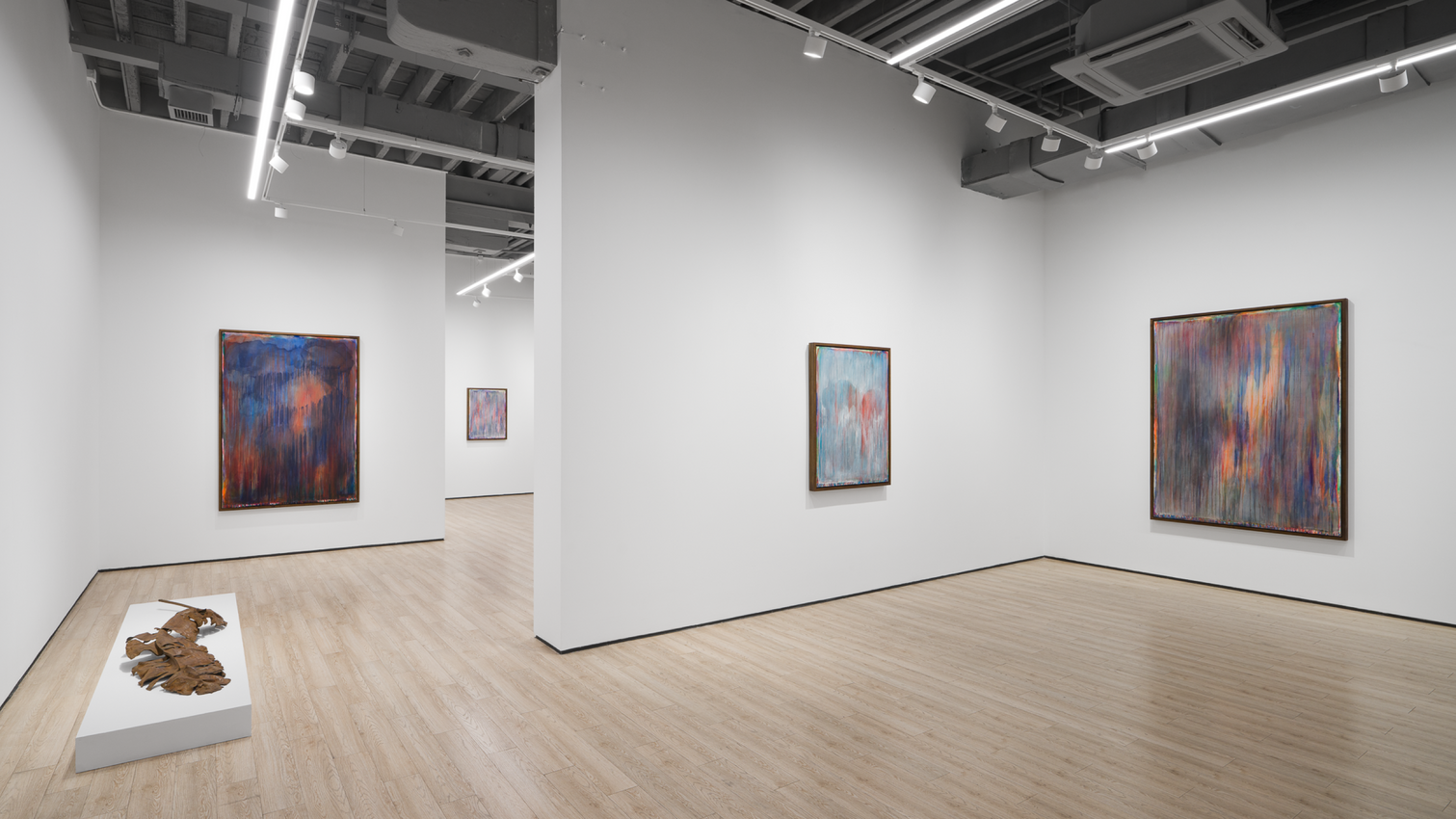


In Erik Lindman’s new works, the artist creates fresh abstract forms with a fine attunement to painterly details, constellated around various found surfaces and their treatment as compositional elements, surfaces, and supports. The majority of these new works are on primed or linen-wrapped panel that are affixed with thin sheets of aluminum or steel sheetmetal, which are disguised and revealed to varying degrees by the application of paint on and around them. Colors and forms tend to accrete in the center of the painting, framed by white or unpainted space.
These found elements, which were picked up on regular walks by Lindman around the neighborhood of his studio in Harlem, Manhattan, are handled in a way that is characteristic of the artist’s cogitative approach, wherein material economy becomes an entry point to a particular type of seeing. To the extent that these compositions restrict form, color, and representation, they may elicit a subtle awareness through the shifts in perception that occur as a viewer’s focus wanders between the process of painting and its effects.
In his use of metal, Lindman attaches the found element to the support invisibly, then builds up paint around its edges, bringing it nearly level with the surrounding layers of paint so that it appears practically embedded in the painting’s surface. Almost flush with the ground of the paintings, these metal sectors receive paint in uneven ways and emit a faint, irrepressible sheen. The complicated flatness of each composition becomes a stage to exhibit detailed wrinkles, scratches, and striations in the paint, margins where color and metal meet, and expanses of thin pigment stretched across scuffed reflective veneers.
Scrutinizing this paint on metal, we might add the layer of our own optical, tactile, and spatial experience. The vertical shape and human height of the pieces, along with their recurring narrow central figures, offer an analog to the instinctive, somatic self lying deep in our bodies. Awareness is a feedback loop created somewhere between our faculties and the object, while the boundaries of a painting could provide a theoretical if not a literal kind of mirror.
Lindman has also created several small works using fragments of steel welded to steel panels, occasionally adding oil paint. In these pieces, rather than inserting metal into a painting, the artist effectively creates the painting in metal; a stainless, enduring stand-in. But their modest scale diminishes any lingering bravado associated with their rugged materials and provides a counterpoint to the larger works on panel.
Presence, an ambiguous noun attributable to both humans and objects, could also be the invisible stratum differentiating a painting from an image. Lindman creates frameworks for examining this liminal terrain through a sensitive range of micro-variegations. Transmitting exchanges between light shining forth from alloy, absorbed into painted color or blank primer, these works imagine an encounter with the irreducible.
Erik Lindman (b. 1985) received his B.A. from Columbia University in 2007. He has had several solo gallery exhibitions including Blanks, Almine Rech Gallery, Paris (2015), Open Hands, Almine Rech Gallery, Brussels (2014), Do not touch doubtful things ribordy contemporary, Geneva (2013), Human Personality, Almine Rech Gallery, Paris (2012) and Studio, ribordy contemporary, Geneva (2012). His work is regularly shown in group exhibitions in Europe and the U.S, among them In Different Ways, Almine Rech Gallery, London (2016), The Shell: Landscapes, Portraits & Shapes: a show curated by Eric Troncy, Almine Rech Gallery, Paris (2015); The Painter of Modern Life organized by Bob Nickas at Anton Kern Gallery, New York (2015), Neo Povera, L&M, Los Angeles (2013); Pour une grammaire du hasard, Fri Art, Fribourg (2012); . Erik Lindman lives and works in New York.
Erik Lindman is by his own admission a painter who is not trying to change things as such. From his writing alone, one can gauge that his is a serious intent, nonetheless to add meaningfully, for his own time and generation, to the complex discourse of abstract painting in terms of its inherent content and subject matter. His earlier paintings reminded this viewer of the more simplified advanced abstractions, executed both as painting and as coloured paper collages, by Ljubov Popova and Olga Rosanova–two of the so-called Amazons of the Russian Avant-Garde. Today, Lindman attempts to achieve in his paintings a personal imagery that in its own way is part reminiscent of the Russian icon tradition. He amazingly succeeds in doing this in spite of the heavy burden of the abstract tradition of the last hundred years.


A respected voice in contemporary art discourse.
Focusing on ambitious storytelling and insightful art-world commentary. Ocula Magazine publishes in-depth interviews, critical essays and timely analysis on the artists, exhibitions and ideas driving the global art world.
Learn more about Ocula Magazine
Showcasing the best of the art world.
Ocula partners with galleries from around the world to highlight their artists, artworks and exhibitions. Gallery membership is by application and invitation, with each member vetted by an independent panel.
Learn more about Ocula Membership

Specialises in the sale of major artworks.
Led by a team with deep ties to the world’s leading auction houses, galleries and collectors. Ocula’s advisory team offers bespoke services to high-net-worth clients from around the world who are looking to acquire the best of contemporary and modern art.
Learn more about our team and services