Press Release

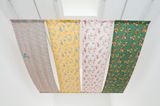
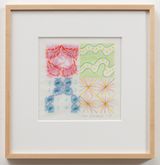
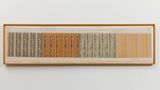
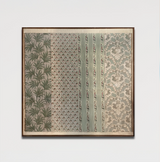
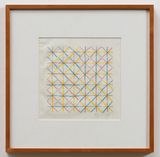
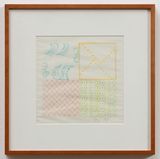
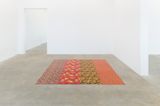
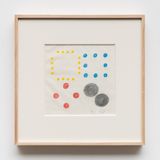
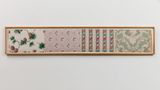
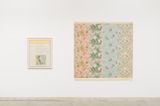
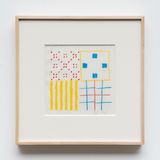
Anat Ebgi is pleased to present a focused survey of artworks by American artist Tina Girouard (1946–2020). The selection draws from works made during the 1970s including Sky Above, Earth Below (1974), major works from Walls Wallpaper and Test Pattern drawing series, along with a selection of performance documentation, highlighting works the Girouard created in Europe during this period. This presentation marks the artist’s first solo exhibition in Europe since 1984 and a return to Basel since Holly Solomon Gallery presented her work there in 1977.
Art Basel Unlimited: Faith Wilding

Completed in 1982, Faith Wilding’s Natural Parables is a 12-piece work that comprises pairings of large watercolour-drawing hybrids with corresponding oil paintings on shaped masonite panels. Installed above or near their illuminated pair, the six parables fuse two branches of Wilding’s practice: exploration of mythological narratives and highly detailed imagery inspired by nature.

The creation of the Natural Parables marked the culmination of years of research into female mythologies, paganism, Romantic poetry, illuminated herbals, bestiaries, and alchemical manuscripts. Its layered symbolism and formal complexity reflect Wilding’s rich thematic interests, which carried throughout her career, while also exemplifying a moment of careful conceptual planning in her typically intuitive practice.

Each element of this allegorical epic reveals Wilding’s distinctively diaristic and searching approach to image making. Layers of meaning emerge through quotations of dreams and visions, musings on alchemy, and recorded memories. Maps, diagrams, and poems are coupled with Wilding’s primordial imagery of mystical creatures such as dragons and mandrakes, roots, leaves, limbs, pods, shells, and totems. Her application of color and embellishment through abstracted forms delves richly into emotional ideas of women’s transformation and into the metamorphosis of the natural world through human intervention and destruction.

The commingling of handwritten script and visual iconography frequently appears in Wilding’s early work, but it takes a greater significance following a research trip to London in 1976. She travelled to study illuminated manuscripts in the British Museum, fascinated by historical and elaborate examples of verbal and visual notations. And it marks a shift in her works as she began incorporating in-laid elements, gold leaf, and intricate gestural moments that become an expository site. Through deepening connections with ancient and historic traditions, Wilding sought to develop alternative metaphors and new imagery—breaking from the male dominated art historical canon that emerged from Judeo-Christian systems.

Throughout the 1960s and 70s hard-edge, minimalist, and colour field abstract painters experimented with shaped geometric canvas supports, breaking from the rectangular format of traditional painting. In this lineage, Wilding’s Natural Parables went a step further; seeking organic forms, the six panels are: a shrouded body, a leaf, a husk, a rose, a seed pod, and a pregnant chrysalis. These shapes emerged from her Leaf Series (1976-77) of cut canvas paintings, where Wilding used biomorphic abstraction of plants as symbols to point toward the cyclical nature of life. Challenging painting conventions, she created an apparatus of image-objects using nature as a metaphor for transformation, rebirth, and revitalisation.

The forms explored in Natural Parables stem from a life-long unification of art and the body, of both image and nature as political sites, revealing the inseparability of humanity and the natural world. Wilding often makes simple sketches and small drawings iterating forms in graphite and ink prior to completing more complex works that incorporated temperamental technique-intensive materials such as gold leaf or detailed narrative elements exemplified in her Scriptorium series of the 1980s. Wilding planned in advance and executed Natural Parables according to a structured drawing, where she outlined the symbols and themes the work would elaborate on including, birth, death, war, redemption, fecundity, worship, hope, and possibilities.

Within Wilding’s oeuvre, Natural Parables represents a pinnacle moment where she articulates her own system of representation, illustrating interconnection between beliefs, mythologies, dreams, and fantasy worlds. Diagrammatic and discerning, Wilding forms an elegy for the dying world and an ode to the world to come. In the sixth parable she situates herself in this cosmology with a small text that encircles the page:

I am a spear that roars for blood

I am a salmon in a pool

I am a lure from paradise, from paradise

I am a hill where poets walk

I am a boar ruthless and red

I am a breaker threatening doom

I am a tide that drags to death

I am an infant, who but I peeps from the unhewn dolmen arch?

I am the womb of every holt

I am the blaze on every hill

I am the queen of every hive

I am the shield for every head

I am the tomb of every hope

Wilding’s poetic voice is powerful and assertive. She gives utterance to the embodiment of earth, creature, and ideas. In the drawing, this text wraps around a central ovoid form with a central blue sphere, solid and geologic, an all knowing oracle, delicate like a braid, exalted like a crown. In this final parable, Wilding puts forth a triumphant resolution of hope, full of possibilities and the unveiling of truths.

Read More

Selected Works

Loading...

Artists Exhibiting

Also Exhibiting at Anat Ebgi

The art world in focus