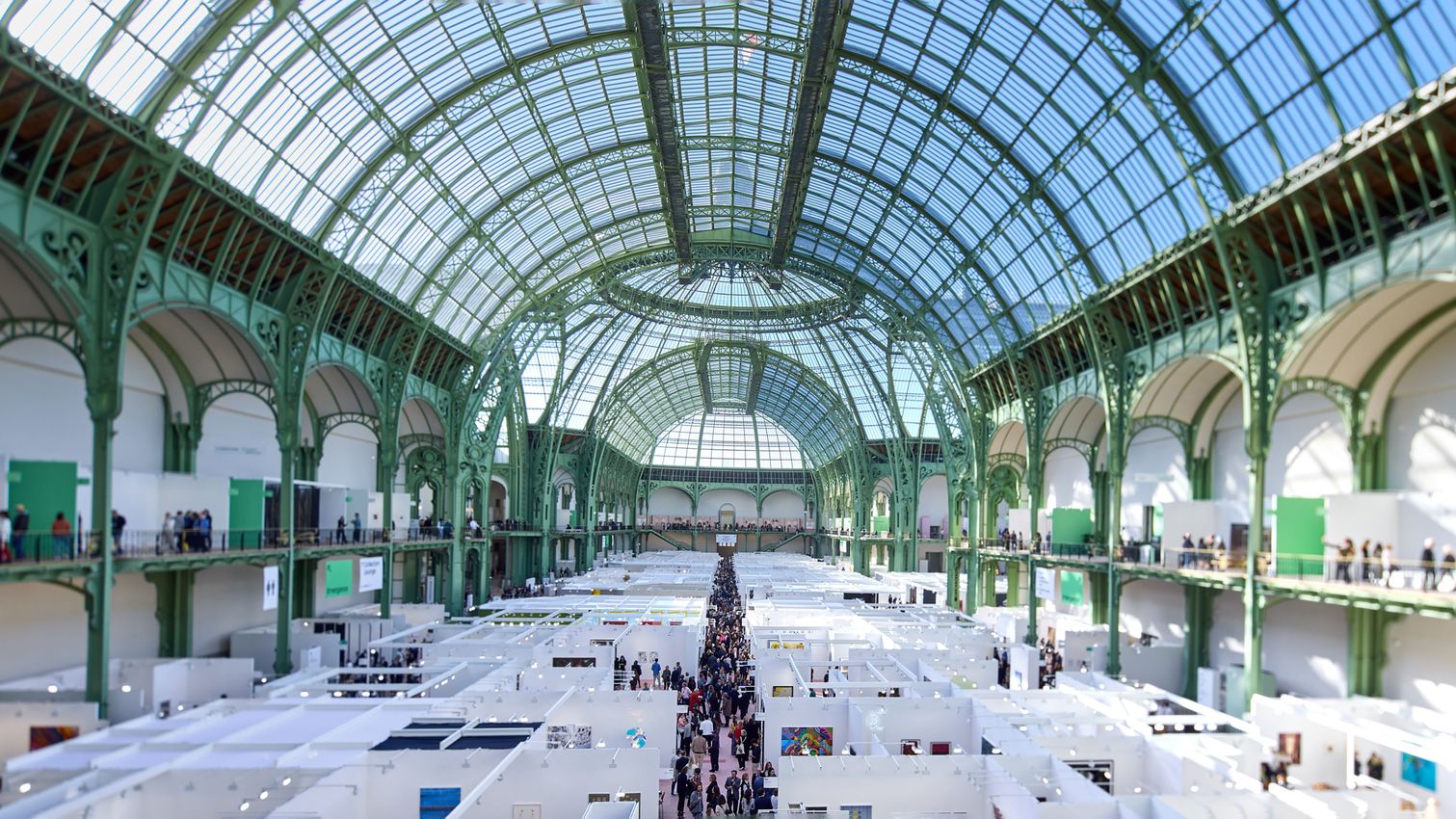
Press Release

For the second edition of Paris+ par Art Basel, Galerie Barbara Wien is delighted to present salient works that reflect our current times in meaningful ways by artists representing different generations from a diverse range of cultural backgrounds. Our showcase will include works by ERIC BAUDELAIRE, NINA CANELL, IAN KIAER, DANIEL LIE, DAVE MCKENZIE, SHIMABUKU, and HAEGUE YANG.

French artist and filmmaker ERIC BAUDELAIRE (b. 1973 in Salt Lake City, US) began his artistic career in the field of photography. Right from the start, his projects addressed social, cultural, and political phenomena. In light of the war in Ukraine, we will revive Baudelaire’s first work as an artist: “Imagined States” (2005). This photographic series was captured in Abkhazia, a small partially recognised state in the former Transcaucasian republics, whose political status has been a central issue of the Abkhaz–Georgian conflict and Georgia–Russia relations. Destroyed by war, it exists as a state solely through the will of its inhabitants. Additionally, we will be showcasing a series of graphic works from Baudelaire’s most recent project, “What it is of” (2023), in which he uses a tychoscope – a tool invented to conduct parapsychological research – to create drawings. Delving into the perimeter between the paranormal and our real world, this project will also be at the centre of his next solo show at our Berlin gallery, opening November 17th, 2023.

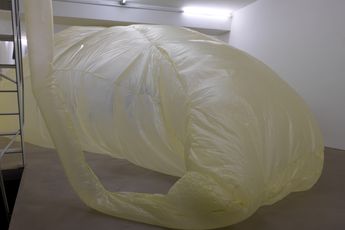
In her minimalist, conceptual, and poetic sculptures and installations, Berlin-based artist NINA CANELL (b. 1979 in Växjö, Sweden) draws the viewer’s attention to invisible systems and phenomena – natural and human-made – that surround us. Her work “Brief Syllable (Wrecked)” (2019) features a fragment of a disused power cable connected to a plinth-like concrete element. The formal quality of the “ready-made” thus presented lends the work the presence of a classical sculpture and at the same time refers laconically to its previously “lived” function of conducting electricity, with all its infrastructural, ecological, and other implications. The sculpture’s formal resemblance of models used in biology classes and its allusion to material presentations at industrial fairs witness the humour inherent in Canell’s practice.

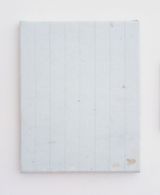
In his work, IAN KIAER (b. 1971 in London, UK) draws upon utopian approaches to architecture, literature, philosophy, and art. His painting “Melnikov project, light grey (large)” (2012), references the special attention that Russian architect Konstantin Melnikov paid to the structural engineering of the floor in his iconic cylindrical house studio. Kiaer’s painting, a monochrome trace of his own studio floor, presents a surface of significance for the hermetic production of work. It also investigates Melnikov’s relationship to painting, which he turned to in the early 1930s when Stalinist censorship prevented him from practising as an architect.

In his painting “Endnote oblique, pink (blue)” (2023) Ian Kiaer resumes the game of balancing conceptual choice and chance. This painting is part of a new body of work Kiaer developed for his current solo show at Galerie Barbara Wien in Berlin, his first show focusing purely on painting.

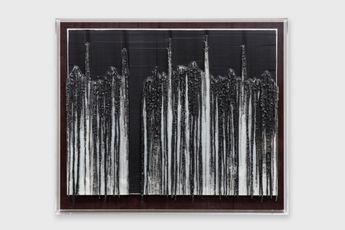
DANIEL LIE (b. 1988), who was awarded both the Ars Viva Prize and the National Gallery Prize this year, will be celebrating their international fair debut with our presentation of their work in Paris. Their practice comprises performances, drawings, and large-scale installations based on long-term research into topics around time, our fraught understanding of death, and its underlying binaries and taboos. At Paris+, we are showcasing one of the sculptures that Lie developed for the installation “Grieving Secret Society,” a commission for the Carnegie International 2022. Fabrics dyed with turmeric are draped as hanging sculptures. They are “Members” of the “Grieving Secret Society,” created from recycled materials of Lie’s large-scale installations.

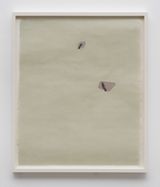
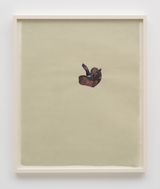
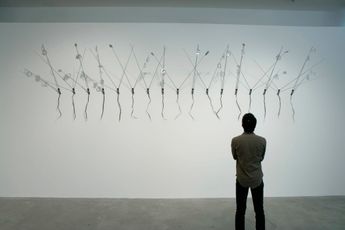
DAVE MCKENZIE (b. 1977 in Kingston, Jamaica) broaches issues of Black identity by investigating the ways in which gestures – such as, hands in pockets, shoulders askew – when exercised by Black bodies are said to signal danger or the need for surveillance. “Furtive Movements (Post Movement Study #1 & #2)” (2018) are collages that McKenzie created in connection with a namesake performance, looking at the self-surveillance Black bodies are continuously forced to exercise. McKenzie’s artworks are often an instrument of communication, of interaction, and of the filling of voids. An example of this is his painting “Proposal” (acrylic on linen, 2007), also on view at our booth, in which he proposes to meet with him once a year until one cannot or will not.

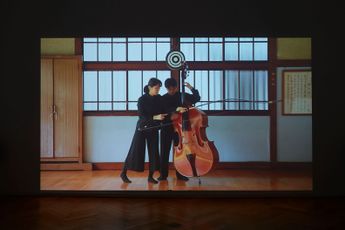
All works by SHIMABUKU (b. 1969 in Kobe, Japan) originate in the artist’s minute observations and are a mixture of respect and curiosity for the new and strange. Experiences with nature, animals, eating habits, forms of behaviour, the details of daily life, and the cultural techniques in different areas of life and societies in which Shimabuku lives and travels are the subject of his art. In his film “Sea and Flowers” (2013), which we are presenting at Paris+, Shimabuku pours a basket of bright pink petals into the sea. The film, without sound and commentary, only shows the movement of the leaves on the water as they disappear further and further. Presented next to the video is a quote from the artist:

“One day, I saw a red flower floating in the waves at the coast. Will this flower drift away from here to some far place? I wondered. And I thought of the day when these flowers, long ago, drifted here from the continent across the sea. Where will they go, the flowers I cast into the sea? Will they eventually arrive somewhere?”

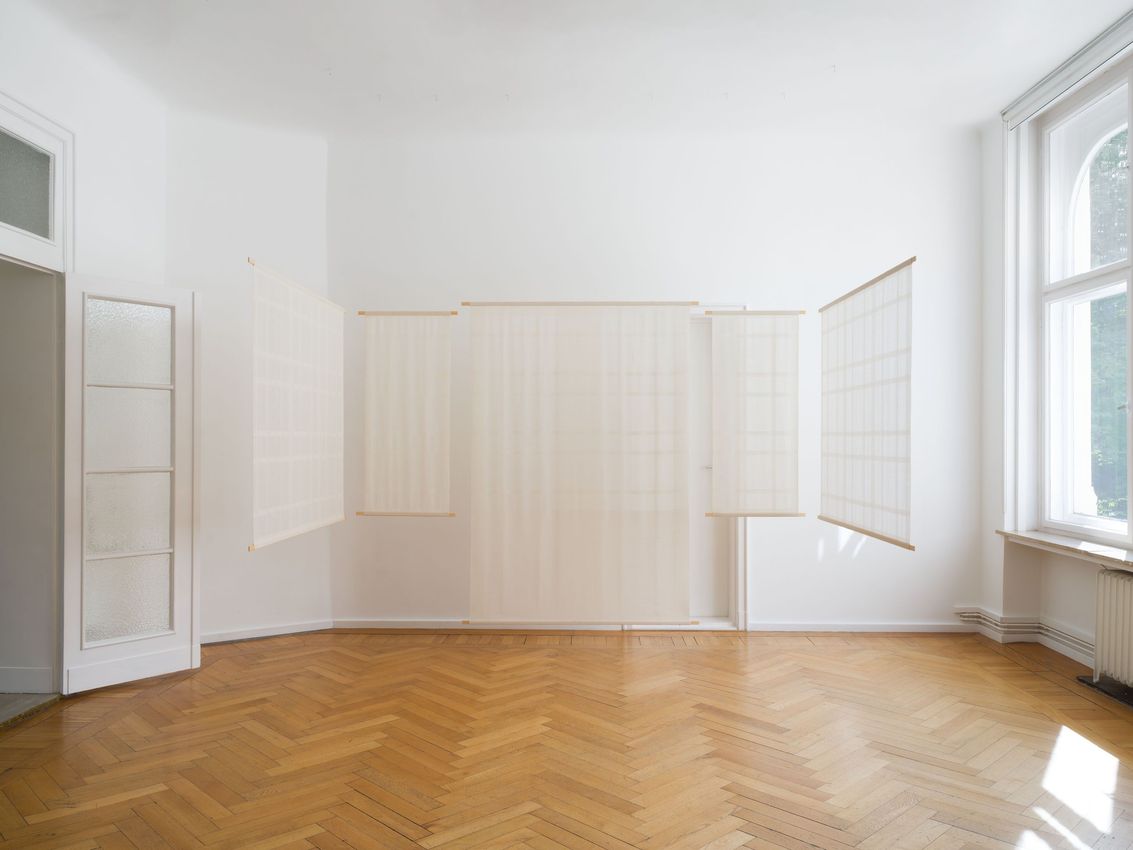
HAEGUE YANG’s (b. 1971 in Seoul, Korea) work negotiates and traverses boundaries between different geographies, historical eras, and artistic styles. Recently, she has been expanding her series of “Mesmerizing Mesh” collages – made of hanji, Korean mulberry silk paper – into the sculptural realm. At Paris+, we are presenting “Mesmerizing Two-Leaf Folding Screen – April Showers Soul Glyph #5” (2022), a free-standing sculpture that evokes connotations to paravent-like furniture. “Mesmerizing Mesh” collages are inserted into the upper part of each of the folding screen’s wooden wings. The collages each have a Chinese character at their centre – “春” (meaning spring season) and “心” (meaning mind, thinking, heart...) – referring to the titular “April Showers”. The folding screens expand Yang’s series of “Mesmerizing Mesh” collages and represent a variation of the artist’s practice of spatial interventions that simultaneously conceal and reveal more broadly.

EXTRA: ROBERT FILLIOIU (1926–1967), strove for a radical opening up of the concepts of art, with any means, any form, and any working method equally able to produce art. In January 1962, the artist founded his own gallery in the form of a cap. This Galerie Légitime draws on Marcel Duchamp’s idea of a miniature museum in a suitcase. This enabled Filliou to open his exhibition for anyone at any time and at any place: in the streets, in bistros, in shops, or in museums. His cap later grew to the size of a bowler hat, and then a top hat containing works by artist friends, and was sold in Perspex versions. This print edition refers to Fillious’ gallery in a hat, adding colourful hats to Paris’ main landmarks. Editions of this print are part of renown international collections including the MoMA, NY.

Read More

Artists Exhibiting

Also Exhibiting at Barbara Wien

The art world in focus