Press Release

In her third solo exhibition at Galerie Barbara Wien, Mariana Castillo Deball is driven by her project Who will measure the space, who will tell me the time? (2015).

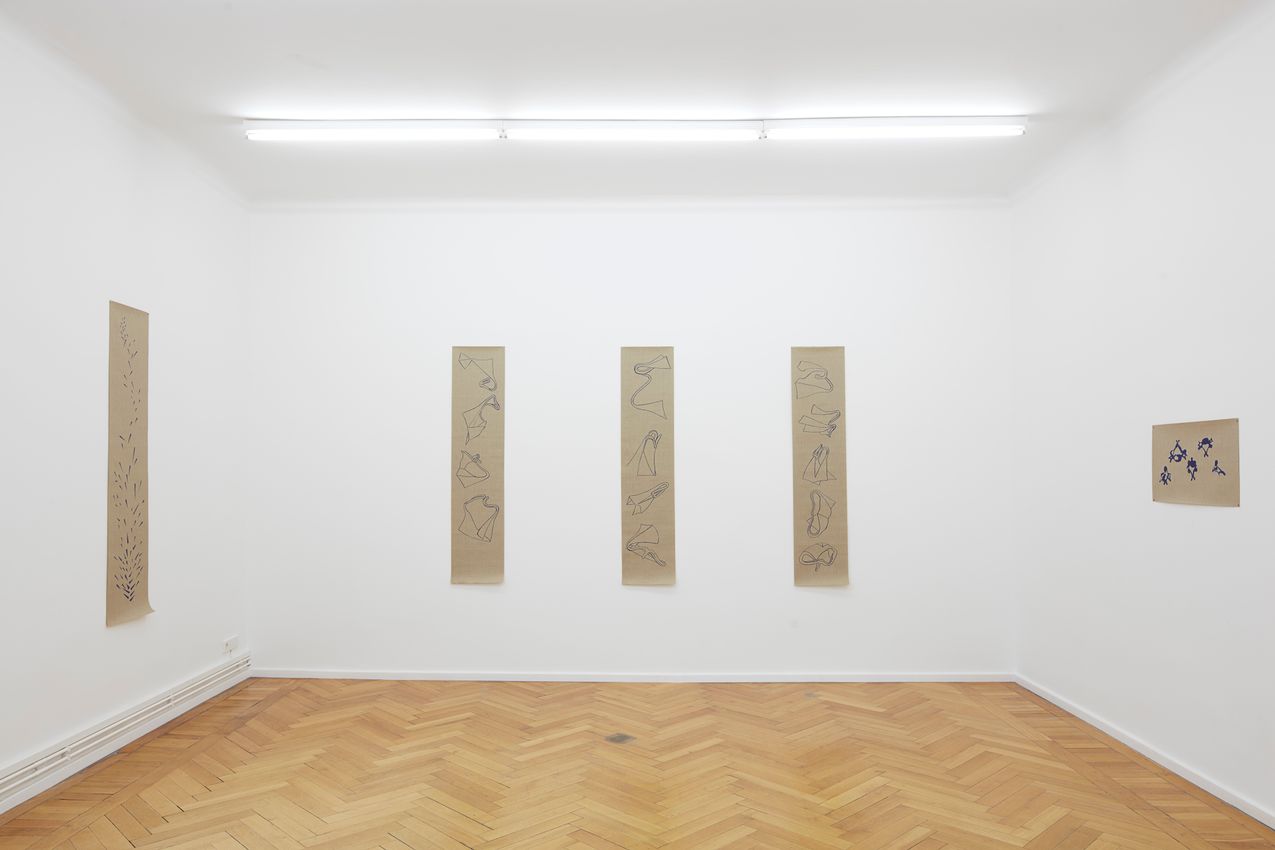
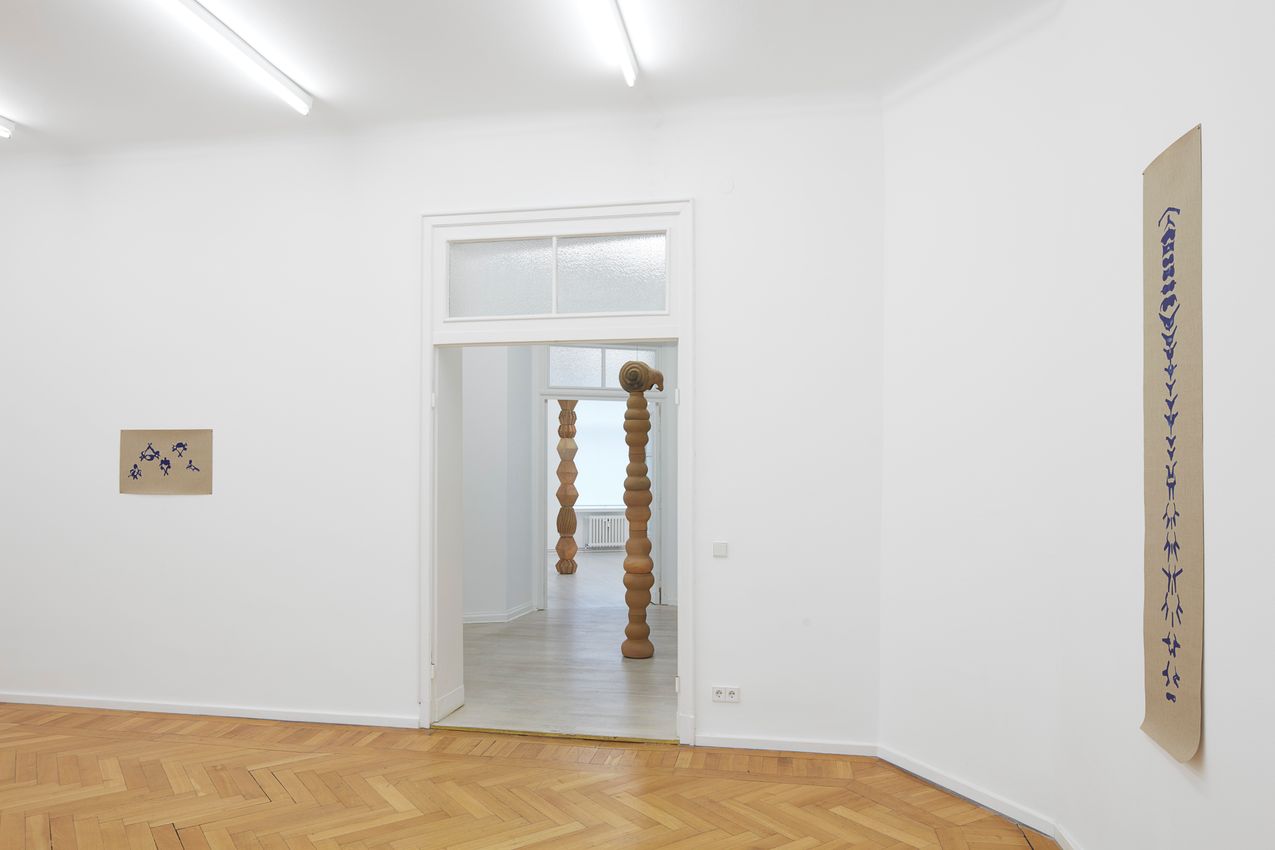
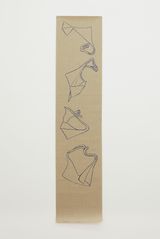
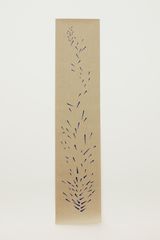
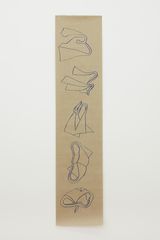
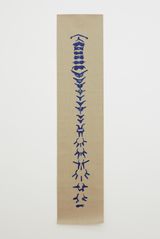
The sculptures of the project were first shown in the Museo de artecontemporáneo de Oaxaca (Mexico)(1), then in France, at Musée Régionald’Art Contemporain Languedoc-Roussillon (Sérignan).(2) The presence ofthe columns is developed further in the Berlin exhibition Reliefpfeiler, benefitting from the selection and composition of the other works ondisplay. They are accompanied by a series of drawings and the fourthissue of the artist’s collaborative research journal Ixiptla (herededicated to poetry and published in November 2015 by Wiens Verlag andBom Dia Boa Tarde Boa Noite in Berlin).

The initial question for the project was what relationship the Atzompapotters have with their archeological heritage and how it is expressed,contaminated or dissolved in the present. Far away from taking a puriststance, this work began with a series of discussions on the copies,forgeries, style changes and influences in the history of Mexicanarcheology. Together with Kythzia Barrera from the institution Innovando la tradición and the family Martínez Alarzón from Atzompa, Deball visited thearchaeological museum Rufino Tamayo and selected their favorite pieces.To this set of pieces, they added a lot of nuts and gears found inRamiro Alarzón’s workshop, also a whipping top, a ball, and otherbelongings, to form a repertoire, a vocabulary to tell own stories.

The procedure was similar to the surrealist exquisite corpse, Chinesewhispers or any other assembly or gossip that adds fragments gradually.The group split in two. The main exercise was to develop a story of twovarieties: one that would take place over one hundred years and one thatwould span just one day.The collaborators ended up with two stories ofthe origin of the Universe in the two different timespans. Deballwrites: “The two stories are almost the same, which got us thinking.Then came the story of the journey of a potter, since he wakes up atdawn to prepare the clay until he finishes the pieces, burns them, andthen leaves to sell them in order to buy corn to eat. And then everycharacter became clay, and we ordered them in columns to reach theceiling, so visitors can surround the stories of top-down andbottom-up.”

As is her habit, Deball prefers to pose questions rather than offeranswers, generating a space for collaboration and discussion. Indeed,each of the columns constitutes a material response to the twoquestions:

– How to tell the story of the universe in a hundred years?

– How to tell the story of the universe in one day?

Thus, we are facing elevated rebuses. Several patterns can be identifiedamong the different ceramic modules: pre-Hispanic figures (from RufinoTamayo’s museum collection in Oaxaca), screws, toys or even Brancusi’sfamous rhomboids from the Endless Column. Pottery is the central trade among the population of Atzompa, and the columns play with thisancient tradition to question authenticity, displacing the craft withincontemporary art contexts. Somehow, archeological fantasies fix theevolution of ceramic craft. Mingling the traditional and thecontemporary in a grotesque hybridization, Who will measure the space, who will tell me the time? re-appropriates and releases a repertoire of patterns. Theseexpressions defy a simulated or merely intellectual encounter betweencraft and contemporary art. Here, indeed, the two realms do not collide,but are instead produced within each other.

As an alphabetic tic, we compulsively attempt to decipher meaning withinthe patterns, reading them as words that constitute a coherentsentence. However, the columns are not comprehensive puzzles, butinstead propose an alternative system. Even as the columns embody “grandnarratives” (here the “story of the universe”), subjectivity rendersthe answers arbitrary. Who will measure the space, who will tell me thetime? could be seen as a playful re-appropriation of “universal history”through local and individual imaginaries. Thus, Deball challengeslinear coherence to allow for a discontinuous narrative where ancientand contemporary, history and myth, true and false, authentic andreplica meet. The trope of verticality (which appears throughout theexhibition, notably in the drawings) is significant here. It offers aninteresting alternative to horizontal linearity, which is privileged inWestern spheres as representative of time and history (for example, thechronological frieze to be read from left to right). Palindromic, thevertical column works both ways, defining neither beginning nor end.

In Reliefpfeiler, Castillo Deball does not comment on “grand narratives” themselves but rather reflects on the different systems thatgenerate their representations. Thereby, she draws from several modesof language and their histories, creating a tension where images,reliefs, matter, colors, words and composition become interrelated.

(1) ’‘Quién me dirá el espacio, quién me dirá el momento ?’’, Museo dearte contemporáneo de Oaxaca maco, Oaxaca, Mexico, 24.01. - 20.04.2015

(2) ’‘Cronotopo’’, Musée Régional d’Art Contemporain Languedoc-Roussillon, Sérignan, France, 28.06. - 30.08.2015

(press release in collaboration with Gauthier Lesturgie)

Read More

Installation Views

About the Artist

Mariana Castillo Deball (b. 1975, Mexico City) lives in Berlin, Germany. Castillo Deball works in installation, sculpture, photography and drawing, exploring the ideologically constructed conditions under which artefacts appear in today’s culture. She takes on a kaleidoscopic approach to her work, culling information from various disciplines such as archaeology and science, and through research and collaboration, creating works that arise from the collision and recombination of these different languages.

View Artist Profile

Also Exhibiting at Barbara Wien

About the Gallery

Based in Berlin’s central Tiergarten district, Barbara Wien is an established contemporary art gallery with a focus on conceptual art. Since Barbara Wien opened her namesake gallery in 1988, it has also operated a bookshop, selling artist books that date as far back as the 1960s.

View Gallery Profile
Address
Schöneberger Ufer 65, 3rd floor
Berlin
Germany
Opening Hours
Wed – Sat 12–6pm
(1)
Berlin Schöneberger Ufer 65, 3rd floor
Barbara Wien
Schöneberger Ufer 65, 3rd floor, Berlin, Germany
+49 30 28 38 53 52
http://www.barbarawien.de

Opening hours
Wed – Sat 12–6pm
The art world in focus