Hu Xiaoyuan’s latest solo exhibition at Beijing Commune, The Sand from the Urns has the potential to bring the spectators into the site where puzzling ways of perceptions grow from. A total of three series of installations are scattered inside and outside the walls on which the colour of light cold grey was chosen by the artist with particular means. Amid these two irregular exhibition spaces are the artist’s implicit observations, imaginations, and wonders deriving from her everyday life. Throughout her artistic practice, Hu Xiaoyuan constantly investigates and revisits the very process of ‘becoming’, and that further leads her to such works that stand in between tangibility and intangibility, fleetingness and eternality. As much as Hu Xiaoyuan wraps her perceptions of individual living subjects in the materials, she also endows them with enough room wherein a wide range of reflections could brew.
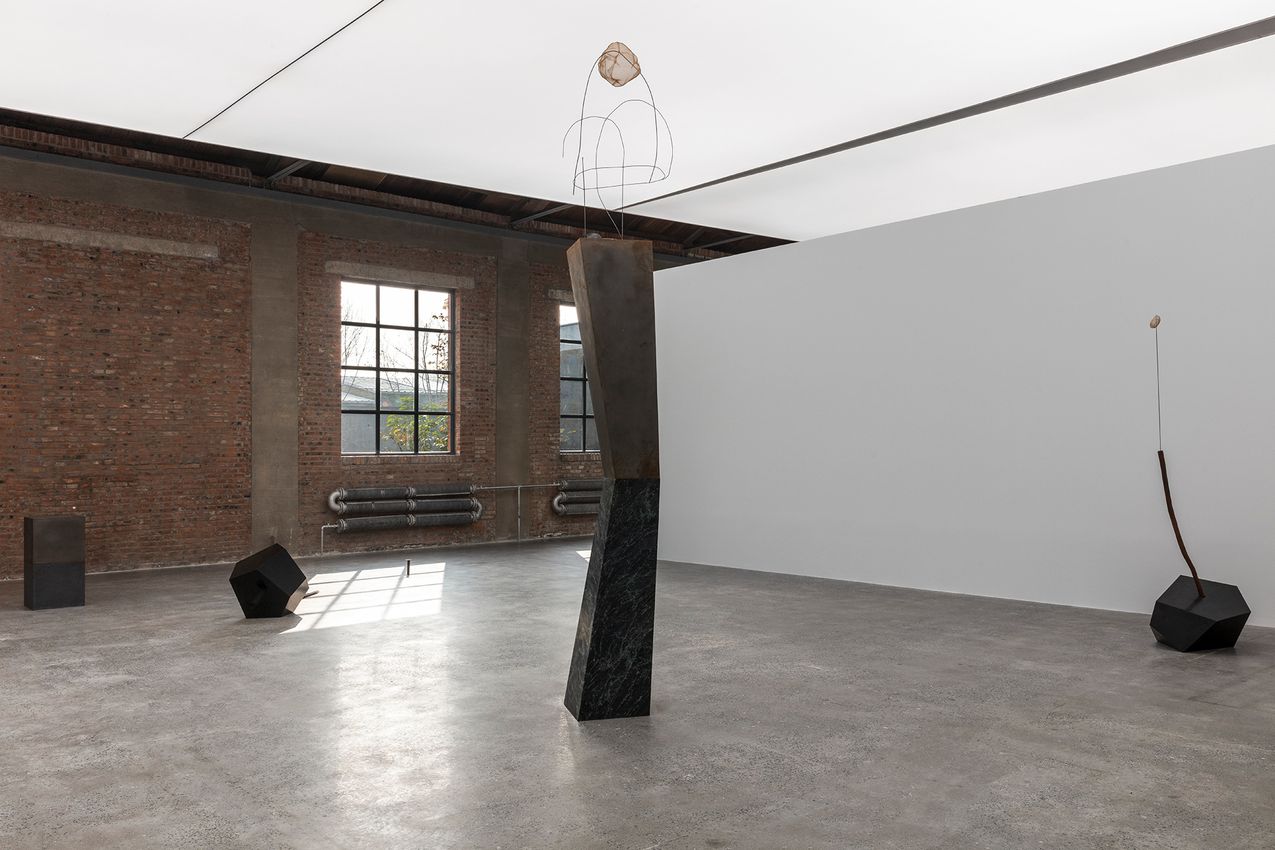
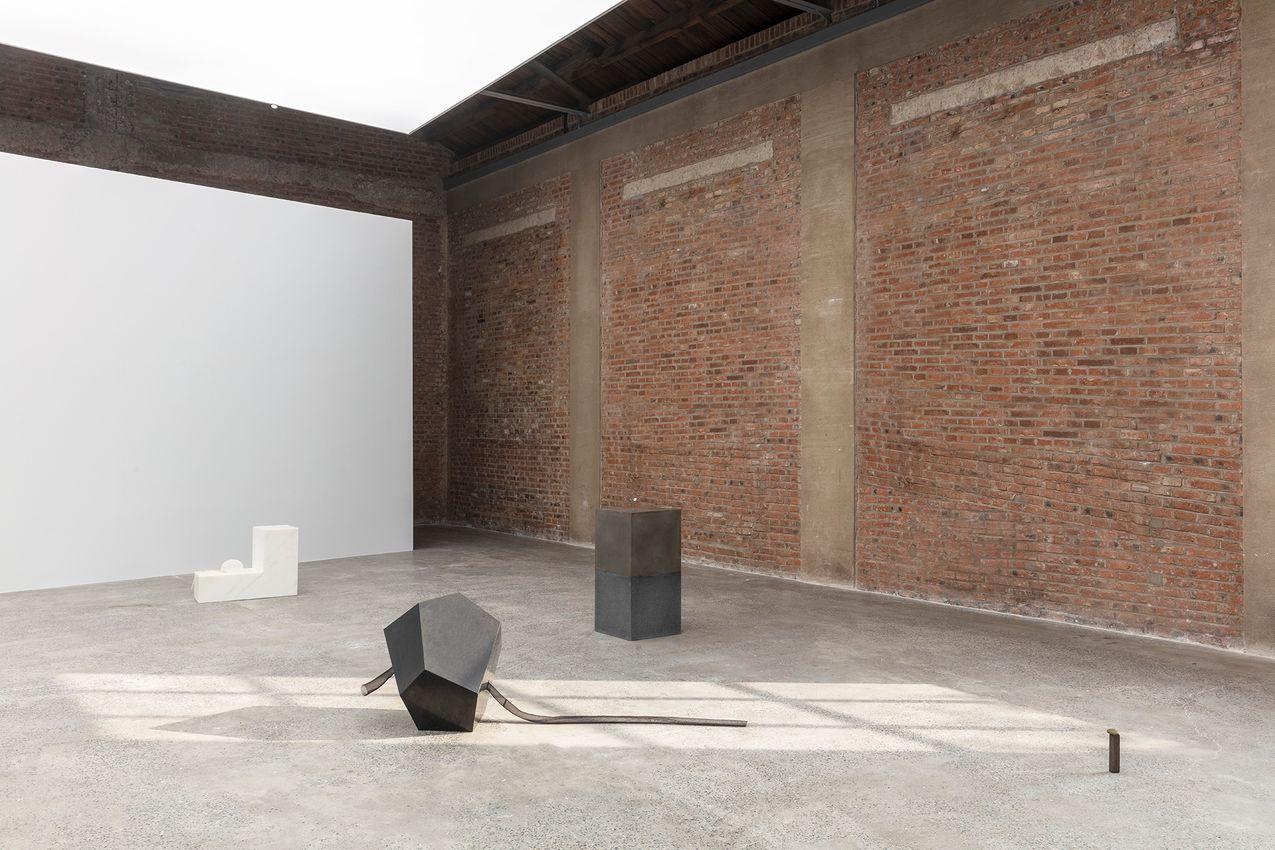
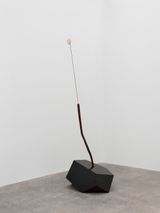
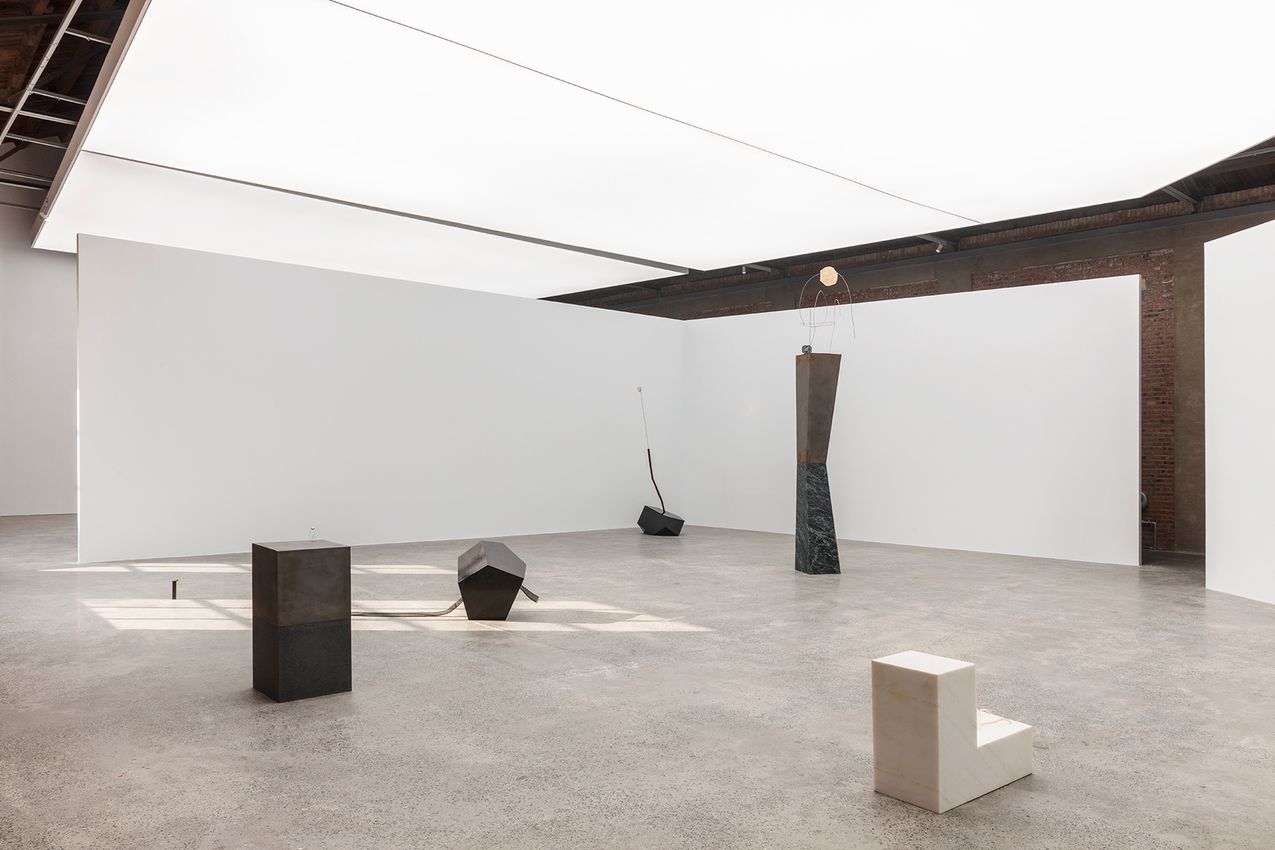
As the latest series, ‘The Age of Stillness’ is named by Hu Xiaoyuan herself with the inspirations rooted in her under-standing of ‘Anthropocene’. As a temporal process that has no means to categorise time itself, ‘The Age of Stillness’ points to the settling progress that takes place prior to the chaos which is not yet to come. Such a hidden and dialectical tension is precisely the driven force lying at the core of this series that has a total of six pieces presented. For The Age of Stillness I, II and V, amid the fugue of the artificially stable marble blocks and the seemingly vulnerable steel wire and raw silk, the dialectics of permanent stillness and movement, there seems to be a collective tension standing still in permanent melancholy. Hu Xiaoyuan’s site, therefore, allows the spectators to constantly transit in between such paired yet contradictory states of tensions.
For The Age of Stillness III and IV, the dark-coloured marble blocks, with their facades calculated, also blend into the lightness of the silk and wire structures, which are altogether translated into the very initial and determining point of movement. The Age of Stillness VI, indulged in fleetingness with its distinguishably small size, also fails to pull itself away from the continued tension between vulnerability and firmness.
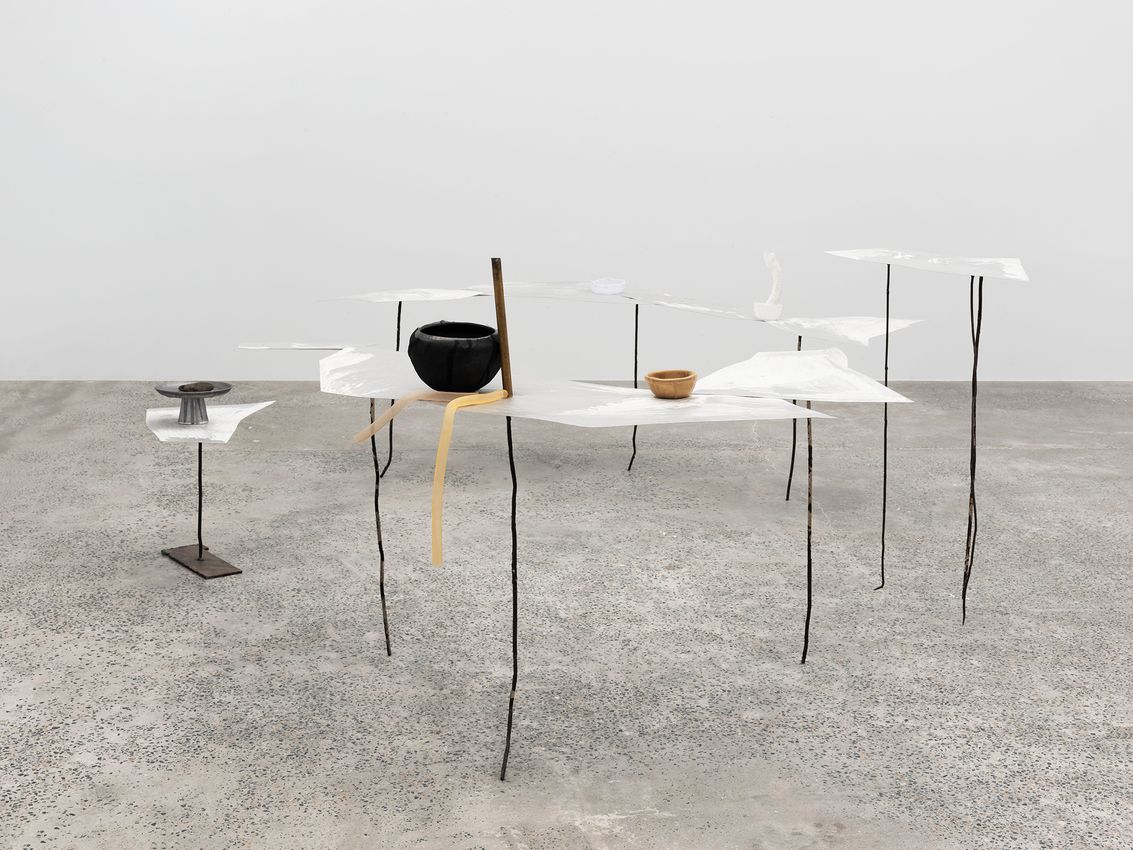
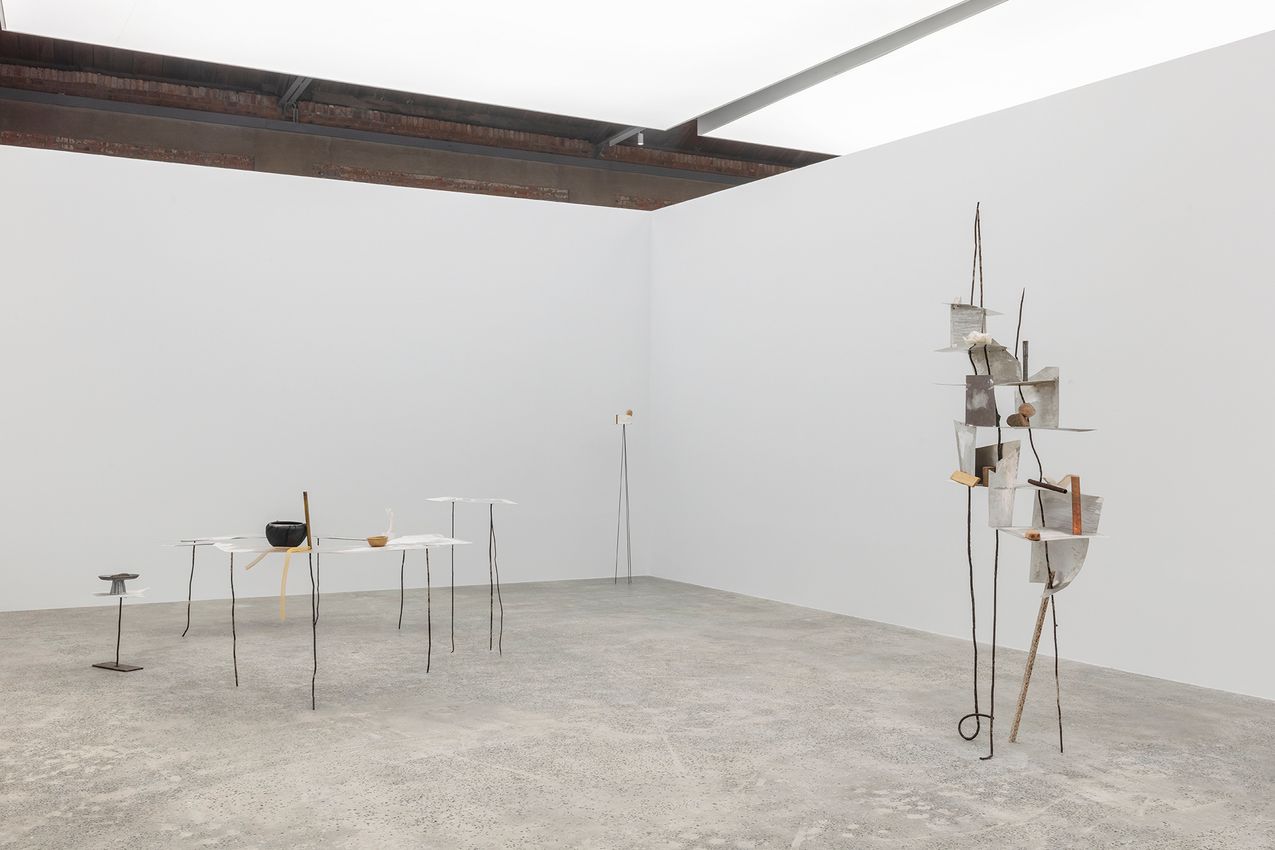
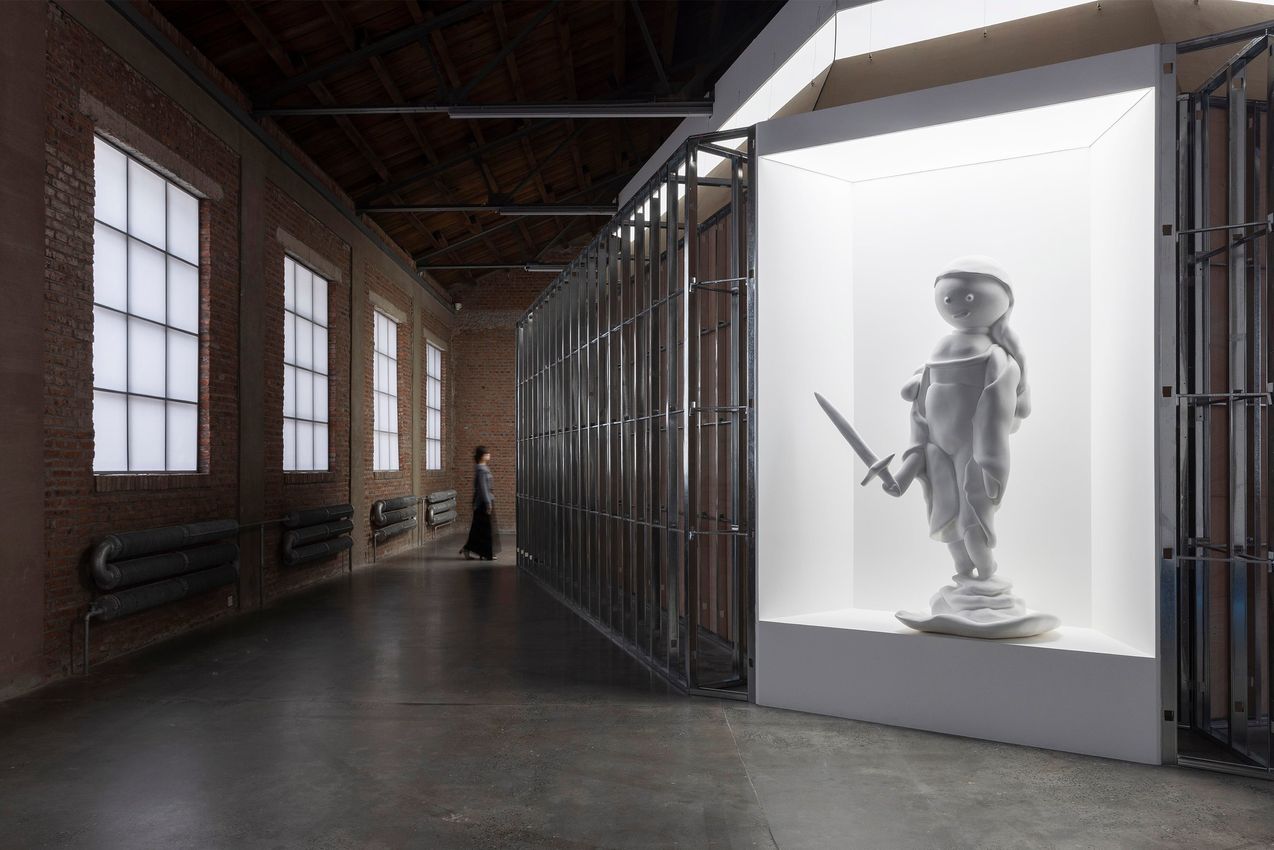
As a continuation of the series ‘Spheres of Doubt III – Farewell, Forever’, Hu Xiaoyuan puts the daily objects in dialogue with her collection of fragmented construction materials, complemented with space aluminium, on which the scratches were purposedly imprinted with the electric saw, to create the tone of futurism as well as to build up a seemingly vulnerable yet structurally tangible base via which the spectator’s personal life experiences could be approached. Among the objects are, on the one hand, the very intimate everyday objects such as the used toilet paper and the slowly shrivelled fruit core. The ritual vessels collected from the artist’s trips to the borderlines, which include the black pot from the Tibetan region, the bronze sacrificial ware, etc., are, on the other hand, bringing another branch into the exhibited collection. Though they are irreconcilable with one another on the functional level, they could evoke the spectators of the sensible connections to varied extents. Either it is the often-ignored daily objects, or it is those that have not entered our conscious awareness, under the artist’s delicate treatment, seemingly disordered perceptions are given with the space to continually grow and expand. Might it be awe, obsession, or suspended hesitation and constant contradiction, such a hardly defined yet unspeakable sentiment is, therefore, ceaselessly circulating within this layered and cyclic spatial structure.
‘A Day in Heaven’ is also a new series that is exhibited for the first time at Beijing Commune. With the dried fruit wrapped in the raw silk placed on the top, the mixed-media painting on the wood piece intertwines closely with the thin rebar structures. It resonates with the former works as much as grows into new ideological images.
The exhibited works or the poem of Paul Celan inscribed on the wall is neither standing alone narrating itself nor does it intend to formulate a collective narrative with one another. Rather, they are layering on top of each other’s complex structure, which is comprised of unsettling perceptions itself, to unpack and retrieve the unspeakable emotions wrapped within. As for how the original version of The Sand from the Urns is not as metaphorical as the translated versions, Hu Xiaoyuan’s works also attempt to evoke emotions by keeping them unrevealed. Lies within the tangible and perceivable passion are the restrained hardness and concealed calmness. The extent to which the poetics of misleading interpretations, that of such undefined complexity which is borne out of and lost in translation, would reach is precisely why Hu Xiaoyuan attempts to present all three versions here. Collected personally by Hu Xiaoyuan, the photographic image hung on the wall was taken in 1943 by an unknown soldier. It is the poppy growing in the wilderness by the Mudan River that was photographed.
Both the photo and the poem should be seen as the entry pathways of this exhibition which is all about ‘Becoming’.


Hu Xiaoyuan’s artistic style has always been dominated by delicate, analytical, and implicit contradictions. Her cross-media works, including installation, painting, and multimedia, all demonstrate a sensitivity toward materials which arise from her careful observations of daily life.
Founded in 2004, Beijing Commune is now located in 798 Art Factory, Beijing. Its initial programs were mainly group shows exploring various currents in contemporary art while now it primarily focuses on solo shows to carry on the in-depth research.

A respected voice in contemporary art discourse.
Focusing on ambitious storytelling and insightful art-world commentary. Ocula Magazine publishes in-depth interviews, critical essays and timely analysis on the artists, exhibitions and ideas driving the global art world.
Learn more about Ocula Magazine
Showcasing the best of the art world.
Ocula partners with galleries from around the world to highlight their artists, artworks and exhibitions. Gallery membership is by application and invitation, with each member vetted by an independent panel.
Learn more about Ocula Membership

Specialises in the sale of major artworks.
Led by a team with deep ties to the world’s leading auction houses, galleries and collectors. Ocula’s advisory team offers bespoke services to high-net-worth clients from around the world who are looking to acquire the best of contemporary and modern art.
Learn more about our team and services