




ALEXANDER CALDER
1898-1976, United StatesAlexander Calder was one of the most influential artists of the 20th century, revolutionising the presentation of sculpture by introducing space and motion. His suspended kinetic abstract “mobile” sculptures and large-scale “stabiles” were characterised by geometric forms and primary colours, and his public commissions are still on view around the world.
Early Years
Alexander Calder was born in 1898 into an artistic family: his mother was a painter and his father and grandfather were sculptors. Aged 11, Calder made two small sculptures, Dog and Duck, for his parents, yet his mum and dad discouraged him from following an artistic career because they understood the struggles. Calder gained a degree in mechanical engineering from the Stevens Institute of Technology in 1919 but eventually he returned to his true vocation. He moved to New York in his mid-twenties, studying at the Art Students League, and then to Paris in 1926, returning to the States in 1933 and moving to a farmhouse in Roxbury, Connecticut, with his wife, Louisa.
Alexander Calder: Artworks
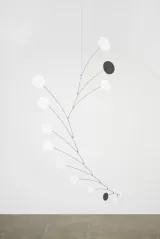
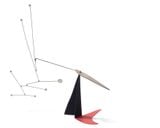
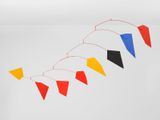
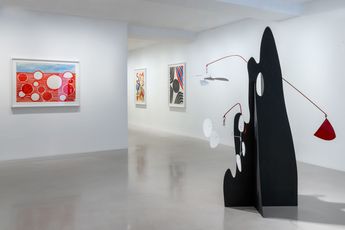
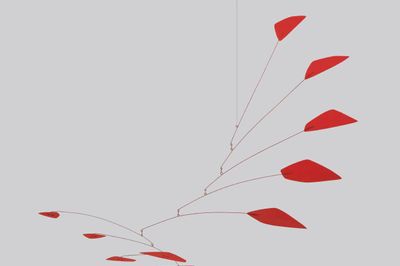
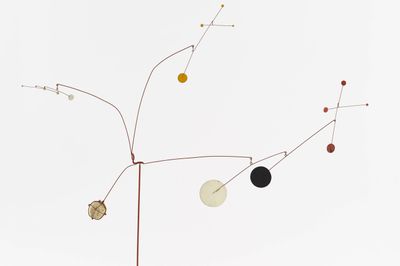
Calder bent and twisted wire to develop a new method of sculpture—following a 1929 exhibition in Paris, a French journalist described his ethereal, figurative creations as “drawings in space”. But perhaps his most significant contribution to art is the creation of the abstract moving sculpture, the “mobile”, originally powered by a motor (for example, 1932’s Half-circle, Quarter-circle and Sphere) but later by air currents. These pieces were made from sheet metal (1939’s Lobster Trap and Fish Tail_ is still in situ at MoMA) although Calder used wood during wartime shortages.
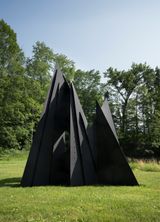
In contrast, Calder’s “stabiles” were static sculptures suggesting movement rather than actually moving. These steel artworks grew in scale and were commissioned for public spaces around the world (for example, 1962’s Teodelapio, under which people could walk and drive).
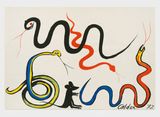
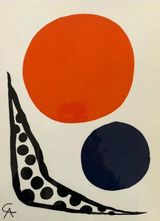
Away from sculpture, Calder created jewellery, while on paper his gouache-and-ink works used exuberant lines and geometric forms and bringing the vocabulary of sculpture to a two-dimensional format.
Alexander Calder: Select Public Commissions
- .125, John F Kennedy International Airport (Idlewild at time of commission), New York (1957)
- Spirale Unesco, Paris (1958)
- El Sol Rojo, Aztec Stadium, Mexico City (1968)
- La Grande Vitesse, City Hall, Grand Rapids (1969)
- Flamingo, General Services Administration, Chicago (1973)
Alexander Calder: Select Posthumous Exhibitions
- Calder. Rêver en Équilibre (Dreaming in Balance), Louis Vuitton Foundation, Paris (2026)
- High Wire: Calder’s Circus at 100, Whitney Museum of American Art, New York City (2025)
- Kindred Spirits: Joan Miró and Alexander Calder, Opera Gallery, New York City (2024)
- Calder, Kukje Gallery, Seoul (2023)
- Calder Gouaches, Opera Gallery, Geneva (2022)
- Alexander Calder: Dissonant Harmony, San Francisco Museum of Modern Art (2021)
- Alexander Calder: Works on Paper, Huxley-Parlour Gallery, London (2019)
- Alexander Calder: Radical Inventor, Montreal Museum of Fine Arts (2018)
- Calder: Hypermobility, Whitney Museum of American Art, New York City (2017)
- Alexander Calder, Pace Gallery, Hong Kong (2016)
- Calder: Discipline of the Dance, Museo Jumex, Mexico City (2015)
- Calder After the War, Pace Gallery, London (2013)
- Alexander Calder: A Balancing Act, Seattle Art Museum (2009)
- Calder Gouaches, Galerie Alfa, Paris (2007)
- Calder: Gravedad y la Gracia (Gravity and Grace), Guggenheim Foundation, Bilbao (2003)
- Alexander Calder: Motion and Colour, Iwaki City Art Museum (2000)
- Alexander Calder: 1898–1976, National Museum of Art, Washington DC (1998)
- Alexander Calder: Artist as Engineer, Bakalar Sculpture Gallery, MIT (1986)
- Alexander Calder: Memorial Exhibition, American Academy and Institute of Arts and Letters, New York City (1977)
Further Reading
- Official website of The Calder Foundation
- New York Times article about the 2026 Paris exhibition
- Profile page at Pace Gallery Artist profile from Tate
Alexander Calder FAQs
Who were Alexander Calder’s influences?
Alexander Calder knew Joan Miró and Piet Mondrian from his time in Paris, and his artworks on paper exhibit some of their influence: geometric forms, a focus on line, and vivid colours.
What is Calder’s Circus?
When Calder was living in Paris in 1926, he created a miniature circus from ordinary materials (metal, wood, string, fabric, cork, wire) featuring characters that would fly through the air, as well as animals, props, music and lighting. He would enact Calder’s Circus for friends including Piet Mondrian, Marcel Duchamp and Joan Miró. The Circus was loaned to the Whitney Museum of American Art in New York City in 1970 and following Calder’s death the institution fundraised to acquire it permanently in 1983.
Did Alexander Calder build stage sets?
Yes, Alexander Calder created stage sets—perhaps the most famous was designed in 1936 for a touring production of Erik Satie’s Socrate. The set had three elements: a red disc, a vertical rectangle (black on one side and white on the other) and interlocking steel hoops, all set against a blue backdrop. The set was destroyed in a fire but recreated four decades later. Sadly, Calder died before he was able to see the finished version.
How did the mobiles and stabiles get their names?
Marcel Duchamp christened Alexander Calder’s early moving sculptures “mobiles”—a word meaning both “moving” and “motive” in French. It has been suggested that following this, abstract artist Jean Arp asked what the stationary pieces were called, suggesting “stabiles”.
Ocula










Explore Alexander Calder's Exhibitions










Alexander Calder in Ocula Magazine






Explore and Follow Artists Shaping Contemporary Art
A respected voice in contemporary art discourse.
Focusing on ambitious storytelling and insightful art-world commentary. Ocula Magazine publishes in-depth interviews, critical essays and timely analysis on the artists, exhibitions and ideas driving the global art world.
Learn more about Ocula Magazine
Showcasing the best of the art world.
Ocula partners with galleries from around the world to highlight their artists, artworks and exhibitions. Gallery membership is by application and invitation, with each member vetted by an independent panel.
Learn more about Ocula Membership
Specialises in the sale of major artworks.
Led by a team with deep ties to the world’s leading auction houses, galleries and collectors. Ocula’s advisory team offers bespoke services to high-net-worth clients from around the world who are looking to acquire the best of contemporary and modern art.
Learn more about our team and services