




SAM FRANCIS
1923-1994, United StatesSam Francis was a visionary American artist whose vibrant, large-scale abstract paintings bridged Abstract Expressionism with international movements like Art Informel and Tachisme, earning him acclaim as one of the 20th century’s most globally influential contemporary artists.
Early Years
Born in San Mateo, California, in 1923, Sam Francis served as a U.S. Army pilot before being hospitalised with spinal tuberculosis. It was during this prolonged recovery in the 1940s that he began painting—an encounter that profoundly redirected his life. Francis went on to study art and psychology at the University of California, Berkeley, where he received both BA and MA degrees.
In the early 1950s, Francis moved to Paris, where he became associated with the School of Paris and formed lasting connections with European artists and thinkers. Over the following decades, he lived and worked between California, France, Japan, and Switzerland. His wide-ranging travels and engagement with diverse cultures became central to the evolution of his highly distinctive visual language.
Artworks
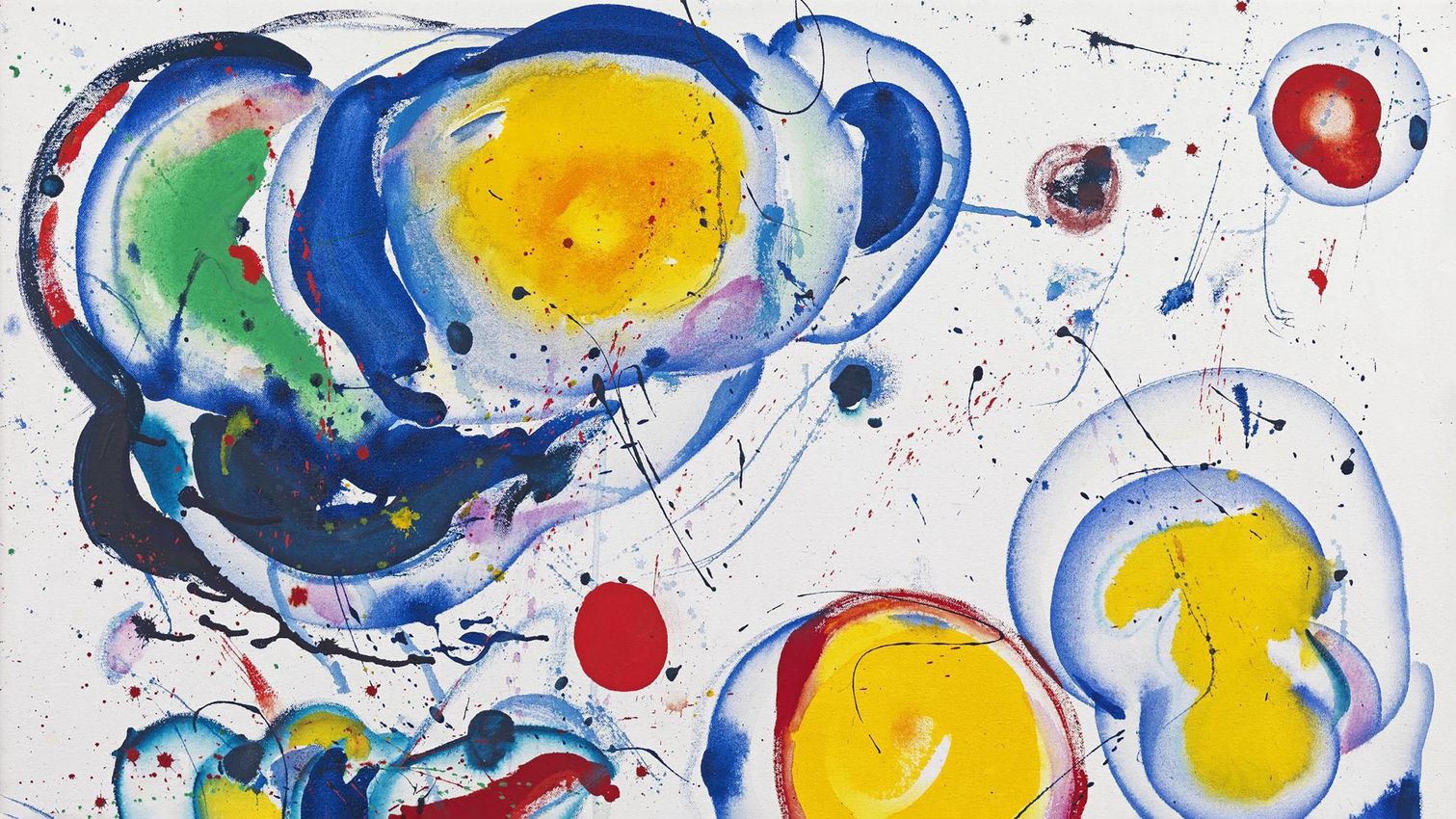
Best known for his intensely colourful abstract paintings, Sam Francis developed a painterly style that was both spontaneous and deeply meditative, often marked by fields of luminous white space and expressive splashes of pigment.
The Edge Paintings
In the early 1950s, while living in Paris, Sam Francis developed the ‘Edge Paintings’—a pivotal series that radically shifted the compositional dynamics of contemporary painting. Rather than centring the action, Francis allowed vivid colour to accumulate around the edges of the canvas, leaving a white void at the centre. These works suggest light breaking into the picture plane from outside the frame, creating a sense of infinite space. Inspired by Monet’s late Water Lilies, the Edge Paintings translated European Impressionist sensibilities into the language of American abstraction. Key examples include Deep Blue and Black (1955) and Composition in Blue and Black (1956).
The Blue Balls Series (1960—1963)
Painted during a period of physical illness and recovery, The Blue Balls Series (1960—1963) is one of Francis’s most psychologically charged bodies of work. The biomorphic forms—clustered or floating in white expanses—resemble cellular structures or bodily organisms, rendered predominantly in deep ultramarine. The title references not only the recurring blue palette but also visceral bodily tension and psychic struggle. These artworks represent Francis’s attempt to transform pain into vitality, fusing physiological metaphor with formal abstraction. With their combination of raw emotion and compositional sophistication, the Blue Balls paintings stand among his most intimate and groundbreaking contributions to contemporary art.
Matrix Paintings
During the 1970s and 80s, Sam Francis entered a period of prolific output, refining a visual language that merged spontaneity with structure. His Matrix paintings are characterised by vibrant grids of calligraphic brushwork layered over airy grounds, forming rhythmic patterns that seem to pulse and vibrate. These works suggest both cosmic expansion and microscopic complexity, evoking forms as vast as galaxies and as minute as cells. Though appearing chaotic at first glance, they are often carefully composed, demonstrating Francis’s mastery of colour theory and mark-making. The Matrix series exemplifies the artist’s commitment to colour as energy—a bridge between material and metaphysical realms.
Awards and Accolades
- Receives the order of “Commandeur de l’Ordre des Arts et des Lettres” (1983)
Exhibitions
Sam Francis has been the subject of both solo exhibition and group exhibitions at important institutions. A selection of important exhibitions are provided below.
Solo Exhibitions
- Sam Francis: The Archetypal Image. Travelled to: Frederick M. Weisman Museum of Art, Pepperdine University, Malibu, USA: The Fundacion Caja de Madrid, Madrid (1997)
- Sam Francis, Albright-Knox Art Gallery, Buffalo, New York, that traveled to Corcoran Gallery, Washington, D.C.; Whitney Museum of American Art, New York City; Dallas Museum of Fine Arts, Texas; Oakland Museum of Art, Oakland, California (1972)
- Sam Francis, Museum of Fine Arts, Houston. Travelled to University Art Museum, Berkeley; and San Francisco Museum of Art (1967)
- Sam Francis, Kunsthalle, Bern. Travelled to Moderna Museet, Stockholm, Sweden (1959-1961)
- Sam Francis, Pasadena Art Museum, Pasadena. Travelled to San Francisco Museum of Art, San Francisco; Seattle Art Museum, Seattle (1959)
Group Exhibitions
- La Novelle Presentation des Collections Modernes, 1905-1965, Centre Pompidou, Paris (2015)
- Renard Collection, Fondation Beyeler, Basel (2013)
- Art in Progress, Louisiana Museum of Art, Humlebaek, Denmark. Travelled to Centre Pompidou, Paris; Liljevalchs Konsthall, Stockholm (1975-77)
- 12 Americans, Museum of Modern Art, New York (1956)
Critical Reception
The artist’s practice has been featured in leading publications, including Artforum, Frieze, and Hyperallergic.
Website
Sam Francis’s website can be found here.
Sam Francis FAQs
What style of art is Sam Francis known for?
Sam Francis is best known for his lyrical and gestural approach to abstract art. While his early work was aligned with Abstract Expressionism, his practice evolved into a more transcultural language that incorporated elements of European Art Informel, Japanese Zen aesthetics, and Californian light and space. Francis’s distinctive use of saturated colour, dynamic brushwork, and luminous white space became a hallmark of his style, setting him apart from his American contemporaries and positioning him as a uniquely global voice in contemporary art.
What role did travel play in his practice?
Travel played a transformative role in shaping Sam Francis’s artistic development. Living and working in France, Japan, Switzerland, and the United States, Francis absorbed diverse cultural philosophies and visual traditions. His time in Paris deepened his engagement with colour and post-war abstraction, while exposure to Japanese calligraphy and Zen Buddhism profoundly influenced his compositional strategies and use of empty space. These transnational experiences enriched his visual language and reinforced his belief in art as a form of universal communication that transcended borders and ideologies.
Did Sam Francis influence other contemporary artists?
Sam Francis’s expansive approach to colour, gesture, and composition has influenced generations of contemporary artists working across abstraction, conceptualism, and transdisciplinary practices. His ability to synthesise Eastern and Western philosophies resonated with artists seeking to dissolve cultural boundaries in their work. Francis’s openness to improvisation, emotional vulnerability, and the metaphysical potential of colour made him a model for West Coast painters and international artists alike. His legacy continues through the Sam Francis Foundation, which supports scholarship and fosters engagement with contemporary art inspired by his pioneering vision.
Ocula | 2025




Explore Sam Francis' Exhibitions






Explore and Follow Artists Shaping Contemporary Art
A respected voice in contemporary art discourse.
Focusing on ambitious storytelling and insightful art-world commentary. Ocula Magazine publishes in-depth interviews, critical essays and timely analysis on the artists, exhibitions and ideas driving the global art world.
Learn more about Ocula Magazine
Showcasing the best of the art world.
Ocula partners with galleries from around the world to highlight their artists, artworks and exhibitions. Gallery membership is by application and invitation, with each member vetted by an independent panel.
Learn more about Ocula Membership
Specialises in the sale of major artworks.
Led by a team with deep ties to the world’s leading auction houses, galleries and collectors. Ocula’s advisory team offers bespoke services to high-net-worth clients from around the world who are looking to acquire the best of contemporary and modern art.
Learn more about our team and services