



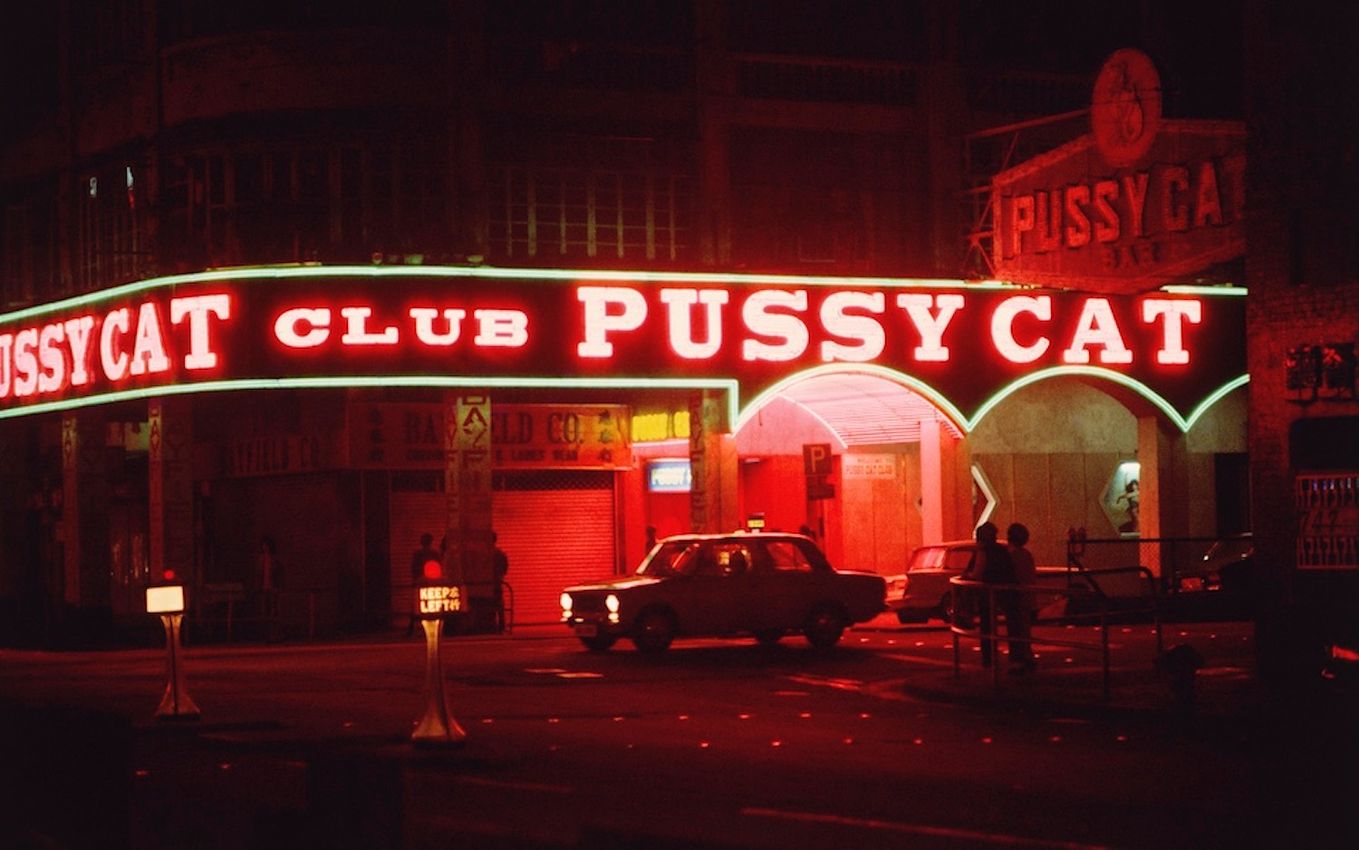
‘I started taking photographs at night as soon as I picked up my first camera. I never really thought of them as “night” pictures. It was just a different kind of light, whether neon, fluorescent, moonlight or the light of the city reflected off an overcast sky. But Hong Kong was alive at night in a way that other places weren’t,’ says Girard. Alive indeed, when darkness falls another world comes out to play and these photographs capture just that.
HK:PM shows people at work, people at play, and simply getting on with their lives, mostly with the particular atmospheric backdrop of Hong Kong at night. A world onto itself, a place where jetliners almost touch the buildings when they come in for landing, where your desires can be met at an instant, and where people from all over the world pass through. Not portraying the glamour that some may associate with the city, instead we are invited to see how this place may have been tough for some, however driven by the hope that is the ‘Hong Kong Dream.’
Attracted to the hidden and often dark beauty in everyday life, Girard is a champion of the common man as he explores ‘the often overlooked features that define daily life for its residents.’ Girard always captures his subjects and surroundings with a non-judgmental eye and genuine interest paired with a journalistic/anthropological approach to accessing and documenting what may not last, and the sense to see it at the right time. Born and raised in a suburb of Vancouver, Girard began taking photographs as a high school student in the 1970s, spending days and nights in the downtown districts surrounding the port. In 1974 Girard first travelled to Hong Kong, where he later settled and found work, first as a sound recordist for the BBC, and then eventually as a photographer.
For many years Girard produced editorial work for publications such as National Geographic, Time, Newsweek, Fortune, Forbes, Elle, Paris-Match, Stern, and New York Times Magazine. More recently his photographs have been exhibited and collected around the world, with shows for example at the International Centre for Photography (USA), PM Gallery (UK), the National Gallery of Canada, the Yixian International Photo Festival (China), and numerous other public and private institutions. As for HK:PM, part of the motivation behind this series is clear when Girard explains, ‘at the time (1970s and 80s) I wasn’t seeing anything, apart from a rare scene in a Hong Kong gangster film perhaps, that was visually registering the place I was living in.’
He is famous for capturing what may be lost in history but he also admits to the failures, the photographs that got away: ‘There used to be ballroom dance clubs where patrons could pay per dance with a hostess. The patrons were older gents. All rather genteel from what I could tell. Long gone I assume now. I would poke my head in but was never able to make a picture.’ Girard still gets a ‘thrill’ when arriving in HK and loves ‘wandering aimlessly around the streets,’ but admits to feeling some sense of loss about features of the city that have vanished, like ‘the filling in of the harbour, certain buildings and neighbourhoods, and especially Kai Tak airport of course’.
Hong Kong is a sum of many parts, the seedy nightlife is but one, and this unglamorous underbelly makes for a rich and alluring world that attracted a young photographer from the first day he stepped off a freighter in Hong Kong in 1974.
Greg Girard (born 1955) is a Canadian photographer living in Shanghai since 1998. His work looks at the physical and social transformations taking place in China and Asia. He divides his time between photographing on assignment for publications such as National Geographic, Time, Fortune, The New York Times Magazine, and others, and pursuing his personal work. While living in Hong Kong between 1983 and 1998 he published “City of Darkness”, co-authored by Ian Lambot, a document of the final years of the Kowloon Walled City. His second book, “Phantom Shanghai” (Magenta, 2007), with an introduction by novelist William Gibson, looks at the homes, streets, shops, buildings and neighborhoods that will not survive the vision that city has for itself. The Independent Newspaper (U.K.) cited Greg Girard’s “Phantom Shanghai” as one of the top ten photography books. Included in the list is Robert Frank’s “The Americans”, “The Devil’s Playground” by Nan Goldin, and “Beneath the Roses” by Gregory Crewdson. His work was recently acquired in a major purchase by the Canadian Museum of Contemporary Photography.
Located on the quiet historic Pound Lane in Sheung Wan, Hong Kong, Blue Lotus Gallery specialises in contemporary photography with a focus on exploring the culture and identity of Hong Kong.

A respected voice in contemporary art discourse.
Focusing on ambitious storytelling and insightful art-world commentary. Ocula Magazine publishes in-depth interviews, critical essays and timely analysis on the artists, exhibitions and ideas driving the global art world.
Learn more about Ocula Magazine
Showcasing the best of the art world.
Ocula partners with galleries from around the world to highlight their artists, artworks and exhibitions. Gallery membership is by application and invitation, with each member vetted by an independent panel.
Learn more about Ocula Membership

Specialises in the sale of major artworks.
Led by a team with deep ties to the world’s leading auction houses, galleries and collectors. Ocula’s advisory team offers bespoke services to high-net-worth clients from around the world who are looking to acquire the best of contemporary and modern art.
Learn more about our team and services