




MAMMA ANDERSSON
b. 1962, SwedenMamma Andersson is Swedish painter known for her atmospheric landscapes and portraits that incorporate folklore and Nordic scenes to narrate melancholic recollections.
Early Years
Born Anna Karin Andersson in Luleå, Sweden, Mamma Andersson studied at the Royal Institute of Art in Stockholm, where she acquired the nickname Mamma to distinguish herself from another student who went by the same name.
While at art school Mamma had two sons with artist Jockum Nordstrum. Mamma began painting landscapes following her daily promenades with the toddlers, whom she pushed around in a pram while noting the subtle changes in the environment around them.
Mamma Andersson Artworks
Mamma Andersson’s melancholic paintings show domestic interiors, expressive portraits, and atmospheric landscapes drawing from art books and nature, often referencing Nordic figurative painting and folk art.
Nature and Folklore
Andersson’s works draw from a range of influences, from the topographical landscapes observed while walking with her children to archival photographic sources, filmic imagery, theatre sets, and period interiors.
Amongst Andersson’s culturally and historically influenced work is the painting Ni börjar ju alltid om II (1999), in which figures wearing traditional garments from different cultures are painted against an abstract landscape, holding expressive postures.
Likewise, Första mötet (First Encounter) (2002) depicts a group of indigenous women as an assemblage of geometric shapes. Set in a pine green forest, they are huddled in a corner beside a pink chair and an empty wooden desk.
Fictions
Most prominent in Andersson’s paintings are the sparse landscapes of North Sweden, where she grew up. Andersson uses the mountainous backdrops, trees, snow, and wooden cabins of her surroundings to create atmospheric scenes that appear to weave together past, present, and future.
Amongst them, Abandoned (2008) shows the ravaged insides of a wooden cabin with a toppled-over desk and papers scattered over the ground. The remaining furniture remains intact, alluding perhaps to the discarding of old projects.
Similarly, Absint (Absinthe) (2010) depicts a desolate landscape against a crimson sky populated with sparse trees and scattered houses. The hue is achieved by applying thick layers of paint and textured washes, replicating the warm glow after one drink too many.
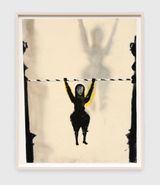
In Mamma Andersson/Jockum Nordstrom: Lou (2016), a naked boy can be spotted running in the woods in the snow. While Grandma (2016), a monotype print on rice paper, shows a hunchback figure in a field, faceless, with one arm reaching towards the ground.
Memory
Personal narratives often infuse the fictional in Andersson’s works, with recurring elements including domestic interiors and Andersson’s children. Resulting compositions blend past and present through the manipulation of pictorial space.
In Alice (1996), a wandering child with dark hair is depicted walking along the banks of a river against open skies. The vertical logs planted in the backdrop hint at the narrative fiction that may have inspired the landscape.
Likewise, in Readers (2002), where a group of children sculpted in marble appear to interrupt a library scene, a landscape painting is bolstered to a wooden shelf in the foreground, alluding perhaps to the birth of Andersson’s sons during her time at art school.
Awards and Accolades
Mamma Andersson is the recipient of the 2018 Guerlain Drawing Prize and the 2006 Carnegie Art Award for Painting.
Exhibitions
Mamma Andersson has exhibited widely across Europe, the U.K., and the United States.
Select solo exhibitions include David Zwirner, New York (2020); Stephen Friedman Gallery, London (2017); Galleri Bo Bjerggaard, Copenhagen (2016); Galleri Magnus Karlsson, Stockholm (2016); House of Sweden, Washington, D.C. (2011); Aspen Art Museum (2010); Douglas Hyde Gallery, Dublin (2009); and Moderna Museet, Stockholm (2007).
Select group exhibitions include Stephen Friedman Gallery (2021); Museum Dhondt-Dhaenens, Sint-Martens, Belgium (2020); Artipelag, Stockholm (2020); 33rd São Paulo Biennial (2018); Nordic Heritage Museum, Seattle (2018); Centre Pompidou, Paris (2018); The National Museum of Art, Architecture and Design, Oslo (2015); and Musée d’Art Moderne, Paris (2013).
Elaine YJ Zheng | Ocula | 2022


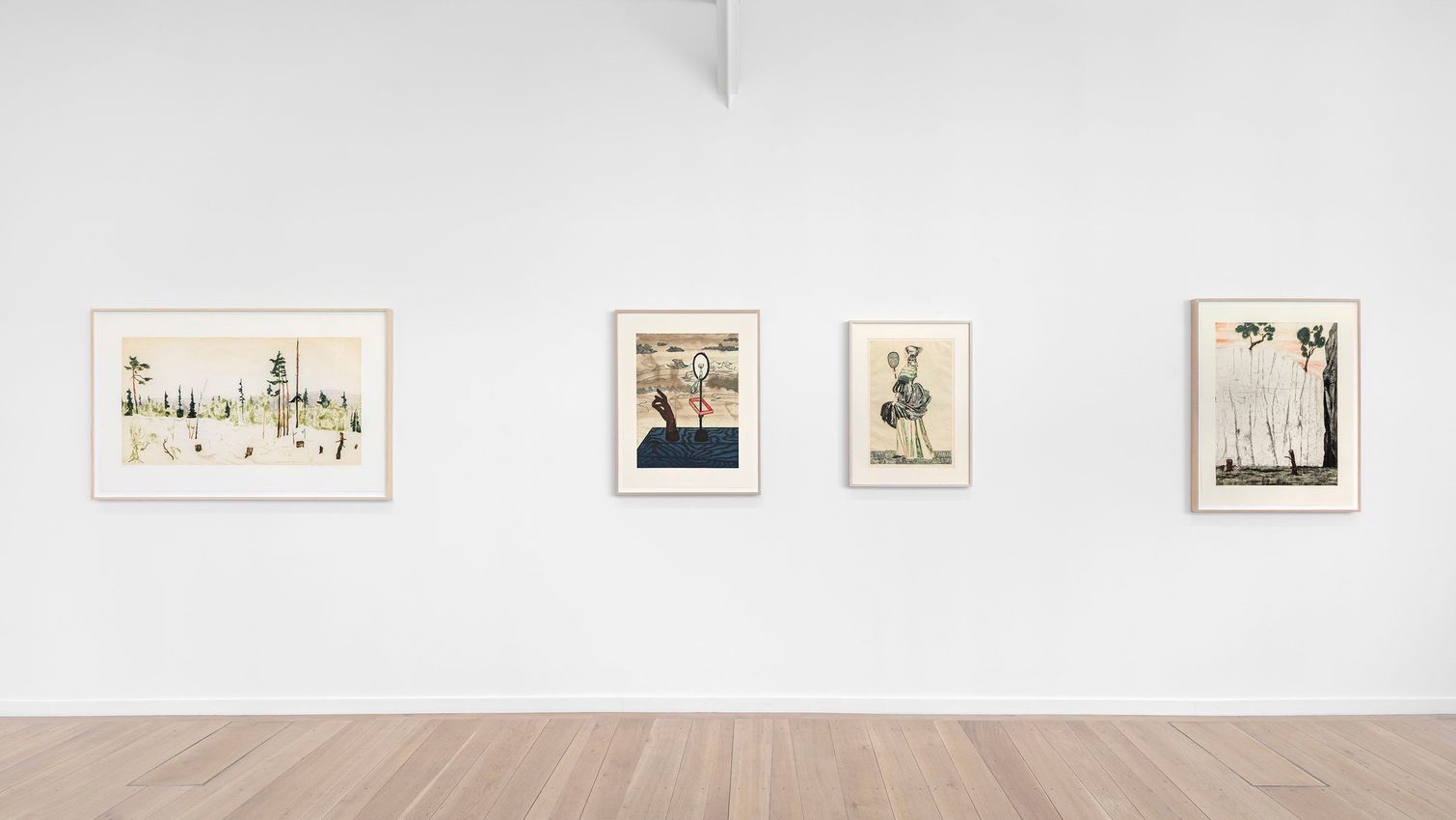
View Mamma Andersson's Artworks



























Explore and Follow Artists Shaping Contemporary Art
A respected voice in contemporary art discourse.
Focusing on ambitious storytelling and insightful art-world commentary. Ocula Magazine publishes in-depth interviews, critical essays and timely analysis on the artists, exhibitions and ideas driving the global art world.
Learn more about Ocula Magazine
Showcasing the best of the art world.
Ocula partners with galleries from around the world to highlight their artists, artworks and exhibitions. Gallery membership is by application and invitation, with each member vetted by an independent panel.
Learn more about Ocula Membership
Specialises in the sale of major artworks.
Led by a team with deep ties to the world’s leading auction houses, galleries and collectors. Ocula’s advisory team offers bespoke services to high-net-worth clients from around the world who are looking to acquire the best of contemporary and modern art.
Learn more about our team and services