





BEATRIZ GONZÁLEZ
1932-2026, ColombiaBeatriz González, who died at age 93, was a Colombian painter, sculptor, critic, curator, and art historian, and a foundational figure in Latin American contemporary art. Often associated with Pop Art and new figuration, González developed a singular visual language that appropriated press photography, official imagery, and vernacular design to address Colombia’s collective memory, political violence, and everyday life.
Early years and background
Beatriz González was born in Bucaramanga, Santander, where she spent her childhood during the period of civil conflict known as La Violencia, which profoundly shaped her understanding of Colombian society. After initially enrolling in architecture at the National University of Colombia in Bogotá in the mid 1950s, she abandoned the discipline and later studied fine arts at the Universidad de los Andes, graduating in 1962 under the tutelage of Argentine critic Marta Traba and Spanish painter Juan Antonio Roda.
From the early 1960s she began exhibiting in Bogotá, showing work at institutions such as the Museo de Arte Moderno de Bogotá (MAMBO), where she later also worked on the museum’s educational programme between 1978 and 1983. Between 1989 and 2003 González served as chief curator at the Museo Nacional de Colombia in Bogotá, significantly influencing the way national history and visual culture were presented to the public.
Beatriz González artworks
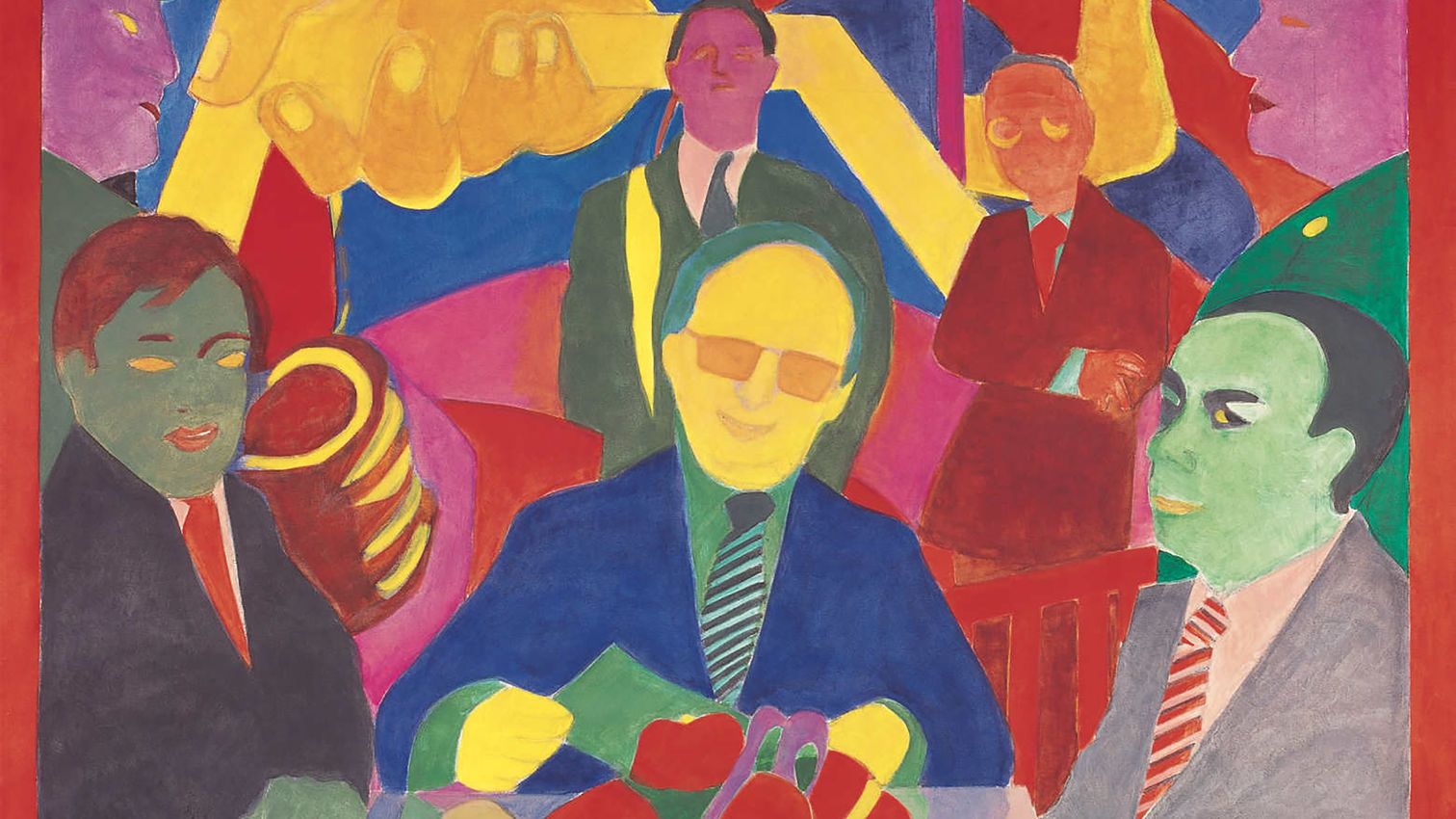
Beatriz González’s art appropriates images from mass media, political iconography, and popular culture, translating them into paintings, prints, sculptures, and furniture-based works that merge satire with mourning. Across more than six decades, her practice shifted from brightly coloured domestic objects to stark, large-scale works that register the trauma of political violence and forced displacement in Colombia.
Los suicidas del Sisga and early appropriations
A key breakthrough came with the series Los suicidas del Sisga (The Suicides of Sisga, 1965), based on a tabloid photograph of a young couple who drowned themselves at Colombia’s Sisga Dam. Repainting the image with flattened forms and an acidic palette, González turned a sensationalist newspaper story into a stark meditation on intimacy, tragedy, and how the press circulates images of the dead.
This strategy of appropriating press images extended to series depicting political leaders, family portraits from society pages, and everyday scenes, which she often painted on unconventional supports such as wardrobes, metal beds, and utilitarian furniture. Her hybrid idiom—combining art-historical reference, provincial vernacular design, and mass-media imagery—led critics to connect her with Pop Art, even as she insisted on the specifically Colombian context of her work.
Furniture paintings and political iconography
From the late 1960s and 1970s, González produced works on domestic furniture that reproduced portraits of politicians and elites, exposing the overlap between public authority and private life. By painting such imagery onto cabinets, beds, and screens, she brought national iconography into the intimate spaces of the home, highlighting how ideology permeates everyday environments.
Her engagement with political imagery intensified as she drew on photographs of presidents, military figures, and religious symbols, translating them into stylised silhouettes and repeating motifs. This approach aligned her with currents of new figuration in Latin America while maintaining a distinctly ironic and provincial tone that questioned official narratives.
Violence, mourning and collective memory
From the 1980s onward, González increasingly addressed the human cost of Colombia’s armed conflict, often working from press photographs of victims, mourners, and mass funerals. Critics have described this period as a turn toward darker, more elegiac work, in which her characteristic flat colours and simplified forms are mobilised to register grief and displacement.
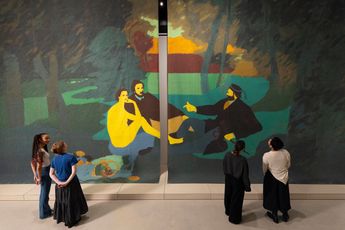
One of her most significant projects is Auras anónimas (Anonymous Auras, 2007–2009), a large-scale public installation at Bogotá’s Cementerio Central. For this work, González created thousands of printed silhouettes—approximately 8,956 heads and figures carrying the dead—which were installed over the niches of columbaria associated with anonymous victims of violence, transforming the site into a monument to the disappeared.
Select public commissions by Beatriz González
- Auras anónimas (Anonymous Auras), Cementerio Central, Bogotá, approximately 8,956 silkscreened silhouettes installed across the columbaria, 2007–2009
- Public mural and large-format works related to political memory in Colombian institutional and urban contexts (various sites)
Select awards and accolades
- Participation in the 11th São Paulo Biennial, São Paulo, 1971
- Participation in Documenta 14, Kassel and Athens, 2017
- Major retrospective Beatriz González: A Retrospective at Pérez Art Museum Miami (PAMM), surveying six decades of work
- Recognition in international surveys of Latin American art as a leading figure in contemporary Colombian painting and installation
Beatriz González exhibitions
Beatriz González has been the subject of major solo exhibitions and has participated in important international group shows at museums and biennials across Latin America, Europe, and the United States. Below is a selection of notable exhibitions.
To be kept up to date with upcoming exhibitions featuring Beatriz González follow her on Ocula.
The exhibition lists below are reordered from least recent to most recent and updated with dates, while keeping only well-documented institutional exhibitions.
Select solo exhibitions
- Beatriz González, 11th São Paulo Biennial (solo representation within the Colombian context), São Paulo, 1971
- Beatriz González, Museo de Arte Moderno de Bogotá (MAMBO), Bogotá, 1984
- Beatriz González, Museo Nacional de Colombia, Bogotá, 1999
- Beatriz González: A Retrospective, Museo Nacional de Colombia and Museo de Arte Moderno de Bogotá (travelling survey), Bogotá, 2009
- Beatriz González: A Retrospective, Museo de Arte Moderno de Medellín (MAMM), Medellín, 2014
- Beatriz González: A Retrospective, Pérez Art Museum Miami (PAMM), Miami, 27 April 2018–2 September 2018
- Beatriz González, KW Institute for Contemporary Art, Berlin, 14 April 2018–19 August 2018
- Beatriz González, Museo Reina Sofía, Madrid (expanded retrospective originating from KW/PAMM), 22 November 2018–2 September 2019
- Beatriz González, Barbican Centre, London, 4 October 2019–1 March 2020
- War and Peace: A Poetics of Gesture, De Pont Museum, Tilburg, 26 October 2024–23 February 2025
Select group exhibitions
- 11th São Paulo Biennial, São Paulo, 1971
- The World Goes Pop, Tate Modern, London, 17 September 2015–24 January 2016
- Radical Women: Latin American Art, 1960–1985, Hammer Museum, Los Angeles, 15 September 2017–31 December 2017 (with later venues in Brooklyn and São Paulo)
- Documenta 14, Athens and Kassel, April 2017–September 2017
- Beatriz González: The Artist of Colombia’s Political Memory, included within broader surveys of Colombian art, Museo de Arte Moderno de Bogotá and other institutions, 2019–2020
More reading
Beatriz González’s practice has been discussed in leading publications and catalogues, including ArtReview, Hyperallergic, AWARE, and institutional essays by museums such as De Pont and PAMM.
Beatriz González FAQs
Who is Beatriz González?
Beatriz González was a Colombian painter, sculptor, critic, curator, and art historian whose work uses images from the press, official history, and popular culture to examine collective memory and political violence. You can follow Beatriz González on Ocula to learn more about her work, find out about art for sale, contact her galleries, and keep up to date with upcoming exhibitions.
Where can I see work by Beatriz González?
Work by Beatriz González is held in major museum collections, including the Museum of Modern Art (MoMA) in New York and the Museo de Arte Moderno de Bogotá, among others. You can follow Beatriz González on Ocula to receive alerts on upcoming exhibitions by the artist.
Are there any lesser-known and interesting facts about Beatriz González?
A lesser-known aspect of Beatriz González’s career is her sustained work as an educator and curator, including her long tenure as chief curator at the Museo Nacional de Colombia from 1989 to 2003.
Where did Beatriz González live?
Beatriz González was born in Bucaramanga in 1932 and later moved to Bogotá, where she studied, worked in museums, and ultimately died at her home on 9 January 2026 at the age of 93. Beatriz González and her husband, the architect and civil engineer Urbano Ripoll Rodríguez, lived in Bogotá until his death in 2024.
How is Beatriz González’s name pronounced?
Beatriz González is pronounced ‘Beh-ah-TREES Gon-SAH-lehs’ in Spanish, with the stress on the final syllable of both her first name and surname. The acute accent on ‘González’ indicates the stressed ‘á’ sound in Spanish.
What themes does Beatriz González explore in her art?
Beatriz González’s work consistently explores themes of political violence, mourning, collective memory, and how mass media images shape public perception in Colombia and Latin America. She often focuses on the everyday circulation of images of pain—such as news photographs of funerals, protests, and displaced people—and how these images become part of a shared but fragile memory.
Why is Beatriz González’s use of furniture and everyday objects important?
Beatriz González is known for painting on wardrobes, beds, tables, and other domestic objects, rather than traditional canvases. This strategy brings political imagery into the intimate space of the home, highlighting how ideology and state power permeate everyday life and middle-class taste.
How did Beatriz González work with newspaper and archive images?
Beatriz González frequently appropriated black-and-white press photographs and archival images, translating them into simplified, brightly coloured silhouettes. By reworking these images, she emphasised both their ubiquity and their fragility, turning ephemeral news into durable artworks that insist on remembrance.
How has Beatriz González been reappraised internationally in recent years?
In the last decade, Beatriz González has been increasingly recognised in major international surveys, retrospectives, and scholarly writing on global modern and contemporary art. Large-scale exhibitions at institutions such as Pérez Art Museum Miami, KW Institute in Berlin, Museo Reina Sofía in Madrid, and the Barbican in London have cemented her status as a key reference for histories of Latin American art and political memory.
How do critics describe Beatriz González’s visual style?
Critics often highlight Beatriz González’s flat fields of colour, graphic silhouettes, and use of pattern and repetition, which create a deceptively playful surface for images of pain and loss. Her style has been described as oscillating between irony and lament, combining references to popular design, religious imagery, and official portraiture in a distinctly “provincial” yet globally resonant language.
Where can I buy Beatriz González’s artwork?
Beatriz González has been represented by leading contemporary art galleries, including Casas Riegner and Galerie Peter Kilchmann, which have exhibited and placed her works internationally. You can explore Ocula to find out which Ocula galleries represent the artist and enquire directly about buying art by Beatriz González, as well as contact Ocula’s art advisory team to learn more about buying or selling work by Beatriz González.
Ocula | 2026




Representative Artworks

View story

View story


View story

View story

View story


Explore and Follow Artists Shaping Contemporary Art
A respected voice in contemporary art discourse.
Focusing on ambitious storytelling and insightful art-world commentary. Ocula Magazine publishes in-depth interviews, critical essays and timely analysis on the artists, exhibitions and ideas driving the global art world.
Learn more about Ocula Magazine
Showcasing the best of the art world.
Ocula partners with galleries from around the world to highlight their artists, artworks and exhibitions. Gallery membership is by application and invitation, with each member vetted by an independent panel.
Learn more about Ocula Membership
Specialises in the sale of major artworks.
Led by a team with deep ties to the world’s leading auction houses, galleries and collectors. Ocula’s advisory team offers bespoke services to high-net-worth clients from around the world who are looking to acquire the best of contemporary and modern art.
Learn more about our team and services