




CHUCK CLOSE
1940-2021, United StatesChuck Close (1940–2021) was an American painter and photographer best known for his monumental, photo-based portraits that turn the human face into fields of optically vibrating colour and pattern. Emerging in the late 1960s, he developed a gridded method that translated photographs into large paintings, prints and tapestries, and his work has been shown at institutions including the Museum of Modern Art, New York, the Walker Art Center, Minneapolis, and the National Gallery of Art, Washington, DC.
Early Life and Career
Born in Monroe, Washington, Close grew up with learning disabilities and neuromuscular problems and turned to drawing and performance as early creative outlets. He studied at the University of Washington and Yale University, initially working in an Abstract Expressionist idiom before a Fulbright in Vienna and a move to New York prompted a shift to large-scale, photo-based figuration. By the late 1960s he had developed his signature grid-based portraits, including Big Self-Portrait (1967–68), which quickly drew institutional attention and helped establish his reputation.
Methods, Series and Major Works
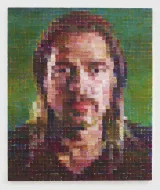
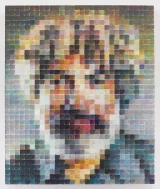
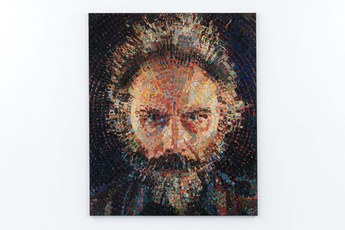
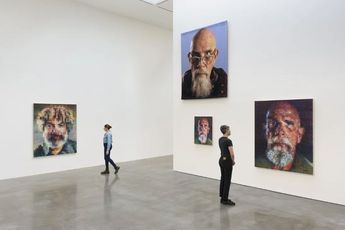
Close’s practice centres on translating photographic portraits into gridded images in which each square is treated as a discrete unit. Early black-and-white canvases, such as Big Self-Portrait and Phil, were airbrushed cell by cell in grey tones, producing unflinching, tightly cropped “heads” that magnify surface detail. From the 1970s he developed complex colour systems, filling each square with fingerprints, lozenges or abstract shapes that read as non-representational marks up close but resolve into recognisable faces from a distance.
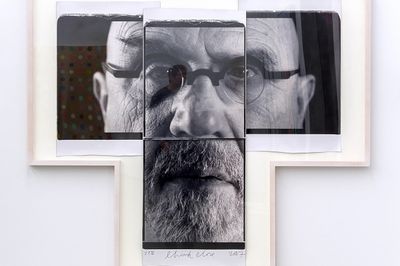
Printmaking and photography are central to Close’s oeuvre. He pursued ambitious projects in mezzotint, etching, woodcut and pulp paper, and made large-format Polaroids and daguerreotypes that served both as sources and autonomous works. After a spinal artery collapse in 1988 left him largely paralysed, he resumed painting using adaptive supports and assistants; later canvases intensify the mosaic-like structure of his images, as seen in the late series presented in Pace Gallery‘s Red, Yellow and Blue: The Last Paintings.
Themes and Context
Close’s work is often linked to Photo-Realism, Minimalism and Conceptual art but sits between them. Rather than simply reproducing photographs, he uses them to investigate how visual information is encoded and how recognition occurs when faces are built from abstract marks and mechanical systems. His focus on friends, family and fellow artists, presented with analytical reserve, has made him a key reference for later artists exploring portraiture, perception and the status of photography in painting.
Exhibitions, Collections and Recognition
Close has been the subject of major solo exhibitions at the Museum of Modern Art, New York, the Whitney Museum of American Art, the Walker Art Center and the San Francisco Museum of Modern Art, among others. His 1998 MoMA retrospective consolidated his position as a central figure in late 20th-century portraiture. His work is held in leading public collections worldwide, including MoMA, the Whitney, the National Gallery of Art, Tate and the Centre Pompidou, and he received honours such as the National Medal of Arts and service on the President’s Committee on the Arts and the Humanities.
Close died in 2021 in Oceanside, New York, leaving a legacy of work that continues to shape debates on portraiture and the relationship between painting and photography.
2026 Exhibitions
In 2026, Chuck Close’s work was the subject of Chuck Close: On Paper at Pace Gallery in New York, running from 12 March to 25 April, which focused on large-scale watercolours, ink drawings, Polaroids and prints that chart the artist’s use of paper from the 1970s to the 2010s. Earlier in the year, Pace Prints presented Chuck Close and Pulp (12 February–14 March 2026), a show dedicated to the artist’s experimental paper-pulp works. Developed with the Chuck Close Estate, this exhibition brought together finished pieces, matrices and studio tools to foreground the material and process-driven aspects of his printmaking practice.
Chuck Close FAQs
What is Chuck Close best known for?
Chuck Close is best known for large-scale, grid-based portraits derived from photographs, in which thousands of discrete marks coalesce into a face. These images helped redefine Photo-Realism and are among the most recognisable works of late 20th-century American art.
How did Chuck Close make his paintings?
Close started with a photographic portrait, overlaid it with a grid, and transferred each cell to canvas or paper. He filled the squares with carefully calibrated marks—from airbrushed greys to colourful abstract shapes—that appear autonomous up close but resolve into a coherent head at a distance.
How did paralysis affect Chuck Close’s work?
After a spinal artery collapse in 1988, Chuck Close resumed painting using adaptive devices and assistance from studio staff. His subsequent works often emphasise the modular, mosaic-like structure of his images, heightening the tension between abstract surface and figurative image.
Where can I see Chuck Close’s work?
Close’s work is in major museum collections, including the Museum of Modern Art and the Whitney Museum in New York, the National Gallery of Art in Washington, the San Francisco Museum of Modern Art, Tate and the Centre Pompidou. Pace Gallery, his longtime representative, continues to organise posthumous exhibitions of his work.
What themes does Chuck Close explore?
Chuck Close’s art explores perception, portraiture and the ways photographic and painterly systems mediate identity. By building faces from abstract grids and rule-based processes, he raises questions about recognition, authorship and the role of labour and technology in contemporary painting.
Ocula | 2026






Explore Chuck Close's Exhibitions












Explore and Follow Artists Shaping Contemporary Art
A respected voice in contemporary art discourse.
Focusing on ambitious storytelling and insightful art-world commentary. Ocula Magazine publishes in-depth interviews, critical essays and timely analysis on the artists, exhibitions and ideas driving the global art world.
Learn more about Ocula Magazine
Showcasing the best of the art world.
Ocula partners with galleries from around the world to highlight their artists, artworks and exhibitions. Gallery membership is by application and invitation, with each member vetted by an independent panel.
Learn more about Ocula Membership
Specialises in the sale of major artworks.
Led by a team with deep ties to the world’s leading auction houses, galleries and collectors. Ocula’s advisory team offers bespoke services to high-net-worth clients from around the world who are looking to acquire the best of contemporary and modern art.
Learn more about our team and services