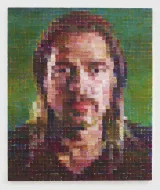
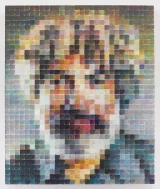
Initially an emerging Photo- (or Neo) Realist painter and printmaker who used grids as part of his process of enlarging images from gridded-up photographs of his sitters (working on the cellular units in sequence), Chuck Close became widely admired for a versatile range of image types and technical methods.
Close’s methods included optical chromatic blending, inventively using fingerprints instead of an air-gun or brush, skilled (but unflattering) skin-tone modulation, and even expressive organic mark-making that referred to the gridded distorting structures of Victor Vasarely.
The scale of Close’s flickering ‘pixelated’ (or photographic) portraits meant that although they were obviously figurative, they were also abstract in structure and difficult to recognise, due to perceptual fragmentation caused by enforced close proximity to their various depths of field, and the spatial limitations caused by the architecture. Close up to the paint provided a very different optical experience to that of standing a long way back.
Reclining nudes
Close also made huge reclining nudes in black and white, rich in their spectacular detail of mottled skin and sagging flesh, but not with the psychological intensity of the symmetrical portraits with their confrontational steely gazes.
Catastrophic spinal seizure
In 1988 Close had a catastrophic spinal seizure that left him paralysed from the neck down, and for the rest of his life he was confined to a wheelchair. With a brush strapped to his arm he regained some movement, and with assistants, kept on working, his number of projects mostly undiminished.
Despite this formidable handicap, Close was known as a gregarious and sociable individual who in later years is said to have greatly enjoyed conversing with his sitters about art issues, its history, painting and drawing techniques and colourful personalities. The sitters mainly consisted of family, old university friends and other artists like Roy Lichtenstein or musicians like Philip Glass.
The assorted art historical dialogues were recorded in the studio and eventually published in a book: The portraits speak: Chuck Close in conversation with 27 of his subjects.