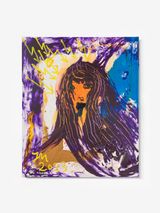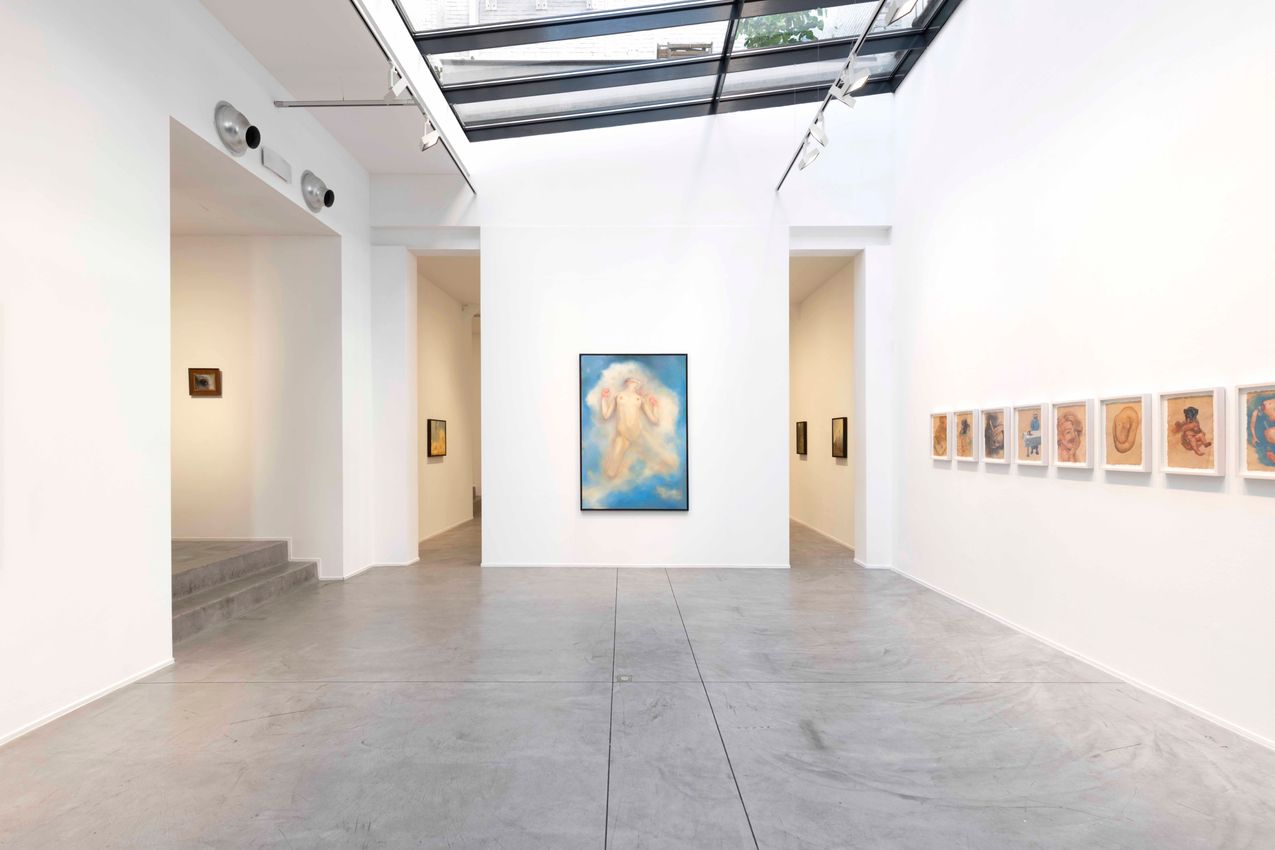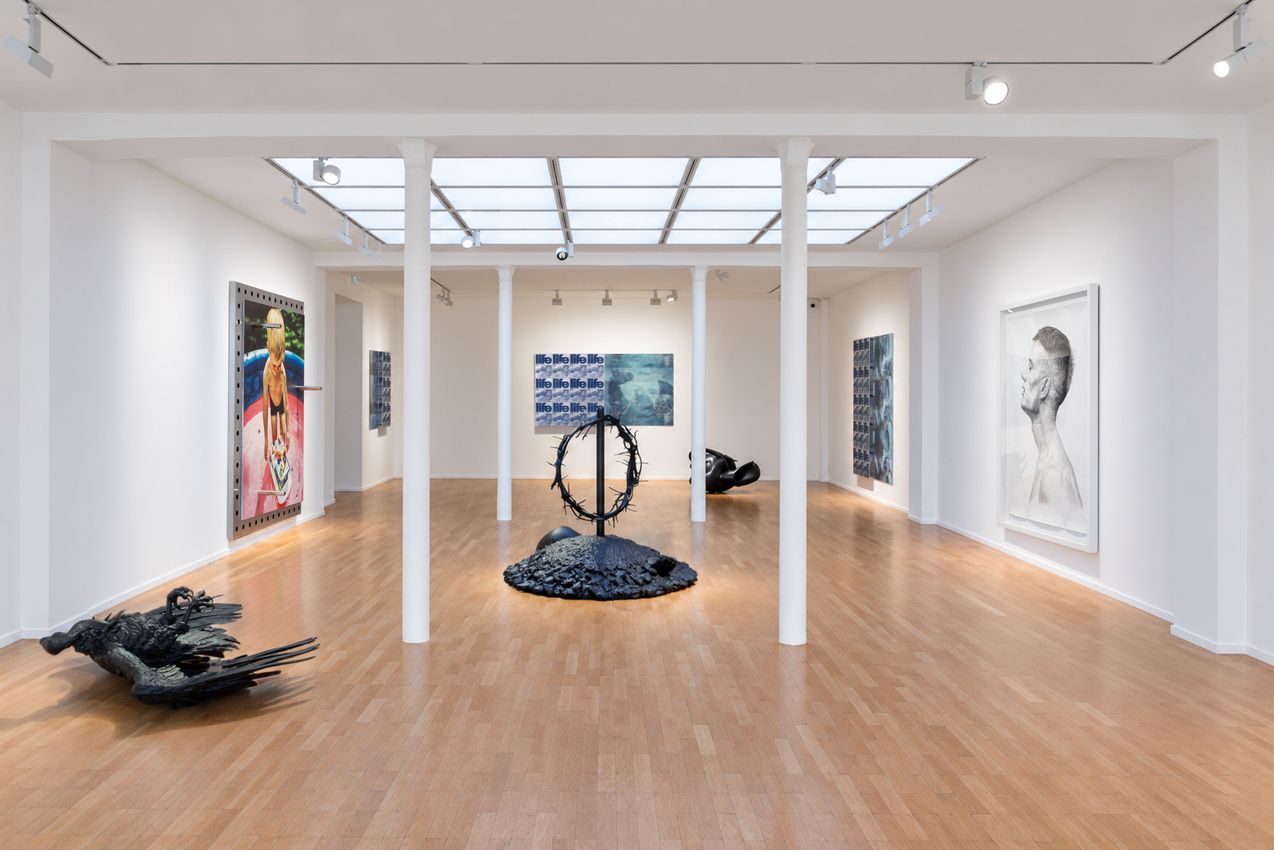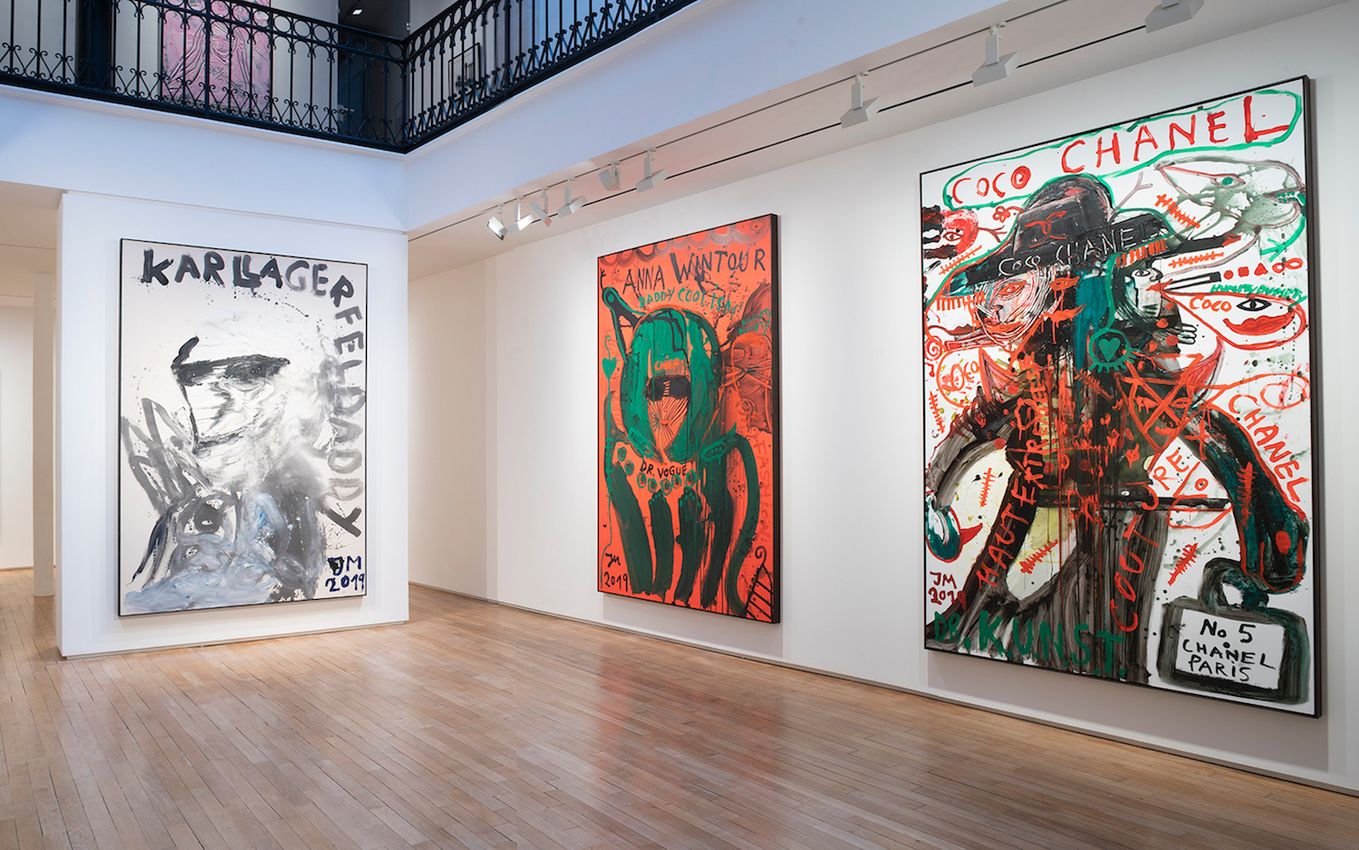
Five years after his last exhibition, Jonathan Meese is set for a spectacular return to Paris with his very own MEESE fashion show. This vibrant exhibition lights up the gallery space with a mix of installations, sculptures and paintings in a homage to the capital of fashion. With a zany tribute to the late Karl Lagerfeld as his starting point, Jonathan Meese creates a gallery of portraits depicting some of the main figures of the fashion world, such as Coco Chanel, Yves Saint Laurent and John Galliano, as well as Louis XIV, presented as the first fashion icon.
Playing on the ambiguity of these figures, Jonathan Meese takes us on a personal and playful journey into the secret history of haute couture. He references everything from the nudity of Adam and Eve to the Reign of Terror and the uniform of Hitler Youth girls. From the medley emerges a strange pantheon, where the ghostly figures of Saint-Just and Robespierre rub shoulders with self-portraits, vampires, monsters and a whole host of fashion victims.
Jonathan Meese questions the boundary between culture and nature, creativity and conformism, appearance and power, themes which have been haunting his work for the past twenty years. At a time when the fashion industry has comprehensively appropriated contemporary art, which has in turn made its way into the work of countless designers, Jonathan Meese presents an exuberant reversal of hierarchy, imagining a world in which art is the predominant guiding force.
Jonathan Meese was born in Tokyo in 1970 and lives and works in Berlin and Ahrensburg.
He has created an unclassifiable body of work, lying somewhere between expressionism and actionism, combining painting, sculpture, installations and performance.
Jonathan Meese’s work has featured in numerous international exhibitions since he first exhibited in Berlin and at the Berlin Biennale in 1998. He has taken part in various major group shows such as Generation at PS1 in New York (1999), New Blood at the Saatchi Collection in London (2004) and Dionysiac at the Pompidou Centre in Paris (2005). The Deichtorhallen in Hamburg and Magasin de Grenoble organised a retrospective exhibition of his work in 2006: Mama Johnny. In 2011, the Miami MOCA held a retrospective exhibition of his sculpture, and in 2012 the Akademie der Künste in Vienna took a broad-reaching retrospective look at his graphic work. More recently, Jonathan Meese has exhibited at the Pinakothek der Moderne in Munich (2018), Kunsthistoriches Museum in Vienna (2017), Carré Sainte-Anne in Montpellier (2017) and National Gallery in Prague (2015). This summer, the artist took over the city of Lübeck with the Dr. Zuhause K.U.N.S.T (Erzliebe) project, creating exhibitions for all the city’s venues.
Jonathan Meese has also created sets and scenery for the theatre and opera, including Dionysos by Wolfgang Rihm, presented at the Salzburg Festival in 2010 and Staatsoper in Berlin in 2012. He designed the scenery for Charpentier’s Médée directed by Paul Audi at the Théâtre des Champs Elysées in 2012. His improvisation on Wagner’s Parsifal at the Berlin Staatsoper in 2005 and Homage to Noël Coward at Tate Modern in 2006 were both unforgettable events. In 2007, he wrote and performed De Frau: Dr. Poundaddylein - Dr. Ezodysseusszeusuzur at the Volksbühne in Berlin. Jonathan Meese is currently preparing a new show called Lolita (R)evolution (Rufschädigendst)-Ihr Alle seid die Lolita Eurer Selbst! which he will be performing on five occasions from 15 February 2020 at Theater Dortmund.
Born in 1970 in Tokyo, Jonathan Meese is a German artist who lives in Berlin. He has developed an uncategorizable body of work, lying somewhere between expressionism and actionism, combining painting, sculpture, installations and performance. His personal mythology is a blend of historical, legendary and science fiction references, evoking figures as varied as Fantômas, Maldoror and Stalin, all of whom represent different facets of the artist’s identity. His work espouses the ‘dictatorship of art’.


The gallery was founded in 1966 by Daniel Templon, who was then only 21. It first opened rue Bonaparte, in Saint-Germain-des-Prés in Paris, before moving in 1972 to its current location, rue Beaubourg, in the Marais, close to the Pompidou Center, which opened in 1977. Daniel Templon first gained recognition by exhibiting conceptual and minimal artists such as Martin Barré, Christian Boltanski, Donald Judd, Joseph Kosuth, Richard Serra. In the seventies and eighties, Daniel Templon was one of the pioneers of the contemporary art and introduced many important American artists to the French public: Dan Flavin, Ellsworth Kelly, Willem de Kooning, Frank Stella, Andy Warhol. The gallery quickly became one of the references in contemporary art in France. In 1972, Daniel Templon and Catherine Millet co-founded the monthly art magazine ART PRESS.

A respected voice in contemporary art discourse.
Focusing on ambitious storytelling and insightful art-world commentary. Ocula Magazine publishes in-depth interviews, critical essays and timely analysis on the artists, exhibitions and ideas driving the global art world.
Learn more about Ocula Magazine
Showcasing the best of the art world.
Ocula partners with galleries from around the world to highlight their artists, artworks and exhibitions. Gallery membership is by application and invitation, with each member vetted by an independent panel.
Learn more about Ocula Membership

Specialises in the sale of major artworks.
Led by a team with deep ties to the world’s leading auction houses, galleries and collectors. Ocula’s advisory team offers bespoke services to high-net-worth clients from around the world who are looking to acquire the best of contemporary and modern art.
Learn more about our team and services