For his new exhibition Prostutopia at Galerie Templon in Brussels, Chilean artist Iván Navarro has deconstructed the notion of utopia. Extending his exploration of the energetic forces that incite revolutionary action, and following up on his recent exhibition Fanfare, at Templon Paris in 2017, which invoked the power of sound and music as a revolutionary tool, he now turns his attention to the utopian vision and its exploitation.
A resident of New York for over 20 years, Iván Navarro’s works are political, informed by art history, design and architecture as well as his personal experience of American society and the Pinochet dictatorship in Chile. His new work takes the notion of utopia and its subsequent commodification as its starting point. Prostutopia questions the distorting spectacle of utopia dressed up, marketed and denatured.
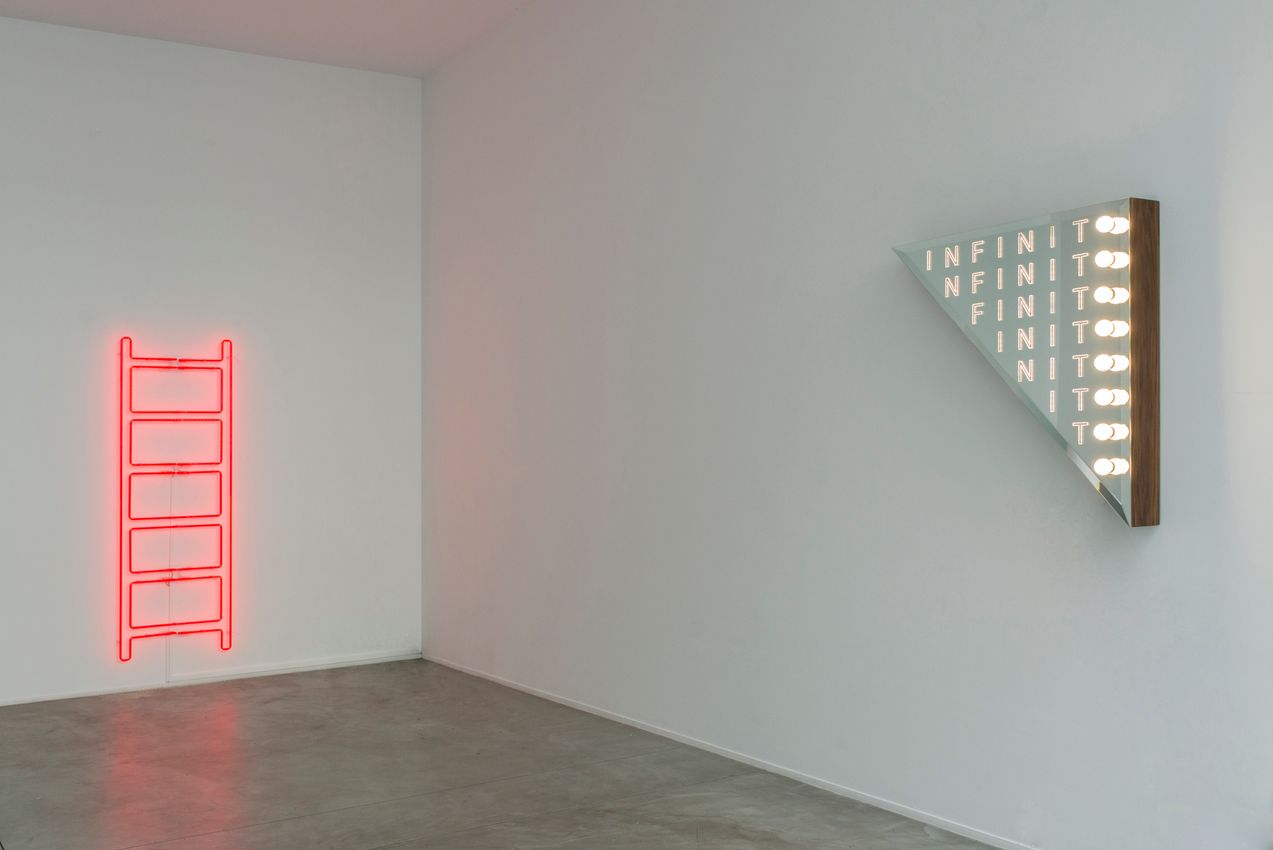
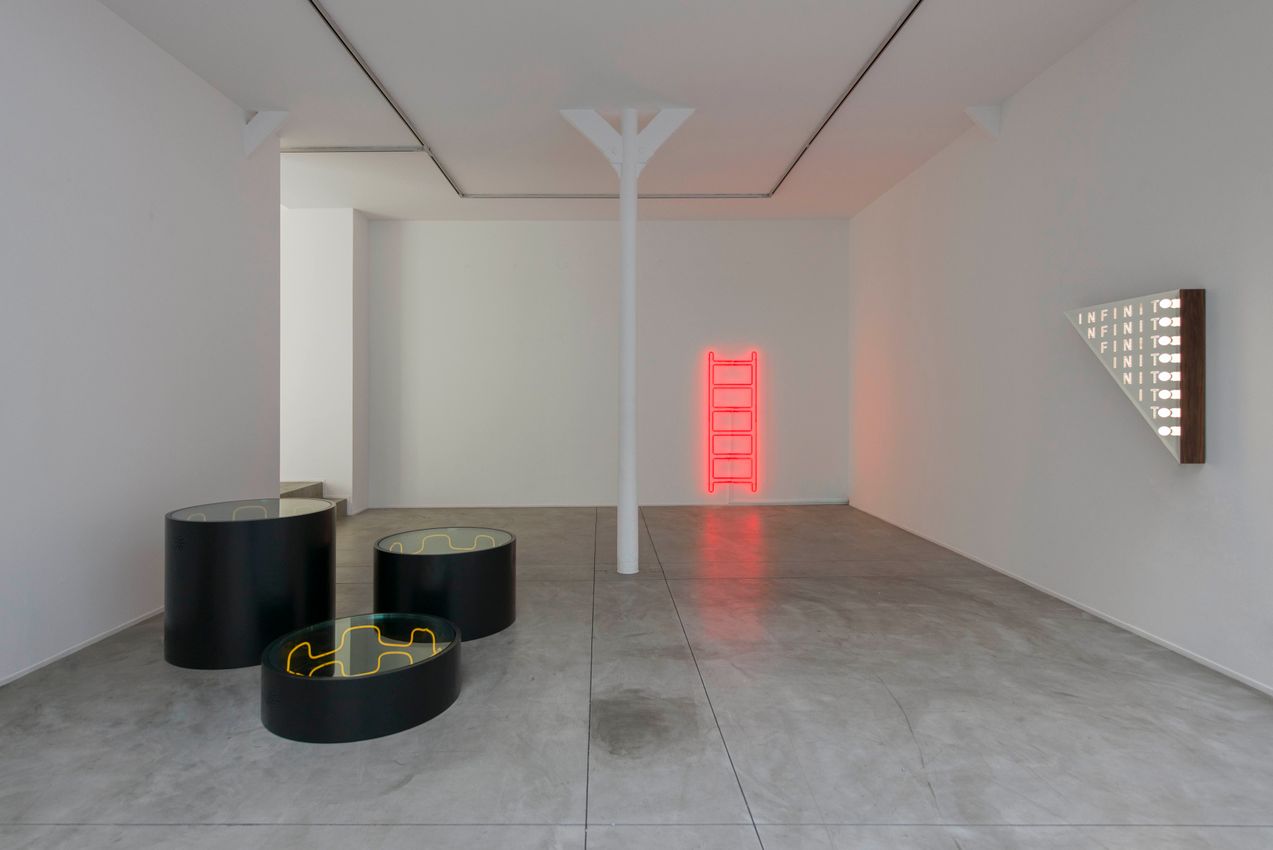
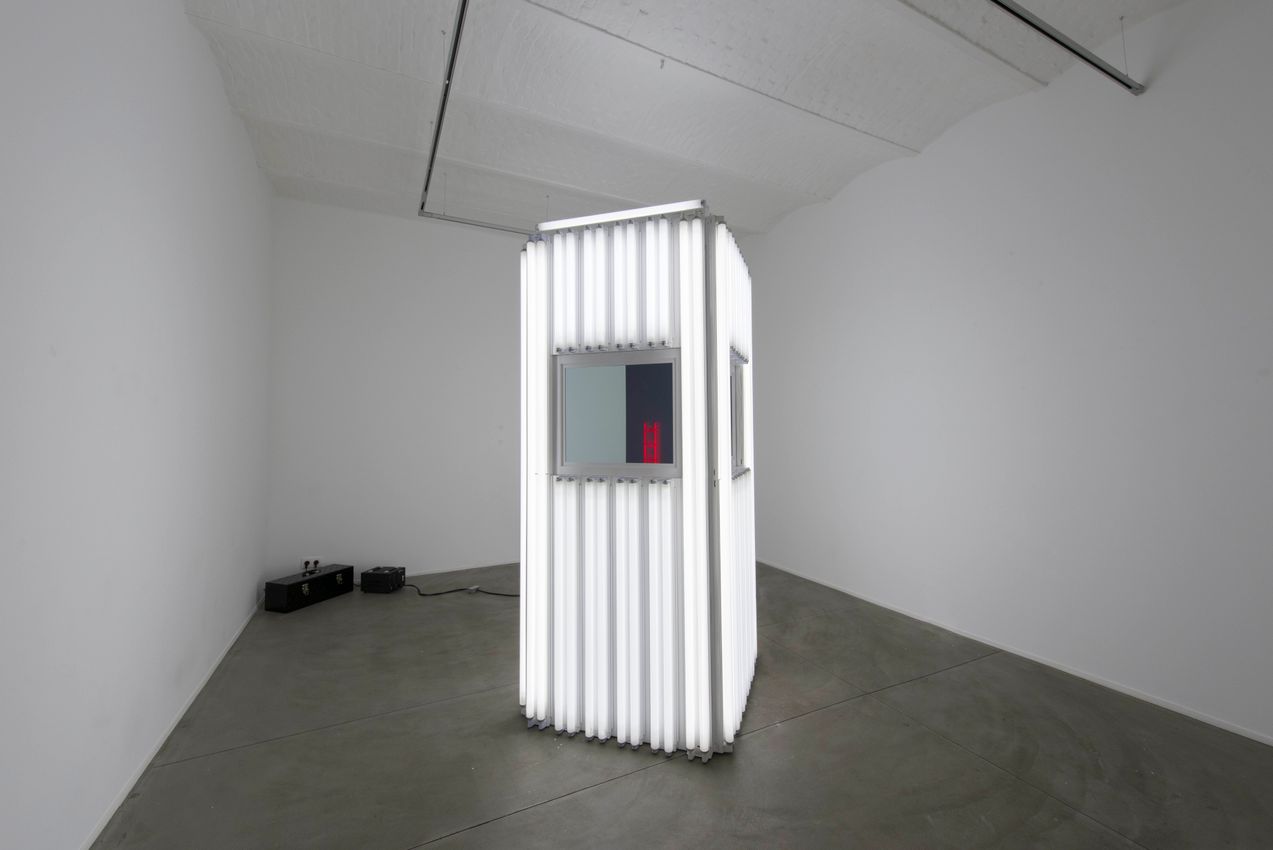
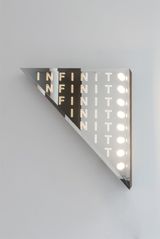
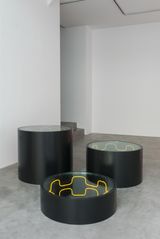
In the half-light, electric sculptures create an interplay of light and optical illusions that transform the space. These subverted everyday objects–a fence, two vanity mirrors, a ladder, a book, a three-tiered podium, a booth–while immediately playful and appealing, take us on a journey haunted by the issue of control and freedom. Each object becomes an instrument of control and surveillance. In a world where everyone is constantly watcher and watched, the artist’s luminous Totem with its minimalist aesthetic becomes a watchtower. Iván Navarro questions the illusion of protection and connection which nourishes the ambivalent power of the political, economic and social bodies doing the watching–government, businesses and social media.
On the opening evening, the exhibition will include a performance piece entitled Sirens, conceived in collaboration with artist Courtney Smith, where three volunteer participants each occupy one of the three podiums. Periodically prompted to shift postures and explore the possible uses of the object to the body, they are free to move and speak and interact; yet strictly confined to their individual stations.
Born in 1972 in Santiago, Iván Navarro has been living and working in Brooklyn (NY) since 1997. He represented Chile at the 53th Venice Biennale in 2009. Recent solo and group exhibitions featuring his work include: This Land is Your Land, solo, Busan Museum, South Korea; Age of Terror, Imperial War Museum, London (2018); Luz y Espacio, Guggenheim Bilbao, Spain (2017); Art Basel Parcours; Yinchuan Biennale, China (2016); Under the Same Sun, South London Gallery (2016 and Solomon R. Guggenheim Museum, New York, 2014); Storylines, Solomon R. Guggenheim Museum, New York (2015); This Land is Your Land, Madison Square Park, New York; Nasher Museum of Art, Durham and North Park Center, Dallas (2014–2016); Light Show, Hayward Gallery, London; Auckland Art Gallery, Auckland; Sharjah Art Foundation, Sharjah and CorpArtes, Santiago (2013–2016); Iván Navarro: Fluorescent Light Sculptures, Frost Museum of Art, Miami (2012). His work is included in a great many international collections, including the Solomon R. Guggenheim Museum (New York), Hirshorn Museum and Sculpture Garden (Washington, DC), Fonds National d’Art Contemporain and Louis Vuitton Foundation (Paris). He was appointed as the associate artist for the Grand Paris Express artistic programme, working in collaboration with architect Dominique Perrault on the future Gare de Villejuif-Institut Gustave Roussy.
Born in 1972 in Santiago, Iván Navarro grew up under the Pinochet dictatorship. He has lived and worked in New York since 1997. Iván Navarro uses light as his raw material, turning objects into electric sculptures and transforming the exhibition space by means of visual interplay. His work is certainly playful, but is also haunted by questions of power, control and imprisonment. The act of usurping the minimalist aesthetic is an ever-present undercurrent, becoming the pretext for understated political and social criticism.


The gallery was founded in 1966 by Daniel Templon, who was then only 21. It first opened rue Bonaparte, in Saint-Germain-des-Prés in Paris, before moving in 1972 to its current location, rue Beaubourg, in the Marais, close to the Pompidou Center, which opened in 1977. Daniel Templon first gained recognition by exhibiting conceptual and minimal artists such as Martin Barré, Christian Boltanski, Donald Judd, Joseph Kosuth, Richard Serra. In the seventies and eighties, Daniel Templon was one of the pioneers of the contemporary art and introduced many important American artists to the French public: Dan Flavin, Ellsworth Kelly, Willem de Kooning, Frank Stella, Andy Warhol. The gallery quickly became one of the references in contemporary art in France. In 1972, Daniel Templon and Catherine Millet co-founded the monthly art magazine ART PRESS.

A respected voice in contemporary art discourse.
Focusing on ambitious storytelling and insightful art-world commentary. Ocula Magazine publishes in-depth interviews, critical essays and timely analysis on the artists, exhibitions and ideas driving the global art world.
Learn more about Ocula Magazine
Showcasing the best of the art world.
Ocula partners with galleries from around the world to highlight their artists, artworks and exhibitions. Gallery membership is by application and invitation, with each member vetted by an independent panel.
Learn more about Ocula Membership

Specialises in the sale of major artworks.
Led by a team with deep ties to the world’s leading auction houses, galleries and collectors. Ocula’s advisory team offers bespoke services to high-net-worth clients from around the world who are looking to acquire the best of contemporary and modern art.
Learn more about our team and services