



Press Release

David Kordansky Gallery is pleased to announce a solo exhibition of paintings andworks on paper by Francisco (Chico) da Silva, on view in New York at 520 W. 20th St.from October 27 through December 16, 2023. Join us for a panel discussion moderatedby Ana Lopes with Rio de Janeiro-born writer Gabriella Angeleti, El Museo del Barriochief curator Rodrigo Moura, and Brooklyn Museum curator of Indigenous art DarienneTurner at 5 PM on Thursday, October 26 at our New York gallery, followed by anopening reception from 6:30 to 8 PM.

The drawing is what the hand gives and the color is what the details ask for. A house isengineering, while painting is autonomy. —Chico da Silva

The search for an autonomous way of artmaking—both inside and beyond the paintedframe—permeates the visionary work and complex legacy of one of twentieth-centuryBrazil’s most prolific and important artists, Chico da Silva (b. circa 1910 or 1922/23, d.1985). At once fantastical, dark, joyous, and mystical, Chico’s intricate lines and dottedpatterning introduce us to a world of the artist’s own making.

Born to an indigenous Peruvian father and an Afro-Brazilian mother, Chico grew up inthe Northwestern state of Acre, where his childhood was shaped by the denseAmazonian forests as well the catechizing agendas of the area’s European missions.While it’s speculated that the artist’s father was of the Kashinawa or Huni Kuin group,the degree with which Chico, who identified simply as caboclo, felt connected to hisindigeneity is unclear. Following his father’s death, Chico and his mother moved toFortaleza, where they settled in Pirambu, an impoverished neighborhood made upprimarily of migrants united by the shared political struggle for housing and stability.

Chico’s first known engagement with art was here, in the 1940s, when he began usingblack charcoal and organic materials to draw murals on the exteriors of fisherman’shouses. These works caught the eye of Swiss art critic Jean-Pierre Chabloz, who,positioning himself as the “discoverer” of the “primitive” painter, assumed a complex role in Chico’s subsequent career, one simultaneously promotional and paternalizing.Chabloz introduced Chico to the gouache, paint, paper, and canvas that soon becamehis primary materials, and championed Chico’s work to the international art world,facilitating widespread recognition that would rise and fall over the next forty years.

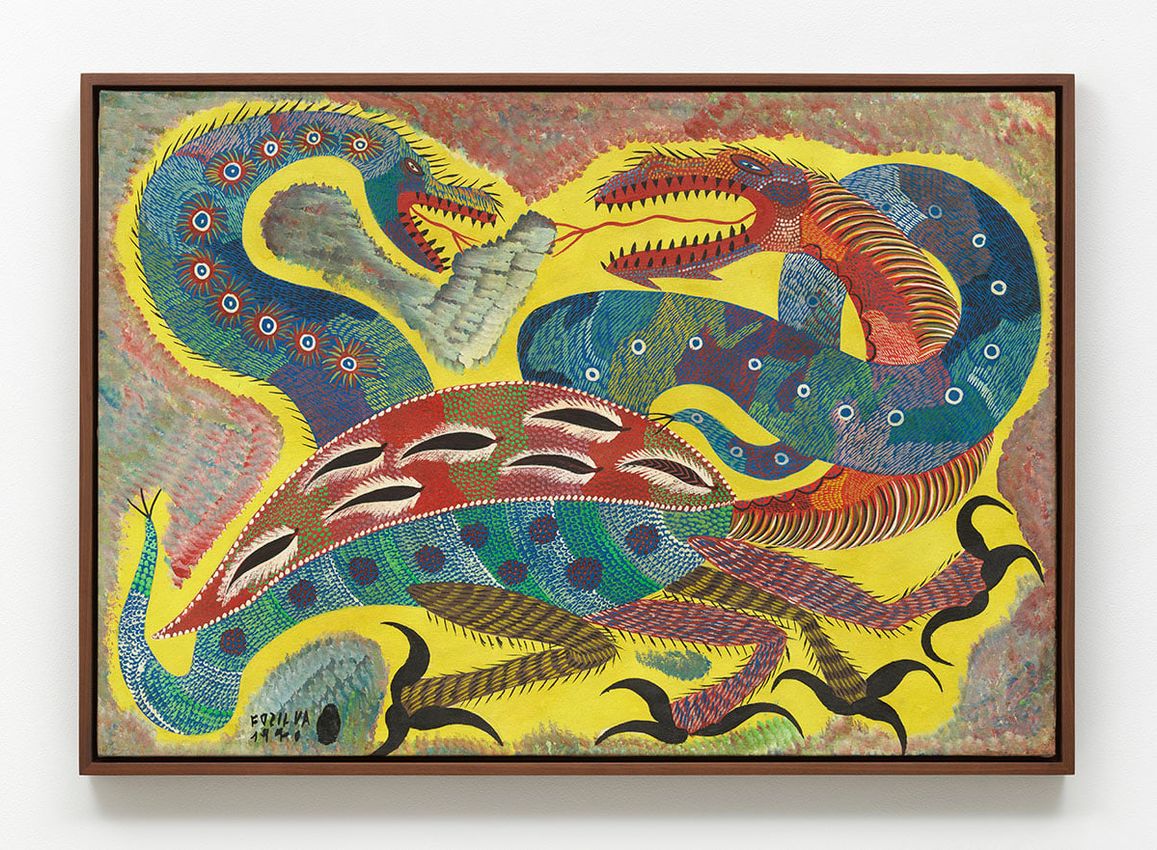
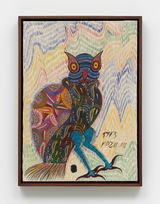
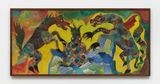
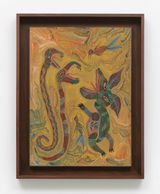
Reconsidered today, Chico’s exuberant, sophisticated paintings shatter the oppressivecategories to which they were once relegated. Graphic, often mythological or enchantedrepresentations of creatures and flora common to northern Brazil are made surrealthrough his bold colors, intricate line work, vivid patterning, and exaggerated featureslike elongated claws, tongues, and beaks. Other elements of anthropomorphizedfigures—like open mouths receiving food, large, spellbound eyes, and floatingappendages—connect nature to humanity, situating all of life within a broad cosmologyof the artist’s own making. This narrative approach to painting, apparent throughoutChico’s career, allowed him to link life in a poor urban area to a realm of dream andfantasy. As he once noted, “These worlds that I paint are not memories from the time Iwas a boy. This is called imagination, occult sciences, astronomy...” While Chico didn’tdepict stars or planets, the astronomy that his works evoke suggests a larger, non-hierarchical interconnectedness in which organisms floating in the deep sea mirrormatter drifting through outer space.

If the expression of his worldview through visual means came second nature to Chico, so, too, did his choice to integrate his community into the making of his increasingly in- demand work. In the early 1960s, Chico established the Pirambu School, an informal workshop in which local artists and curious neighbors learned Chico’s techniques, worked as paid collaborators, and, with his support, developed their own bodies of work. The communal ecosystem of Pirambu was inherently symbiotic: while the exact number of participants remains opaque, it’s known that five key artists—Babá (Sebastião Lima da Silva), Claudionor (José Claudio Nogueira), Garcia (José dos Santos Gomes), Ivan (Ivan José de Assis), and Chico’s daughter Chica (Francisca Silva)—helped streamline the production of Chico’s paintings while also making important creative contributions through their ongoing additions to Chico’s core typologies. In its most organized form,the studio process allowed each artist to contribute his or her own particular skills toChico’s visions.

From our current vantage, Pirambu seems a radical iteration of an artmaking approachthat challenges traditional notions of authorship foundational to the Western canon,including the importance of a work’s verifiable authenticity as made by a singleindividual. In practice, Pirambu echoed indigenous practices of communal making whilealso sharing obvious similarities with The Factory, which Andy Warhol opened in 1963.But without a conceptual or intellectual framing that fit the expectations of a Eurocentricaudience, the larger significance of Chico’s project was, for decades, woefullymisunderstood.

Chico da Silva’s legacy, belatedly reappraised, reveals him to be not only a painter ofremarkable skill and breadth, but a practitioner for whom working alongside one’sneighbors was the intuitive outcome of a long-established way of life that was centeredon communal gathering and the necessary sharing of resources. In forging a practicethat eschewed the desires and value systems of a midcentury European and Americanart world, Chico and the Pirambu School established a sovereign Brazilian art asvisually dazzling as it is assertive in its resistance to colonial intervention.

Chico da Silva has been the subject of numerous solo exhibitions including the recentmajor presentation Chico da Silva e o ateliê do Pirambu, Pinacoteca de São Paulo(2023). Other solo exhibitions include Chico da Silva: Sacred Connection, Global Vision,Museu de Arte Sacra, São Paulo (2022); Chico da Silva – O Renascer 100 Anos,Espaço Cultural Correios, Fortaleza, Brazil (2010); Retrospectiva Chico da Silva: dodelírio ao dilúvio, Espaço Cultural do Palácio da Abolição, Fortaleza, Brazil (1989),among many others. Group exhibitions include The Sacred in the Amazon, CentroCultural Inclusartiz, Rio de Janeiro (2023); Fantaisies brésiliennes, Musée Internationald’Art naïf Anatole Jakovsky, Nice, France (2016); Brasileiro, Brasileiros, Museu Afro Brasil, São Paulo (2005); 33 Biennale di Venezia, Venice, Italy (1966), among manyothers. His work is in the permanent collections of Centre Pompidou, Paris; Tate,London; Pinacoteca de São Paulo; El Museo del Barrio, New York; Guggenheim AbuDhabi, United Arab Emirates; Museu de Arte do Rio de Janeiro; Fundacão EdsonQueiroz, Fortaleza, Brazil, among many others.

Read More
About the Artist

Chico da Silva (b. circa 1910, d. 1985) grew up in the state of Acre, Brazil in the Amazon rainforest, however, his first known engagement with art was in Pirambu, a coastal town in eastern Brazil, where he and his mother relocated after his father’s death. Beginning in the 1940s, Chico gained recognition for creating murals with black charcoal and natural pigment on the exteriors of fishermen’s houses. The years following found Chico expanding his material reach to include works on paper and paintings on canvas and board. During this period, he also gained wider recognition within the European art world, culminating with an honorable mention in the Brazilian Pavilion presentation at the 33rd Venice Biennale in 1966.

View Artist Profile

Also Exhibiting at David Kordansky Gallery

About the Gallery

David Kordansky Gallery is one of the most dynamic venues for contemporary art, and is internationally regarded as a leading gallery of its generation.

View Gallery Profile
Address
520 W. 20th Street
New York
United States
Opening Hours
Tuesday - Saturday
10am - 6pm
(1)
New York 520 W. 20th Street
David Kordansky Gallery
520 W. 20th Street, New York, United States
212-390-0079

Opening hours
Tuesday - Saturday
10am - 6pm
The art world in focus
