David Kordansky Gallery is pleased to announce Why Are You Sitting In The Dark, an exhibition of paintings, drawings, and a sculpture by Jason Fox. The exhibition will be on view in Los Angeles at 5130 W. Edgewood Pl., from May 16 through June 28, 2025. An opening reception will be held on Friday, May 16 from 6 to 8 PM.
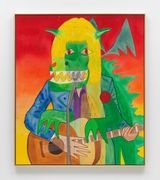
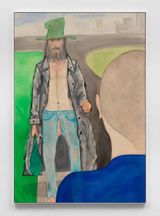
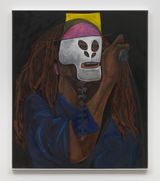
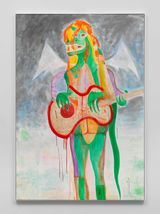
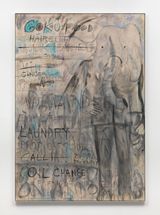
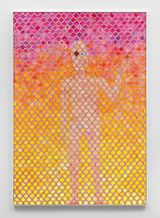
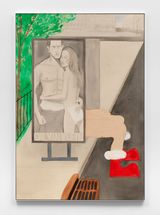
Fox makes paintings that are, first and foremost, about painting but inevitably end up being about everything else. The style he has developed over four decades is responsive to many levels of cultural production, indulging in disparate interests such as modernism, minimalism, comic books, and popular music. No two paintings are alike, even or especially those produced as entries in an immediately recognisable series. Joni Mitchell, Alberto Giacometti, a bemused dragon, a melancholic dog, and various skeletons or other “frightening” figures are among the recurring cast of characters who lend their forms to Fox’s inventive, intuitively elaborated process. The artist continually eludes expectations and gently demands that viewers consider each iteration of his obsessions anew, not just because they are his, but because the avenues he takes to realize his images are the same avenues any of us take when we try to figure out what matters, what moves, and what amazes.
Why Are You Sitting In The Dark is all about the intimacy of this demand. Because it includes paintings of various sizes, the exhibition evokes the emotionally close environs of the salons in which the early modernists showed, debated about, and came to understand their work. Like the early paintings of these important predecessors, Fox’s avant-gardism is not reliant on the spectacle-based effects or serialised predictability that have come to infuse much contemporary art. It is, rather, focused on what it means to take chances, painting by painting and even brushstroke by brushstroke. By remaining off-kilter, the paintings leave open the possibility of some future-oriented, organically rendered harmony. These are pictures of the intersections between hope and despair. They arise out of a hard-won faith in formalism, as well as sanguine acceptance of the fact that formalism on its own is never enough.
To this end, Fox has made a kind of aesthetic science out of the convergence of forms, colors, gestures, and moods. In the eponymous painting that gives the show its title, images of Joni Mitchell, a Goya-inspired goat, and a disaffected gargoyle hover on, in, and through each other, occupying one another’s hearts and minds in visual as well as narrative terms. Any attempt to tease them apart results in awareness of their inseparability, just as the desire to untangle the closely linked denizens in the depths of our beings often leaves us pondering places where distinctions between creativity and destruction, for instance, fall away. The work’s background is a modulated field of darkly luminous tones that appears to breathe along with its more readily identifiable subjects. The artist’s longstanding interest in monochromatic color is a reminder that, on sculptural terms, there is never truly a “background” or “foreground.” In painting, the action always takes place on the surface.
In some cases, as in a saturated red painting of Bob Marley crossed with a dog, surface is synonymous with the bold graphic image inscribed on it. Each body part—eyes, hand, nose—stands out in discrete definition, until the realisation sets in that the depiction is not as clear as it first seems. What is Marley’s and what is the dog’s become questions instead of facts. The blurring of features in The Golden Man (2025), meanwhile, is of the expressionistic variety, with Fox relishing in the moment-to-moment back-and forth that builds textural bridges between the busts of Tom Petty and Giacometti that are the work’s ostensible subjects. The two men become a pile of sensitive, curious, amber-hued attempts to find what unites them. They share a knowing gaze that itself speaks to the complexity of the states the artist conjures, as well as a frankness—of intention, of materiality—that is often obscured in the world at large.
While directness characterises the entirety of Fox’s project, the sculpture and works on paper on view emphasise the lack of pretence in his approach to his materials as well as the range of his research and references. The sculpture Willie (2022) is a wood cross adorned with a bandana and two lengths of synthetic hair. Its resemblance to country music icon Willie Nelson feels both highly determined (it also matches the musician’s height) and completely accidental, as the visual and tactile qualities of its constituent parts quickly override the obvious associations they generate. Fox balances Dadaist humour against the weight and gravitas of totemic form. And in the works on paper that round out the exhibition, Fox makes plain how he moves from one idea to another, making complete statements even out of fragmented attempts to understand—and once again forget—the driving forces behind his work. The works on paper allow viewers to fully appreciate the role played by the unknown in Fox’s ongoing evolution and how breaking down what has come before is an essential phase in the process of making new things.
Jason Fox (b. 1964, Yonkers, New York) has been the subject of solo exhibitions at David Kordansky Gallery, New York (2023); CANADA, New York (2021); and Almine Rech Gallery, Brussels (2018). Recent group exhibitions include Blossom: The Tenth Anniversary of the Long Museum, Long Museum, Shanghai (2024); The Drawing Centre Show, Le Consortium, Dijon, France (2022); Artists for New York, Hauser & Wirth, New York (2020); Samaritans, Galerie Eva Presenhuber, New York (2019); and Animal Farm, Brant Foundation Art Study Center, Greenwich, Connecticut (2017). His work is in the permanent collections of institutions including the Aïshti Foundation, Beirut; Colby College Museum of Art, Waterville, Maine; and Hall Art Foundation, Reading, Vermont. Fox lives and works in Poughkeepsie, New York.
For almost thirty years, Jason Fox has painted pictures that inhabit the charged psychological spaces within American culture, as well as within the medium of painting itself. Exhibiting frequently at Feature Inc., among other galleries in the 1990s, he moved against the grain of prevailing appropriation-based and conceptual methodologies. His idiosyncratic, risk-taking paintings then and since have been filled with imaginary beings informed by modernist art, autobiographical reflection, and mythological symbolism, and a recurring cast of characters from comics, fantasy cinema, and popular music. As such, Fox produces pictures that condense broad propensities in the collective imagination into intimate images whose every brushstroke and colour choice carries emotional weight. These unlikely but arresting pictures—suffused with Dadaist humour—make the most of painting’s ability to register organic, intuitively rendered changes in form and perspective. In many works from the last few years, Fox fuses portraits of well-known figures as well as images of his dog, demons, and angels. These hybridised beings appear to morph before the viewer’s eyes, communicating a sense of the fluidity with which they take shape on the canvas. This makes his work as personal and introspective as it is accessible, immediately recognisable, and culturally resonant.


David Kordansky Gallery is one of the most dynamic venues for contemporary art, and is internationally regarded as a leading gallery of its generation.

A respected voice in contemporary art discourse.
Focusing on ambitious storytelling and insightful art-world commentary. Ocula Magazine publishes in-depth interviews, critical essays and timely analysis on the artists, exhibitions and ideas driving the global art world.
Learn more about Ocula Magazine
Showcasing the best of the art world.
Ocula partners with galleries from around the world to highlight their artists, artworks and exhibitions. Gallery membership is by application and invitation, with each member vetted by an independent panel.
Learn more about Ocula Membership

Specialises in the sale of major artworks.
Led by a team with deep ties to the world’s leading auction houses, galleries and collectors. Ocula’s advisory team offers bespoke services to high-net-worth clients from around the world who are looking to acquire the best of contemporary and modern art.
Learn more about our team and services