Press Release

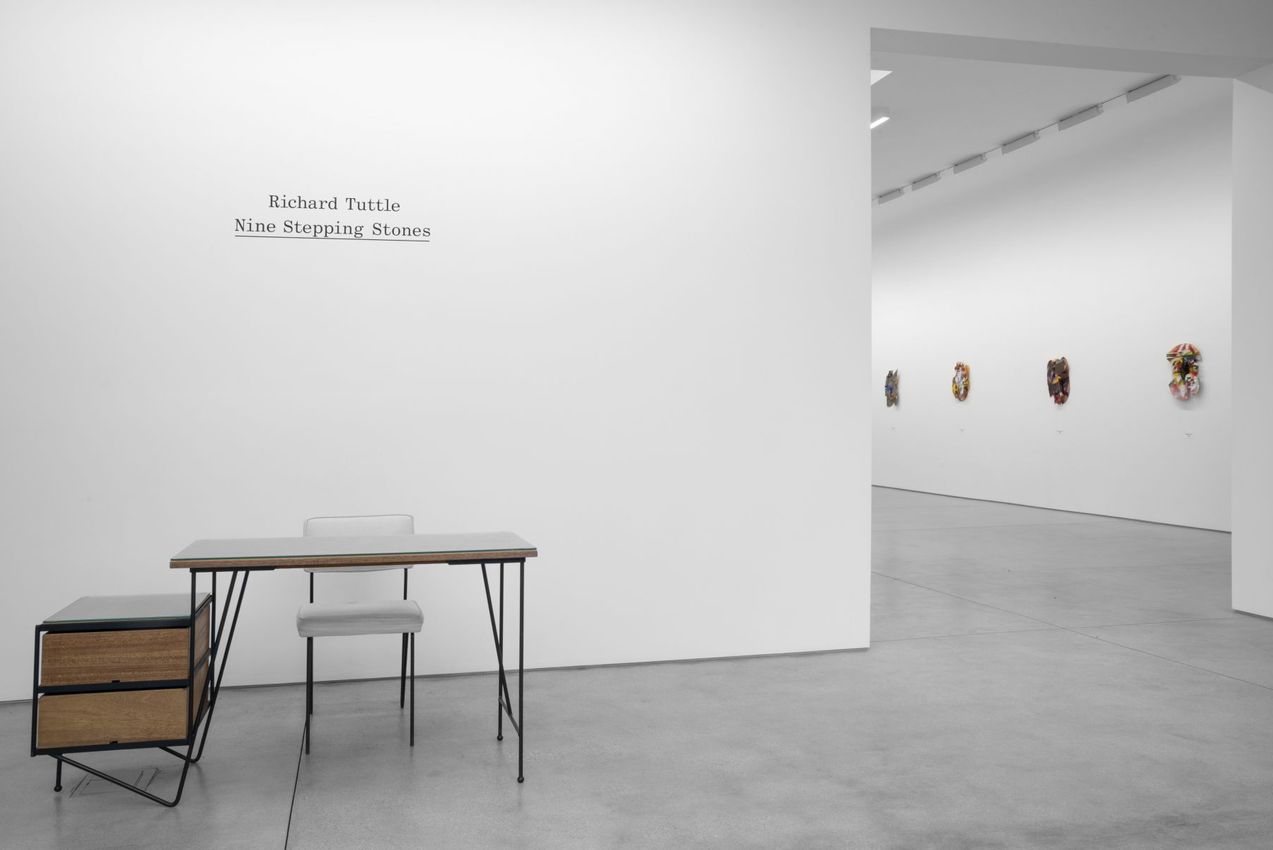
David Kordansky Gallery is pleased to present Nine Stepping Stones, Richard Tuttle‘s first exhibition at the gallery and the first presentation of the artist’s work in Los Angeles in nearly fifteen years.

Featuring a new group of wall-based works, this exhibition highlights the recent production of one of the most representative American artists of the postwar period. Over the past six decades, Tuttle has occupied interstitial positions between several genres, including painting, sculpture, drawing, and poetry. His work demonstrates how traditional categories of art-making can function as starting points for wide-ranging investigations into perception and language, questioning not only how we see or experience, but also what is being seen or experienced. Such questions ultimately hinge upon how a person—whether artist or viewer or both—inhabits and makes sense of the thing that comes to be known as an artwork.

Nine Stepping Stones is dedicated to a series of assemblages whose titles all include the word ‘head’ and whose roughly head-like proportions and shapes symbolise the human (and humanistic) frame of reference through which they can be engaged. Tuttle produced these works throughout 2020 as he recovered from Covid-19, and so they constitute, among many other things, a body of aesthetic-empirical data relating to the subjective and objective effects of the pandemic. Built from plywood—a material he has used throughout his career—which in turn becomes a support for spray-painted marks, each is a lyrical conundrum. Each head is defined by its mysteries of construction and a palpable, affirmative sense of aesthetic openness exercised within limits and expressed through humble materials.

In these works, colour is nominal, i.e., existing in name, but painting is diffracted, revealing a spectrum of constituent parts that goes beyond the visual and pushes the medium into an uncharted territory. The spaces each composition conjures and occupies are both sublime and imminent, which is to say they challenge modes of ordinary perception while remaining firmly rooted in physical fact. Coming to terms with this contradiction reveals another way in which Tuttle evokes the elusively complex, if intimately familiar, things that people call heads: internalised and externalised, fixed and ephemeral, figurative and abstract, sources of language and ultimately impossible to describe in words, heads are things of the mind in every sense. Like artworks in general, and Tuttle’s work in particular, they are also sites or categories in which contradictory elements coexist.

Important to note is Tuttle’s use of repeated forms that nonetheless serve different functions depending on the context of the individual work. A case in point are the zig-zagging plywood constructions that disrupt, adorn, pierce, and open the otherwise flat surfaces of each head, hinting at hidden spaces behind, inside, and around them. Parsing these depths is an act driven in equal measure by the eye and the imagination. And while the works abound with unfinished edges, drops of glue, and other plainly evident traces of their improvisatory making—Tuttle makes no secret of the presence of his hand—they also come across as deliberately planned and conceived, with final forms that are sharp, indelible, and intentional. As a result, the exhibition is defined more than anything by its clarity, and a sense of communication and connection that are ethical in nature. As has been the case throughout his career, Tuttle achieves visual and conceptual strength not by overpowering viewers or the spaces they inhabit, but by coaxing attention back to boundless acts of seeing, thinking, and feeling that are analogues for human freedom.

Since the 1970s, Richard Tuttle (b. 1941, Rahway, New Jersey) has been the subject of numerous solo exhibitions at museums throughout the world, including most recently M Woods Museum, Beijing (2019); Phillips Collection, Washington, D.C. (2018); Kunstmuseum aan Zee, Ostend, Belgium (2017); Museo de Arte de Lima, Peru (2016); Metropolitan Museum of Art, New York (2016); and Whitechapel Gallery and Tate Modern, London (2014). In 2005–2007, a retrospective exhibition organised by the San Francisco Museum of Modern Art traveled to five additional institutions, including the Whitney Museum of American Art, New York and the Museum of Contemporary Art, Los Angeles. His work is included in over sixty public collections, including those of the Centre Pompidou, Musée National d’Art Moderne, Paris; and Stedelijk Museum, Amsterdam; Museum of Modern Art, New York; Art Institute of Chicago; and Los Angeles County Museum of Art. Tuttle lives and works in New York and Abiquiú, New Mexico.

Read More
About the Artist

Over the last six decades, Richard Tuttle has become one of the most representative American artists of the postwar period, occupying interstitial positions between several genres, including painting, sculpture, drawing, and poetry. He consistently opens new possibilities for a variety of mediums and materials, demonstrating how traditional categories of art-making can function as starting points for unhindered, open investigations into the functioning of perception and language. His early encounters with artists and artworks associated with pop and minimalism laid the groundwork for a project precipitated on reinvention and change. As Tuttle developed a syntax remarkable for the frankness of its physicality and the poetry of its juxtapositions, he created a space in which a decidedly avant-garde strain of contemporary art could take on the organic sophistication and subtlety of the natural world. At the same time, he began to produce a number of iconic typologies—including stretched and pinned canvases, painted reliefs, and works on paper—in which divisions between object, image, making, abstraction, and observation fell away, leaving in their wake a mode of translating the multiplicity and complexity of life into discrete, often elegant constructions notable for their precision, radical informality, and immediately tangible intimacy.

View Artist Profile

Also Exhibiting at David Kordansky Gallery

About the Gallery

David Kordansky Gallery is one of the most dynamic venues for contemporary art, and is internationally regarded as a leading gallery of its generation.

View Gallery Profile
Address
5130 W. Edgewoord Pl.
Los Angeles
United States
Opening Hours
Tuesday – Saturday
10am – 6pm
(1)
Los Angeles 5130 W. Edgewoord Pl.
David Kordansky Gallery
5130 W. Edgewoord Pl., Los Angeles, United States

Opening hours
Tuesday – Saturday
10am – 6pm
The art world in focus