



EDVARD MUNCH
b. 1863, NorwayEdvard Munch was a pioneer Symbolist and Expressionist painter and printmaker, famous for exploring themes of masculine interiority, turmoil, and alienation. He developed new subjects of psychological intensity, exploring universal themes of sexual jealousy and desire and expressing traumatisation from family deaths, tuberculosis, and mental illness. Remarkably prolific, Munch was enormously influential on the German Expressionists.
Early Life
The son of a strict, religiously zealous doctor, Munch was raised in Oslo, where he witnessed much personal tragedy. In 1879 he went to a technical collage to become an engineer, excelling in science and maths, but he left in 1881 to begin studying at the Royal School of Art and Design. There Munch was encouraged by Hans Jæger the nihilist bohemian writer and philosopher to focus on his own mental states. Taught by painter Christian Krohg and figure sculptor Julius Middelthun, Munch found he had a talent for figure drawing. His early paintings were influenced by Édouard Manet.
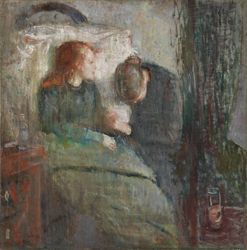
In the mid-1880s when Munch joined the Kristiania Bohème, a radical artist group promoted by Jæger, he exhibited The Sick Child in 1886 and attracted much vitriol. Jæger, in the local paper, was a staunch champion.
Travels to France and Germany
In 1889 Munch went to Belgium and France for two years. His visit to Paris was an eye-opener, for he was excited by the colour and composition of the prints and paintings of Paul Gauguin, Vincent Van Gogh, and Henri de Toulouse-Lautrec, and was impressed by Gauguin’s credo: ‘Art is human work, not an imitation of Nature.’
Munch went to Paris originally to study drawing and painting with Léon Bonnat on a grant, but was soon bored.
Edvard Munch’s Symbolist Style
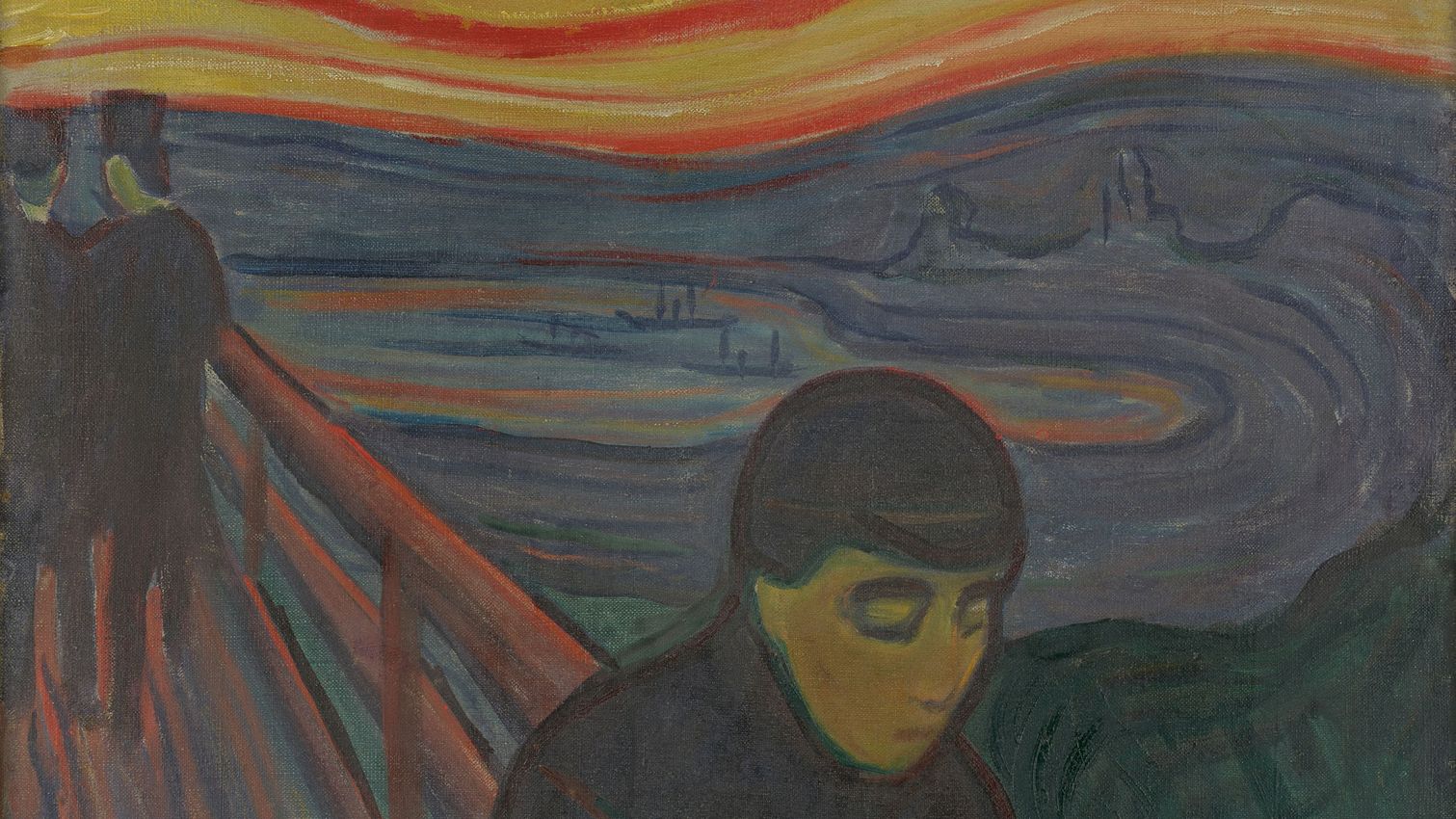
Back in Oslo, Munch’s painting ideas started to synthesise, and he explored varied brushstroke techniques, different palettes, and heavy outlines. His breakthrough with Melancholy (1891) was regarded by Krohg as the first ever Norwegian Symbolist painting. Munch had moved away from the Impressionism and naturalistic styles found in works like Inger on the Beach (1889).
In 1892 Munch’s reputation was such that he was invited to exhibit in Berlin by the Union of Berlin Artists. He became controversial—the furore created a supportive breakaway art group named The Berlin Secession—and he enjoyed the notoriety. In Berlin he met the great Swedish playwright August Strindberg and other intellectuals. He spent four years there, and began to regularly attract German patrons. During this time, he produced The Scream (1893), Vampire (1893), and Puberty (1895).
In 1896 Munch moved back to Paris. The following year he returned to Norway, bringing The Mermaid (1896), a commission.
Prints
In his etchings and woodcuts Munch was initially influenced by Max Klinger and Gauguin, and his innovative images were much admired for their intensity, especially in Germany with the Expressionist group Die Brϋcke.
He also made experimental photographs, including blurred self-portraits, which he never exhibited.
20th Century
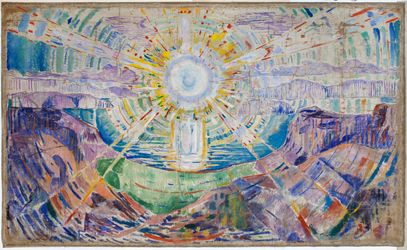
In 1908 Munch had a breakdown from excessive production and alcohol, yet he soon recovered to eventually produce an enormous quantity of work. Over 1909—1916 Munch made a series of murals for Oslo University, which depicted pantheistic images of the sun. Influenced by Van Gogh, Munch also started to depict working class life. In 1916 he moved to Ekely, where he stayed until his death in 1944.
Munch continued to rework old themes of inner anguish and isolation under an overarching title of The Frieze of Life, obsessively exploring variations and using his memory to modify each turbulent image’s emotional power. During World War II his art was declared by the Nazis to be ‘degenerate’, but most of it survived. Work from this period includes Death of Marat II (1907—1927) and Self Portrait: Between the Clock and the Bed (1940—1943).
Exhibitions
The Munch-museet, a museum dedicated to the work of Edvard Munch, opened in Oslo in 1963. In 2020 it was restyled as MUNCH and was reopened in a new location in Bjørvika in 2021. Edvard Munch’s work is also included in major global art collections such as the Nationalgalerie, Berlin; Rasmus Meyer Collection, KODE, Bergen; and Harvard Art Museums, Cambridge, MA.
Significant solo exhibitions include
- Edvard Munch Portraits, National Portrait Gallery, London (13 March—15 June 2025)
- Between the Clock and the Bed, Met Breuer, New York (15 November 2017—4 February 2018)
- The Frieze of Life, National Gallery of Victoria International (13 October 2004—12 January 2005).
- Edvard Munch’s Alpha and Omega, National Gallery of Australia, Canberra (18 August—7 October 1984)
- Frieze of Life, Ugo Barroccio Gallery, Berlin (1895).
Who was Edvard Munch?
Edvard Munch was a Norwegian painter and printmaker best known for his emotionally charged works that laid the foundation for Expressionism. Born in 1863, he developed a psychologically intense visual language that explored themes of anxiety, death, love, and human vulnerability.
What is Edvard Munch’s most famous work?
Munch’s most iconic work is The Scream (1893), part of his ‘Frieze of Life’ series. The image of a figure under a blood-red sky has become one of the most recognisable artworks in modern art history, symbolising existential dread and inner turmoil.
What influenced Edvard Munch’s art?
Munch’s art was deeply shaped by personal tragedy, including the early deaths of his mother and sister. He was influenced by Symbolism, as well as by the writings of Henrik Ibsen and Friedrich Nietzsche. His expressive use of line and colour also reflected a move away from naturalism towards emotional and psychological intensity.
Where can I see Edvard Munch’s art?
Munch’s works are housed in institutions such as the Munch Museum and the National Museum in Oslo, the Museum of Modern Art in New York, and the Tate in London. The Munch Museum holds over 28,000 works and personal items, providing the most comprehensive insight into his life and practice.
How has Edvard Munch’s work performed on the art market?
Yes. Though many of his works are held in public collections, Munch’s prints and paintings continue to appear at major auctions. A pastel version of The Scream sold for over $119 million at Sotheby’s in 2012, making it one of the most expensive artworks ever sold at auction.
John Hurrell | Ocula | 2025


Representative Artworks
View story
View story







Explore and Follow Artists Shaping Contemporary Art
A respected voice in contemporary art discourse.
Focusing on ambitious storytelling and insightful art-world commentary. Ocula Magazine publishes in-depth interviews, critical essays and timely analysis on the artists, exhibitions and ideas driving the global art world.
Learn more about Ocula Magazine
Showcasing the best of the art world.
Ocula partners with galleries from around the world to highlight their artists, artworks and exhibitions. Gallery membership is by application and invitation, with each member vetted by an independent panel.
Learn more about Ocula Membership
Specialises in the sale of major artworks.
Led by a team with deep ties to the world’s leading auction houses, galleries and collectors. Ocula’s advisory team offers bespoke services to high-net-worth clients from around the world who are looking to acquire the best of contemporary and modern art.
Learn more about our team and services